Key Highlights
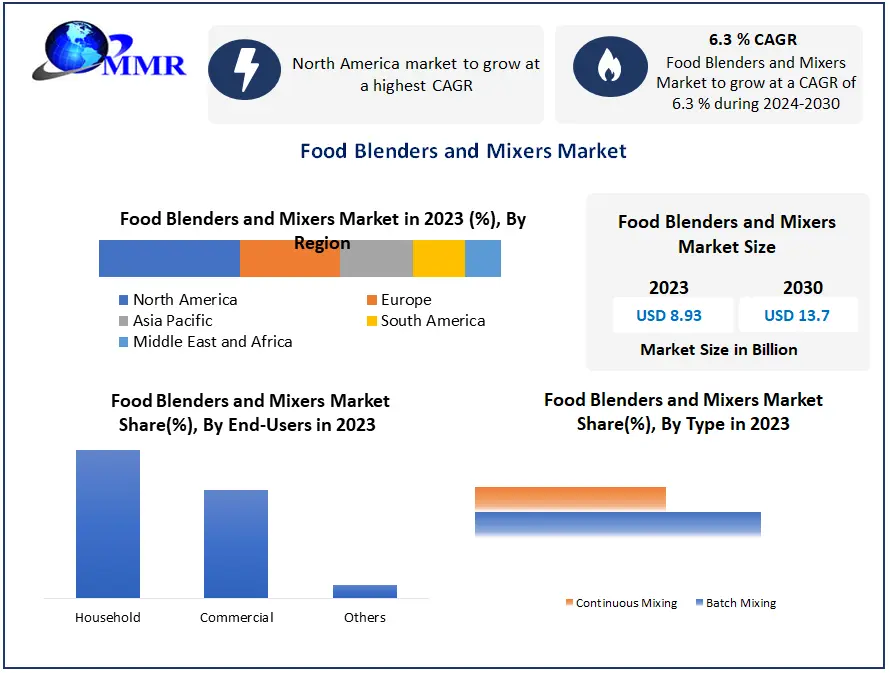
- The global Food Blenders and Mixers Market was valued at USD 8.93 Bn in 2023 and is expected to reach nearly USD 13.7 Bn by 2030, growing at a CAGR of 6.3%. The expansion creates demand for advanced motors, automated controls, sensors, wireless connectivity, and energy-efficient food-processing equipment.
- High-shear mixers held the largest revenue share of 9.2% in 2023. Their faster processing capability gives food manufacturers a direct route to higher output and lower operating time.
- North America is the leading regional market and is expected to grow at a CAGR of 10.5%. The region’s established food-processing base and demand for convenience foods make it a priority market for equipment suppliers.
- Europe ranked second globally, supported by bakery, confectionery, dairy, processed food, sauces, and ready-to-eat meal production.
- Bakery products are expected to grow as an application segment during the forecast period. Rising consumption of bread, cakes, pastries, and cookies is increasing demand for high-capacity, precision-controlled mixing equipment.
- Digital controls, automated settings, Bluetooth connectivity, Wi-Fi connectivity, built-in scales, and intelligent container recognition are shifting blenders and mixers from mechanical appliances toward connected food-preparation systems.
Why This Matters Now
Food processing equipment is becoming a more technology-intensive industrial category. Manufacturers are no longer competing only on blade strength, motor power, or vessel capacity. They are competing on automation, precision, connectivity, maintenance efficiency, and the ability to support higher-volume food production.
The Food Blenders and Mixers Market was valued at USD 8.93 Bn in 2023 and is expected to reach nearly USD 13.7 Bn by 2030 at a CAGR of 6.3%. That growth signals a widening commercial opportunity for motor suppliers, electronics manufacturers, industrial automation firms, appliance OEMs, food-processing companies, and component supply-chain partners.
The market’s technology shift matters to the electronics sector because modern equipment increasingly uses programmable controls, wireless functions, digital interfaces, sensors, automated settings, and intelligent performance adjustment. These features increase the role of embedded electronics in a category once dominated by mechanical engineering.
Market Overview
Food blenders and mixers are kitchen and food-processing appliances used to blend, mix, grind, puree, and process food ingredients. They generally include motorized bases, blending jars, pitchers, bowls, controls, and attachments designed for different food-preparation tasks.
Demand is rising as consumers seek healthy and convenient food options, while home cooking and online shopping gain momentum. The commercial food sector is also increasing demand as restaurants, cafes, catering businesses, bakery producers, dairy manufacturers, and packaged-food companies seek faster and more consistent production systems.
The market is split across continuous mixing and batch mixing technologies. It also includes double cone blenders, screw mixers and blenders, high-shear mixers, planetary mixers, ribbon blenders, and other equipment types. Applications span bakery products, beverages, confectionery, meat products, dairy, and other food categories.
For OEMs and equipment makers, the strategic question is no longer whether demand exists. The question is whether their product portfolios can deliver speed, consistency, automation, hygiene, energy efficiency, and smart functionality without increasing maintenance burdens.
Key Trends Driving Growth
Convenience food demand is changing equipment purchasing decisions. Food producers are responding to higher consumption of processed, ready-to-eat, and minimally prepared foods. Blenders and mixers help manufacturers process ingredients more efficiently and support higher output across sauces, beverages, bakery products, dairy items, fillings, dressings, and other prepared foods.
Food companies are also seeking workflow optimization. Higher-capacity equipment and improved processing performance can reduce preparation time and increase production efficiency. This makes high-performance blending systems valuable for manufacturers managing rising order volumes and stricter consistency requirements.
Smart appliance features are creating a new electronics opportunity. Manufacturers have introduced programmable settings, automated controls, improved motor power, and user-friendly designs. These changes increase demand for electronic control systems, sensors, display interfaces, software-enabled settings, and durable component integration.
Wireless connectivity is becoming more visible in both household and commercial equipment. Bluetooth and Wi-Fi functions allow users to control certain devices through smartphones or tablets. This expands the role of connected-device ecosystems in food preparation and creates opportunities for appliance brands to build app-based engagement, recipe platforms, and usage data capabilities.
The NutriBullet Smart Touch Blender illustrates this shift through its built-in scale and Bluetooth connectivity. The business implication is that personal blenders can evolve from standalone appliances into connected kitchen devices that support ingredient measurement and progress tracking.
Vitamix’s Ascent Series shows how product design is moving toward intelligent performance control. Its self-detect technology recognizes container size and adjusts blending settings accordingly. Wireless connectivity, variable speed control, timers, scales, and advanced blade technology show that product differentiation increasingly depends on precision and convenience rather than raw power alone.
Request a Free Sample Report for Comprehensive Market Insights
Segment Insights
- Dominant Segment: High-Shear Mixers — High-shear mixers held the largest revenue share of 9.2% in 2023. Their high-speed rotation and intensive shearing action reduce processing time, helping manufacturers improve productivity and achieve cost savings.
- Fastest-Growing Segment: Bakery Products Application — The bakery products segment is expected to grow during the forecast period. Rising consumption of bread, cakes, pastries, and cookies is increasing the need for equipment that can process large ingredient volumes while maintaining batch consistency.
- Technology Segments: Continuous Mixing and Batch Mixing — These technologies serve different processing requirements across industrial food production, commercial kitchens, and household applications.
- End-User Segments: Household, Commercial, and Others — Commercial demand is supported by restaurants, cafes, catering businesses, bakeries, dairy producers, and food manufacturers seeking efficient preparation and processing systems.
- Core Equipment Types: Double Cone Blender, Screw Mixer and Blender, High-Shear Mixer, Planetary Mixer, Ribbon Blender, and Others — The broad equipment range allows suppliers to target different food textures, ingredient types, production volumes, and processing requirements.
Regional Growth Story
North America dominates the global Food Blenders and Mixers Market. The region is expected to grow at a CAGR of 10.5%, driven by rising demand for convenience foods, established food-processing companies, and technological advancements in equipment manufacturing.
The region’s equipment suppliers are focusing on automated controls, improved precision, energy efficiency, and easier maintenance. This signals that North American buyers are prioritizing operational reliability and compliance alongside production performance. Food processors in the region operate under stringent regulatory standards and quality-control measures, increasing demand for equipment that supports food safety, traceability, and consistent product quality.
The United States, Canada, and Mexico form the North American market scope. For global equipment manufacturers, the region offers a high-value opportunity because established food processors are more likely to invest in advanced equipment upgrades than first-time basic installations.
Europe ranks second globally and is growing rapidly due to its broad food industry and consumer demand for convenience foods. Bakery, confectionery, dairy, processed foods, ready-to-eat meals, sauces, and spreads are central demand categories.
Germany, the United Kingdom, France, Italy, Spain, Sweden, Austria, and other European markets are included in the regional scope. Europe’s varied consumer tastes increase the need for flexible equipment that can deliver consistent texture, flavor integration, and ingredient uniformity across diverse product portfolios.
Asia Pacific is also strategically important because the report identifies rapid growth in the region’s food sector. A growing population and rising demand for convenience foods are increasing the need for time-saving food-processing equipment across food preparation, processing, and packaging activities.
China, South Korea, Japan, India, Australia, Indonesia, Malaysia, Vietnam, Taiwan, Bangladesh, Pakistan, and other Asia Pacific markets are covered in the report. The opportunity lies in serving expanding food-service operations and food manufacturers with scalable, efficient, and adaptable mixing systems.
Competitive Landscape
The Food Blenders and Mixers Market is highly competitive. Companies are using targeted marketing through trade publications, online channels, trade shows, and industry events to reach customers. Pricing strategies vary by product type, target market, competitive conditions, and corporate goals.
Key market participants include Buhler Industries Inc., GEA Group Aktiengesellschaft, Hosokawa Micron Limited, John Bean Technologies Corporation, KHS GmbH, Krones AG, Marel HF, SPX Flow Inc., Sulzer Ltd., Tetra Laval International S.A., Paul Mueller Co., Alfa Laval Corporate AB, EKATO Holding GmbH, Philadelphia Mixing Solutions Ltd., Diosna GmbH, Silverson Machines Inc., Fristam Pumps, Pentair PLC, ARDE Barinco, and General Machine Company.
The competitive message is clear: suppliers need to combine mechanical performance with automation, precision, energy efficiency, and maintenance simplicity. Equipment companies that offer faster processing, consistent outcomes, intelligent controls, and strong after-sales support can strengthen pricing power in commercial food manufacturing.
European market leaders including GEA Group, Tetra Laval, SPX Flow, Alfa Laval, Marel, Krones, Sulzer, Buhler, John Bean Technologies, and KHS are focused on efficient and technologically advanced blending and mixing solutions. Their product-development and expansion efforts signal that food-processing customers increasingly expect equipment suppliers to deliver productivity gains, not simply machines.
Recent Developments
- NutriBullet introduced Smart Touch Blender features including a built-in scale and Bluetooth connectivity. This indicates growing consumer interest in connected appliances that support ingredient measurement and food-preparation tracking.
- Vitamix advanced its Ascent Series through self-detect technology, wireless connectivity, variable speed control, and advanced blade technology. The development points to a stronger market focus on intelligent performance adjustment.
- Manufacturers are incorporating programmable settings, automated controls, improved motor power, and user-friendly designs. These features increase the value of electronics, controls, and embedded functionality in appliance design.
- Food-service businesses, including restaurants, cafes, and catering companies, are increasing demand for high-performance systems that can handle a range of ingredients for sauces, dressings, beverages, and other culinary products.
- Bakery and dairy manufacturers are adopting blending and mixing equipment to improve production capacity, ingredient consistency, and product quality.
Strategic Implications
For electronics manufacturers, the market creates demand for control boards, sensors, connectivity modules, digital interfaces, motors, and power-management components. Equipment suppliers need components that can perform reliably in demanding food-processing environments while supporting precision and easy maintenance.
For food manufacturers, the investment case centers on output, consistency, and labor efficiency. High-shear mixers and automated systems can reduce processing time and help standardize production across batches. That makes them relevant for companies facing rising demand for bakery, dairy, beverages, sauces, confectionery, and prepared foods.
For investors, the market combines consumer appliance demand with commercial food-processing capital expenditure. The strongest opportunities sit with companies that can serve both premium connected appliances and industrial-scale systems with measurable productivity benefits.
Future Outlook
The Food Blenders and Mixers Market is moving toward connected, automated, and performance-driven equipment. Smart controls, wireless connectivity, intelligent container recognition, precision settings, and energy-efficient operation will shape product development as food producers and consumers demand greater convenience and consistency.
The future leaders will be companies that turn blending equipment into intelligent production assets, while laggards will remain tied to mechanical designs that cannot meet the next generation of food-processing speed, precision, and connectivity requirements.
Analyst Perspective
“Food blenders and mixers are becoming more sophisticated as food manufacturers and consumers seek greater convenience, consistency, and control. Advanced automation, digital controls, and connected features are creating a stronger value proposition across household and commercial food-processing applications,” said Rucha Deshpande, Analyst.
About Maximize Market Research
Maximize Market Research Pvt. Ltd. (MMR) is a global market research and consulting company that provides reliable, data-focused, and practical business insights. The firm serves a wide range of industries, including healthcare, pharmaceuticals, technology, automotive, electronics, chemicals, personal care, and consumer goods. Through market forecasts, competitive analysis, strategic consulting, and industry impact assessments, MMR helps organizations understand changing market conditions, identify growth opportunities, and make informed business decisions for long-term success.
Contact Us
2nd Floor, Navale IT Park Phase 3
Pune Banglore Highway, Narhe
Pune, Maharashtra 411041, India
+91 9607365656
sales@maximizemarketresearch.com
