Key Highlights
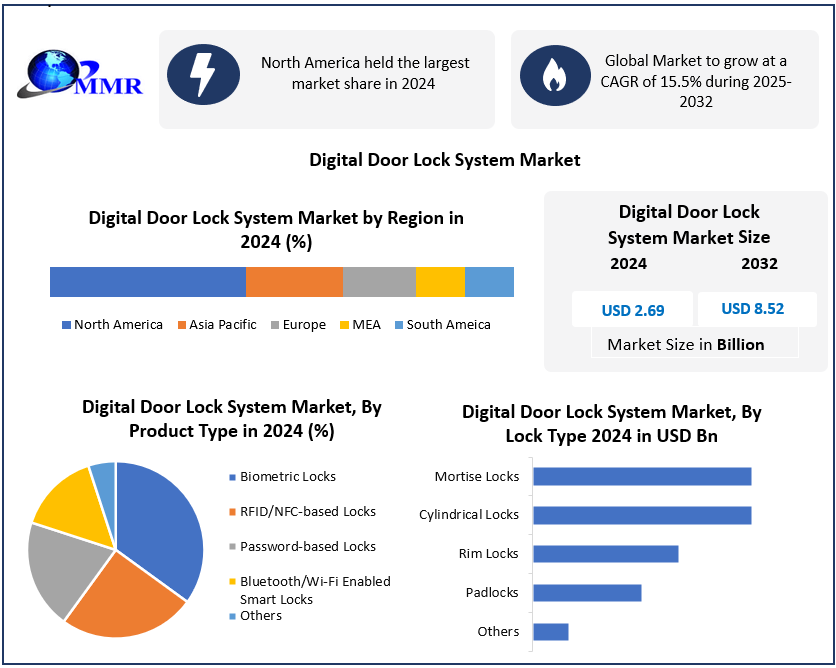
- The global Digital Door Lock System Market was valued at USD 2.69 Bn in 2024 and is expected to reach nearly USD 8.52 Bn by 2032, growing at a CAGR of 15.5% from 2025 to 2032. This expansion creates a larger opportunity for semiconductor suppliers, biometric-component makers, connectivity-module vendors, smart-home OEMs, and building-security integrators.
- Digital door locks replace or supplement mechanical keys with electronic authentication methods. This shifts access control toward connected hardware, embedded software, mobile credentials, and data-driven security management.
- Smart-home adoption is increasing demand for remotely managed entry systems. The market benefits from consumer demand for convenience, real-time monitoring, and integrated home-security ecosystems.
- Biometric authentication strengthens the value proposition of digital locks. Fingerprint, facial-recognition, and other identity-based systems can reduce dependence on physical keys and access cards.
- Commercial and residential users are adopting connected access systems for different reasons. Homes prioritize convenience and remote control, while commercial users focus on audit trails, user permissions, and centralized security management.
- The supplied report does not disclose a dominant segment, fastest-growing segment, leading region, named company list, segment share, or regional market data. These details are omitted rather than estimated.
Why This Matters Now
The front door is becoming an endpoint in the connected-device economy. Smart homes, digital identity systems, mobile applications, and building-management platforms are turning access control into a software-led security function rather than a purely mechanical product category.
The Digital Door Lock System Market was valued at USD 2.69 Bn in 2024 and is projected to reach nearly USD 8.52 Bn by 2032 at a CAGR of 15.5%. The business implication is that electronic access control is moving into a faster-growth phase, creating demand for sensors, biometric modules, microcontrollers, wireless chips, secure memory, batteries, mobile applications, and cloud-connected management systems.
For semiconductor companies, this market is a practical IoT opportunity. Every connected lock needs a combination of processing, connectivity, authentication, power management, and security features. The value chain extends beyond the lock itself to smartphones, smart-home hubs, property-management software, security platforms, and installation networks.
Market Overview
Digital door lock systems use electronic technologies to control access to homes, offices, hotels, retail locations, industrial facilities, and other properties. Users can unlock doors through passwords, PIN codes, biometric credentials, cards, mobile applications, remote controls, or other digital authentication methods.
The category includes keyless entry systems, biometric locks, card-based locks, password-enabled locks, remote-controlled locks, and smart locks connected to broader home or building networks. The market is expanding as users seek stronger security, easier access management, and reduced reliance on physical keys.
The shift from mechanical locks to digital systems changes the business model. Traditional locks are primarily hardware purchases. Digital locks can support software updates, user management, access logs, remote control, mobile integration, and recurring service opportunities. This makes them more relevant to technology companies, platform providers, and cybersecurity specialists.
The report identifies rising security concerns and smart-home adoption as major market drivers. These forces are increasing demand for systems that can authenticate users, restrict unauthorized access, and provide more visibility into entry activity.
Digital door locks also fit into the broader smart-building trend. Connected devices are increasingly used to manage lighting, climate control, surveillance, alarms, and access. A lock can become a central point of interaction between a property owner, a resident, a visitor, and a digital security platform.
Key Trends Driving Growth
Smart-home adoption is changing consumer expectations. Homeowners increasingly want to control devices through smartphones and connected platforms. Digital locks provide a direct use case because they allow users to manage entry without being physically present.
Remote access is a major commercial feature. Users can unlock doors for family members, guests, service providers, delivery personnel, or tenants through authorized digital controls. This reduces the friction of key handovers and gives users more control over access permissions.
Biometric authentication is strengthening security differentiation. Fingerprint-based entry and other biometric options can provide a more personal access credential than a physical key or password. The commercial value comes from reducing the risk of lost keys, copied keys, and unauthorized card access.
Mobile access is also changing the customer experience. Smartphones can act as digital keys, making the lock part of a wider consumer-electronics ecosystem. This creates opportunities for device manufacturers, mobile-platform providers, wireless-chip suppliers, and smart-home software developers.
IoT connectivity is central to the category’s future. Connected locks can communicate with other devices and platforms, enabling functions such as alerts, remote management, access scheduling, and integration with home-security systems. The market’s growth depends on making these functions secure, simple, and reliable.
The supplied report does not identify artificial intelligence, high-performance computing, chiplet architecture, high-bandwidth memory, advanced packaging, foundry investments, or semiconductor-capacity expansion as direct market drivers. These themes should not be treated as report findings. Their relevance is limited to the wider electronics ecosystem that supplies connected-security hardware.
Cybersecurity is becoming a more important product consideration. Digital locks can offer stronger access control, but connected systems also require protection against unauthorized digital access. Manufacturers that build trust through secure authentication, reliable software, and robust system design can gain an advantage as buyers become more aware of connected-device risks.
Request a Free Sample Report for Comprehensive Market Insights
Segment Insights
- Dominant Segment: Not disclosed in the supplied report — The report does not provide market-share data by product type, authentication method, connectivity technology, end user, distribution channel, or region.
- Fastest-Growing Segment: Not disclosed in the supplied report — The report does not identify a fastest-growing product, application, end-user, technology, or regional segment.
- Core Technology: Electronic Access Control — Digital door lock systems use electronic authentication to replace or supplement mechanical key-based entry.
- Core Demand Area: Smart Homes — Smart-home adoption is increasing interest in connected locks that can be managed remotely through digital platforms.
- Core Authentication Area: Biometrics and Mobile Credentials — Biometric and smartphone-enabled access systems expand the role of identity verification in physical security.
- Core Commercial Use: Connected Building Security — Digital locks can support user permissions, access management, and security oversight across residential and commercial properties.
Regional Growth Story
The supplied report does not disclose regional market shares, leading geography, fastest-growing region, country-level demand, or regional CAGR figures. It is therefore not possible to rank the United States, China, Japan, South Korea, Taiwan, Germany, India, or any other market using the approved source alone.
The market is global in relevance because security needs, urban housing growth, smart-home adoption, and commercial-property digitization occur across regions. However, regional adoption patterns can vary based on housing structures, construction practices, consumer spending, mobile-device usage, security regulations, and installation ecosystems.
For supply-chain leaders, digital door locks require coordinated sourcing of microcontrollers, sensors, biometric modules, wireless connectivity components, batteries, mechanical parts, electronic boards, and software systems. Supply resilience matters because a smart lock cannot deliver its core value if hardware, software, and connectivity fail to work together.
Electronics manufacturing services providers can benefit from the category’s growth because digital locks combine mechanical assembly with electronic integration. Manufacturing partners that can manage product testing, component traceability, embedded software loading, quality assurance, and secure-device configuration can become strategic suppliers.
Competitive Landscape
The supplied report does not disclose named companies, market shares, product launches, acquisitions, partnerships, research initiatives, manufacturing investments, or regional competitive developments. This article therefore does not attribute actions or market positions to individual companies.
Competition in the Digital Door Lock System Market will depend on security credibility, product reliability, ease of installation, authentication quality, mobile compatibility, and after-sales service. Consumers and commercial buyers will not adopt connected locks solely because they offer digital features. They need confidence that the system will work consistently and protect physical access.
Technology leadership will favor companies that integrate hardware, software, connectivity, and cybersecurity into a seamless user experience. A lock that supports biometric access but lacks dependable remote management will have limited value. A connected lock with strong features but difficult installation can also lose market momentum.
Pricing power will depend on product differentiation. Suppliers that offer durable designs, trusted authentication, flexible user management, strong mobile applications, and integration with wider security systems can defend premium positions. Lower-cost products may compete on basic convenience, but professional buyers will increasingly assess lifecycle reliability and system compatibility.
The ecosystem opportunity is broader than the lock. Smart-home platforms, security installers, property-management companies, real-estate developers, mobile-app providers, and electronics distributors can all participate in the market. Companies that build strong partnerships across these channels can accelerate adoption and improve customer retention.
Recent Developments
- The Digital Door Lock System Market was valued at USD 2.69 Bn in 2024. The market size confirms that electronic access control has become a meaningful category within smart-home and building-security technology.
- The market is expected to reach nearly USD 8.52 Bn by 2032 at a CAGR of 15.5% from 2025 to 2032. The forecast signals a major expansion opportunity for connected-security hardware and software suppliers.
- Rising smart-home adoption is increasing demand for remote access and connected security systems. This makes digital locks a central component of residential IoT ecosystems.
- Biometric authentication and mobile credentials are strengthening the market’s security proposition. These technologies reduce dependence on traditional keys and support more flexible access management.
- The supplied report does not disclose specific company launches, acquisitions, foundry investments, advanced-packaging initiatives, government incentives, sustainability programs, or named competitive actions.
Strategic Implications
For semiconductor suppliers, digital locks create demand for secure microcontrollers, connectivity chips, biometric sensors, power-management components, and memory solutions. The opportunity is strongest where suppliers can support low-power performance, secure authentication, and dependable operation.
For smart-home OEMs, digital locks can become a gateway product. They offer a frequent, visible use case for connected technology and can encourage consumers to adopt additional devices such as cameras, alarms, lighting controls, and home-management systems.
For property developers and building operators, connected locks can improve access management. Digital credentials can simplify tenant onboarding, visitor entry, maintenance access, and security oversight. The business value lies in reducing manual key handling while increasing visibility and control.
For investors, the market combines smart-home growth with security technology demand. The most attractive companies will be those that can convert hardware sales into durable ecosystems built around software, services, integration, and trusted user experiences.
Future Outlook
The Digital Door Lock System Market is moving toward a security model where physical access is managed through connected hardware, digital identity, mobile platforms, and intelligent authentication. The next phase will depend on whether manufacturers can deliver stronger cybersecurity, simpler installation, reliable connectivity, and seamless integration with wider smart-building systems.
Future leaders will turn the door lock into a trusted digital-security platform, while laggards will remain hardware vendors unable to meet the security, software, and ecosystem demands of connected access control.
Analyst Perspective
“Digital door lock systems are shifting access control from mechanical security to connected, identity-driven protection. Smart-home adoption, biometric authentication, and mobile access are expanding the role of digital locks across residential and commercial environments,” said Rucha Deshpande, Analyst.
About Maximize Market Research
Maximize Market Research Pvt. Ltd. (MMR) is a global market research and consulting company that provides reliable, data-focused, and practical business insights. The firm serves a wide range of industries, including healthcare, pharmaceuticals, technology, automotive, electronics, chemicals, personal care, and consumer goods. Through market forecasts, competitive analysis, strategic consulting, and industry impact assessments, MMR helps organizations understand changing market conditions, identify growth opportunities, and make informed business decisions for long-term success.
Contact Us
2nd Floor, Navale IT Park Phase 3
Pune Banglore Highway, Narhe
Pune, Maharashtra 411041, India
+91 9607365656
sales@maximizemarketresearch.com
