Key Highlights
- Precision navigation is becoming a strategic hardware layer for aircraft, submarines, missiles, naval vessels and spacecraft as defense platforms demand reliable motion sensing without mechanical drift. Ring laser gyroscopes serve that requirement by measuring angular rotation across air, marine and space platforms.
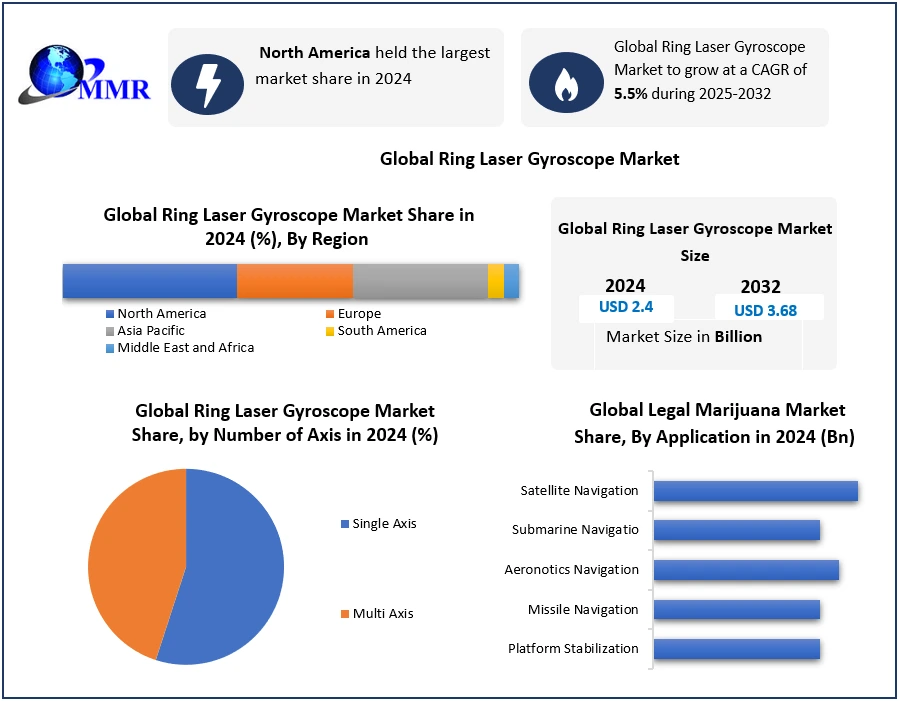
- The Ring Laser Gyroscope Market was valued at USD 2.4 Bn in 2024 and is expected to reach nearly USD 3.68 Bn by 2032, giving navigation and defense electronics suppliers a steady modernization opportunity.
- The market is forecast to grow at a 5.5% CAGR from 2025 to 2032, linking demand to defense navigation upgrades, commercial aircraft, spacecraft and advanced inertial systems.
- Defense dominated by end user in 2024 and is expected to maintain its lead, making military navigation the clearest disclosed demand base.
- North America is expected to hold the largest share, supported by the United States and Canada and by defense and aerospace navigation demand.
Why This Matters Now
Ring laser gyroscopes are not a broad consumer-electronics story. They are a precision navigation story tied to defense modernization, aircraft upgrades, missile guidance, submarine navigation and spacecraft orientation.
MMR states that ring laser gyroscopes were first implemented for defense applications and are also used in aircraft and spacecraft to calculate angular rotation across platforms ranging from naval ships to aerospace systems. That positions the market inside the control stack of high-value platforms where navigation failure is not acceptable.
Market Overview
A ring laser gyroscope is a precision sensor used in inertial navigation. The report segments the market by number of axis into single-axis and multi-axis systems, by application into platform stabilization, missile navigation, aeronautics navigation, submarine navigation and satellite navigation, by technology into strapdown INS and stabilized platform INS, and by end user into commercial, defense and spacecraft.
The Ring Laser Gyroscope Market disclosed electronics relevance is in high-accuracy navigation, laser-based sensing, inertial systems, platform stabilization and miniaturized gyroscope design. The public page does not disclose AI chip demand, high-performance computing trends, foundry investments, advanced packaging, chiplets, HBM, semiconductor capacity expansion, memory and logic chip trends, display technology, IoT penetration, smart-device adoption, EMS activity, sustainability programs or e-waste management.
The public page contains a headline-panel inconsistency. It lists USD 2.4 Bn as forecast market size, while the overview and scope table state USD 2.4 Bn in 2024 and USD 3.68 Bn by 2032. This article uses the overview and scope table figures because they match the supplied market-size statement.
Key Trends Driving Growth
Defense navigation upgrades are the first driver. MMR states that upgrading existing navigation systems onboard ships is expected to raise demand for defense applications, while spending on new defense vessels and incorporation of advanced technology support market expansion.
Commercial aerospace is the second growth lane. The report links demand to commercial applications, especially commercial aircraft and space exploration vehicles, where inertial navigation upgrades support higher reliability and more accurate orientation data.
Technology improvement is also reducing operating limitations. MMR states that advanced ring laser gyroscope technology helps minimize problems such as injection locking associated with devices, which matters for suppliers competing on precision and system reliability.
Product miniaturization is shaping competition. Manufacturers are focused on reducing product size while improving precision and accuracy, especially for aerial applications, where payload, integration space and navigation performance all affect procurement decisions.
Request a Free Sample Report for Comprehensive Market Insights
Segment Insights
- Dominant Segment Defense End User: Defense dominated the Ring Laser Gyroscope Market in 2024 and is expected to maintain its lead. Demand is driven by high-precision navigation and guidance systems for fighter aircraft, military helicopters, naval ships, submarines and missile systems.
- Fastest-Growing Segment Single-Axis RLG: MMR states that the single-axis ring laser gyroscope segment is estimated to be the fastest-growing segment, driven by increasing demand from commercial applications.
- Number-of-Axis Signal Multi-Axis RLG: The page also states that multi-axis ring laser gyroscopes will dominate the market growth rate during the forecast period. This creates a wording overlap with the single-axis fastest-growth statement, so both signals should be read with caution.
- Application Signal Satellite Navigation: Satellite navigation is expected to dominate by growth rate during the forecast period. Aircraft and spacecraft applications occupied around 35% of total market growth, making aerospace navigation a core demand channel.
- Technology Scope Strapdown INS and Stabilized Platform INS: The market covers strapdown inertial navigation systems and stabilized platform INS. The public page does not disclose technology-level share or CAGR.
Regional Growth Story
North America is expected to hold the largest market share during the forecast period. The United States and Canada are cited as contributors to regional growth, and the FAQ confirms that North America dominated market share.
The report states that North America generated around US$215.4 Mn in 2018. That historical base matters because it shows the region’s established demand before the current 2025–2032 forecast cycle.
Europe follows North America, with France, Germany, the UK and the rest of Europe included in the regional analysis. The public page does not disclose Germany-specific value, European defense-program data or country-level production figures.
Asia Pacific covers Japan, India, China, South Korea, Australia, ASEAN and the rest of APAC. The public page does not disclose country-level revenue for China, Japan, South Korea or India, and Taiwan is not listed in the visible regional scope.
Competitive Landscape
Key players include Heppel Photonics GmbH, Ericco International, Honeywell International, Teledyne CDL, Mitsubishi Precision, Safran Electronics & Defense, Northrop Grumman, Optics Blazer, Kearfott, Sperry Marine and Xsens Technologies. The broader list also includes Memsense, Rieker, Jewell Instruments, Comus International, Cooner Wire, Sensata Technologies, ACE Controls, RS Components and Zurich Instruments.
Competition is defined by precision, size reduction and system reliability. MMR states that major players are engaged in extensive research and development, while manufacturers are working to develop smaller, highly precise and accurate RLG systems for aerial applications.
That signals a high-barrier market. Suppliers with defense qualification, aerospace integration capability, marine navigation experience and long lifecycle support will have stronger positioning than generic sensor manufacturers.
No named acquisitions, partnerships, fab investments, advanced-packaging breakthroughs, chip-capacity expansions, AI R&D initiatives or dated product launches are disclosed on the public page. The visible competitive direction is precision navigation, miniaturization and defense-aerospace qualification.
Recent Developments
- R&D Focus: Major players are engaged in extensive research and development to compete in a highly competitive ring laser gyroscope market.
- Miniaturization Direction: Competitive manufacturers are developing ring laser gyroscopes that reduce product size while improving precision and accuracy for aerial applications.
- Technology Improvement: Advanced RLG technology is expected to reduce problems such as injection locking, improving device reliability and performance.
- No Named Dated Deals Disclosed: The public page includes a table-of-contents reference to mergers, acquisitions and recent developments, but it does not disclose specific dated transactions, partnerships, product launches or fab activity in the visible article text.
Strategic Implications
For semiconductor and electronics suppliers, the opportunity is indirect but material. Ring laser gyroscopes require precision optical, electronic and navigation-system integration, but the public page does not quantify chip content, wafer demand or semiconductor sourcing.
For defense OEMs, RLG adoption supports navigation independence and high-accuracy guidance in aircraft, helicopters, naval ships, submarines and missile systems. This is a procurement market where reliability and qualification can outweigh unit-cost pressure.
For investors, the strongest disclosed opportunities are defense modernization, commercial aircraft navigation upgrades, spacecraft demand, satellite navigation and compact aerial applications. The limitations are clear: the public page does not provide detailed country values, segment revenues, government incentive values, supply-chain data or named recent deals.
Future Outlook
The Ring Laser Gyroscope Market is forecast to grow from USD 2.4 Bn in 2024 to nearly USD 3.68 Bn by 2032 at a 5.5% CAGR. Growth will come from defense applications, navigation-system upgrades, new defense vessels, commercial aircraft, space exploration vehicles, satellite navigation, platform stabilization and inertial navigation systems.
The next phase will test whether suppliers can make RLG systems smaller, more accurate and easier to integrate into complex air, sea and space platforms. Future technology leaders will control the precision inertial-navigation layer behind defense and spacecraft autonomy; laggards will remain tied to navigation hardware that cannot meet size, accuracy and mission-reliability demands.
Analyst Perspective
“Ring laser gyroscopes are becoming critical precision-navigation electronics as defense, aerospace, marine and spacecraft platforms require more accurate inertial systems,” said Rucha Deshpande, Analyst at Maximize Market Research. “The strongest suppliers will combine miniaturization, precision, reliability, defense qualification and integration capability across air, marine and space applications.”
About Maximize Market Research
Maximize Market Research Pvt. Ltd. (MMR) is a global market research and consulting company that provides reliable, data-focused, and practical business insights. The firm serves a wide range of industries, including healthcare, pharmaceuticals, technology, automotive, electronics, chemicals, personal care, and consumer goods. Through market forecasts, competitive analysis, strategic consulting, and industry impact assessments, MMR helps organizations understand changing market conditions, identify growth opportunities, and make informed business decisions for long-term success.
Contact Us
2nd Floor, Navale IT Park Phase 3
Pune Banglore Highway, Narhe
Pune, Maharashtra 411041, India
+91 9607365656
sales@maximizemarketresearch.com
