Key Highlights
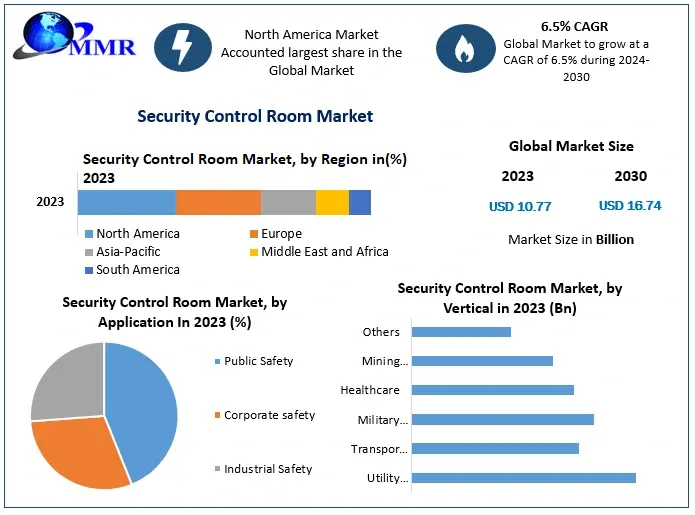
- Security control rooms are becoming the command layer for AI-enabled surveillance, smart cities and cyber-physical risk. The market was valued at USD 10.77 Bn in 2023 and is expected to reach USD 16.74 Bn by 2030, giving electronics and security-technology suppliers a defined modernization cycle.
- Security Control Room Market is forecast to grow at a 6.5% CAGR from 2024 to 2030, linking demand to real-time monitoring, emergency response, smart-city infrastructure and integrated security systems.
- Hardware dominated in 2023 and is expected to maintain leadership, making surveillance cameras, monitors, video walls and access control systems the clearest disclosed electronics demand base.
- Public safety is expected to dominate by application because governments and agencies need real-time threat monitoring, emergency response and information sharing.
- North America dominated in 2023 and is expected to continue leading, supported by security regulations, public safety spending, AI, ML, video analytics, cloud computing and critical infrastructure protection.
Why This Matters Now
Security operations are shifting from passive surveillance to real-time decision systems. Control rooms now integrate cameras, access systems, sensors, alarms, communication devices, video walls and cyber alerts into one operating environment.
That shift has direct relevance for electronics and semiconductor suppliers. The public page does not disclose AI chip demand, HPC trends, foundry investments, advanced packaging, HBM, chiplets, chip manufacturing capacity expansion, memory or logic chip trends, but it does disclose strong demand for hardware, AI, ML, video analytics, cloud computing and IoT-linked security devices.
Market Overview
A security control room, also called a control center or security operations center, is a centralized location where personnel manage and monitor security operations for an organization, event or facility. It acts as the nerve center for real-time monitoring, analysis and response to security incidents and emergencies.
Security Control Room Market is segmented by offering into hardware, software and services. Hardware includes surveillance cameras, monitors, video walls and access control systems; software includes video management, incident management and access control software; services include consulting, integration, installation, deployment, monitoring and maintenance.
The public page contains a visible header inconsistency: the top panel lists USD 10.77 Bn as forecast market size, while the overview and scope table state USD 10.77 Bn in 2023 and USD 16.74 Bn by 2030. This article uses the overview and scope table figures because they match the supplied market-size statement.
Key Trends Driving Growth
Real-time monitoring is the first growth driver. Control rooms allow operators to detect incidents as they occur, dispatch security personnel, alert authorities and implement emergency protocols before threats escalate.
Smart cities are creating the second demand wave. Control rooms integrate surveillance cameras, access control systems, sensors and other security devices across public spaces, key facilities and transportation networks, giving city operators a single platform for incident response and emergency management.
AI and ML are moving control rooms beyond human-only monitoring. The source states that AI and ML algorithms analyze large volumes of data from cameras, sensors and access control systems, identify patterns, detect anomalies and automate routine tasks such as event correlation and decision support.
The convergence of physical and cybersecurity is becoming a market requirement. Control rooms are increasingly expected to assess physical and digital risks together, especially where cyber incidents can disrupt surveillance systems, critical operations or facility access.
The main restraint is cost. Organizations must invest in cameras, access control systems, alarms, communication devices, displays, servers and consoles, while integration across vendors can add hardware, software and middleware costs.
Download a Sample Report Covering Market Size and Forecast
Segment Insights
- Dominant Segment Hardware: Hardware dominated in 2023 and is expected to maintain dominance. Surveillance cameras, monitors, video walls and access control systems provide the physical electronics layer for monitoring, recording, analysis and threat response.
- Dominant Application Public Safety: Public safety is expected to dominate during the forecast period. Public agencies need control rooms for terrorist-threat monitoring, cyber-threat monitoring, emergency response and information sharing.
- Fastest-Growing Segment: The public MMR page does not identify a fastest-growing offering, application or vertical segment with a usable CAGR. No fastest-growing segment is inferred.
- Software Scope VMS and Incident Management: Video management software, incident management software and access control software are included, but the page does not disclose software share or growth rate.
- Vertical Scope Utility, Telecom, Transportation, Defense, Healthcare and Manufacturing: These verticals are covered, but the public page does not disclose vertical-level market sizes or rankings.
Regional Growth Story
North America dominated in 2023 and is expected to continue its lead during the forecast period. The region benefits from stringent security regulations across transportation, healthcare, finance and critical infrastructure, requiring robust control room systems.
North America also leads in technology adoption. AI, ML, video analytics and cloud computing are increasingly integrated into control rooms to improve incident detection, situational awareness and response efficiency.
Europe covers the UK, France, Germany, Italy, Spain, Sweden, Austria and the rest of Europe. Asia Pacific covers China, South Korea, Japan, India, Australia, Indonesia, Malaysia, Vietnam, Taiwan, Bangladesh and Pakistan, but country-level revenues, export dynamics, government incentive values and electronics manufacturing data are not disclosed.
For semiconductor and electronics executives, the regional signal is practical. The source supports North America as the largest market, while Asia Pacific and Europe remain relevant through public safety, transportation, healthcare, defense, telecom and smart-city infrastructure demand.
Competitive Landscape
Key players include ABB, Barco, Black Box, Harris, Motorola Solutions, Tyler Technologies, Eizo Corporation, Zetron, TriTech Software Systems, Hexagon Safety & Infrastructure, Christie Digital Systems, Superion, Electrosonic and SAIFOR Group. The broader list also includes Honeywell, Bosch Security Systems, Siemens, Axis Communications, Genetec, NEC and Hikvision.
Competition is shifting from hardware supply to secure, scalable operating platforms. Barco’s CTRL platform shows that vendors are moving toward software-defined control rooms that connect sources securely from any location and support video-wall and operator-desk workflows.
For electronics suppliers, hardware leadership still matters because cameras, displays, servers, consoles and access systems remain core to deployments. For software and platform vendors, pricing power will come from AI analytics, incident workflow, cybersecurity integration and interoperability across physical and digital systems.
No named fab investment, advanced packaging development, chiplet roadmap, HBM activity, semiconductor capacity expansion or display manufacturing investment is disclosed. The visible competitive direction is AI, ML, cloud computing, cyber-physical convergence, video analytics and scalable control room software.
Recent Developments
- 2022 Barco: Barco launched Barco CTRL, a control room software platform designed to improve workflows, deployment and serviceability while scaling to customer needs.
- Security-by-Design Direction: Barco CTRL follows security-by-design principles, allowing users to securely connect to sources from any location and interact with video wall or operator-desk content.
- AI and ML Integration: Security control rooms are integrating AI and ML algorithms to automate data analysis, event correlation and decision-support workflows.
- Cyber-Physical Convergence: Control rooms are increasingly integrating physical security and cybersecurity to address incidents that affect both infrastructure and digital systems.
Strategic Implications
For semiconductor suppliers, the opportunity is indirect but broad. Security control rooms need cameras, monitors, video walls, servers, access control hardware, communication devices and IoT-linked endpoints, although the source does not quantify chip content or wafer demand.
For system integrators, the critical capability is interoperability. Buyers need control rooms that combine surveillance, access control, alarms, sensors, communication systems, cloud tools, cyber monitoring and incident workflows without forcing operators into fragmented screens.
For investors, the market offers exposure to smart cities, public safety, critical infrastructure protection, AI analytics, video walls, cloud systems and cyber-physical security. The main risk is high implementation and maintenance cost, especially for small and medium-sized organizations.
Future Outlook
The Security Control Room Market is forecast to grow from USD 10.77 Bn in 2023 to USD 16.74 Bn by 2030 at a 6.5% CAGR. Growth will come from real-time monitoring, smart cities, AI, ML, video analytics, cloud computing, public safety spending, critical infrastructure protection and integrated cyber-physical security.
The next phase will test whether suppliers can convert control rooms into secure, AI-assisted operating systems for cities, enterprises and infrastructure. Future technology leaders will control the intelligent command layer behind public safety and cyber-physical resilience; laggards will remain trapped selling disconnected displays and surveillance hardware into a market moving toward automated decision infrastructure.
Analyst Perspective
“Security control rooms are becoming critical command infrastructure as organizations integrate real-time monitoring, AI analytics, smart-city systems and cyber-physical security,” said Rucha Deshpande, Analyst at Maximize Market Research. “The strongest suppliers will combine reliable hardware, scalable software, video analytics, cybersecurity, cloud integration and public-safety workflow expertise.”
About Maximize Market Research
Maximize Market Research Pvt. Ltd. (MMR) is a global market research and consulting company that provides reliable, data-focused, and practical business insights. The firm serves a wide range of industries, including healthcare, pharmaceuticals, technology, automotive, electronics, chemicals, personal care, and consumer goods. Through market forecasts, competitive analysis, strategic consulting, and industry impact assessments, MMR helps organizations understand changing market conditions, identify growth opportunities, and make informed business decisions for long-term success.
Contact Us
2nd Floor, Navale IT Park Phase 3
Pune Banglore Highway, Narhe
Pune, Maharashtra 411041, India
+91 9607365656
sales@maximizemarketresearch.com
