Key Highlights
- Quantum dots are moving from laboratory nanomaterials into the core display, imaging and optoelectronics supply chain. Their role in QLED displays, solar cells, sensors and biological imaging makes the market directly relevant to semiconductor materials, electronics OEMs and display manufacturers.
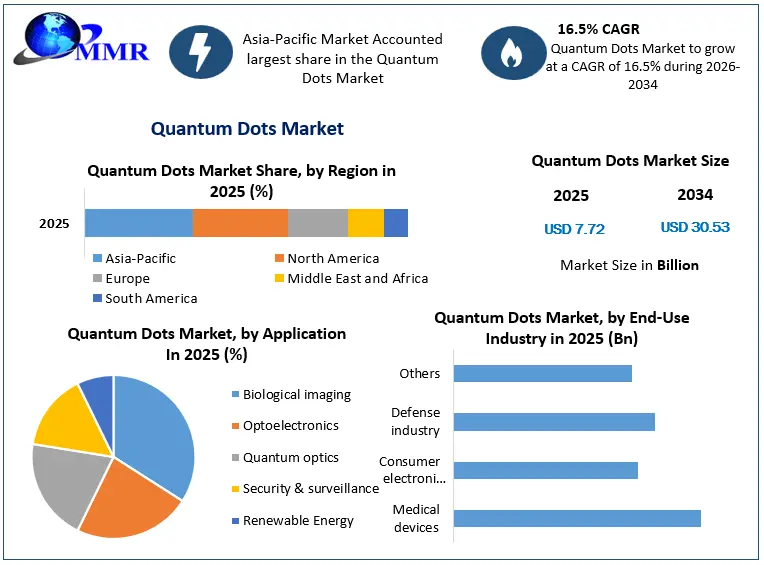
- The Quantum Dots Market was valued at USD 7.72 Bn in 2025 and is expected to reach nearly USD 30.53 Bn by 2034, creating a high-growth materials opportunity for electronics and photonics suppliers.
- The market is forecast to grow at a 16.5% CAGR from 2026 to 2034, linking demand to optimized devices, higher resolution quality and expanding QD applications.
- Cadmium selenide dominated by material in 2025 and is expected to grow at a 14.2% CAGR, making CdSe the clearest disclosed material leader.
- Asia Pacific dominated with about 15.5% share in 2025, supported by QD display demand, optoelectronics, solar energy applications and electronics innovation in China, Japan and South Korea.
Why This Matters Now
Display performance has become a semiconductor materials race. Higher brightness, richer color, stronger contrast, lower power consumption and larger 4K and 8K screens are pushing quantum dots into mainstream electronics design.
Quantum dots are synthetic semiconductor nanoparticles that emit different colors when UV light strikes them. That size-tunable behavior allows manufacturers to engineer color, brightness and energy efficiency in displays, while also supporting solar cells, biological markers, sensing and photonics applications.
Market Overview
Quantum dots are tiny crystals that can transport electrons. Their properties depend on size, material, shape, composition and structure, which makes process control and batch consistency critical for commercial manufacturing.
The Quantum Dots Market is segmented by material into cadmium selenide, cadmium sulphide, cadmium telluride, indium arsenide and silicon. Technologies include colloidal synthesis, fabrication, viral assembly, electrochemical assembly, bulk manufacturing and cadmium-free QD technology, while applications include biological imaging, optoelectronics, quantum optics, security and surveillance, and renewable energy.
For the electronics and semiconductor sector, the disclosed demand signal is concentrated in display systems, LEDs, optoelectronic devices, solar energy and high-performance photonic components. The public page does not disclose AI chip demand, high-performance computing, foundry investments, advanced packaging, chiplet architecture, HBM, chip manufacturing capacity expansion or memory and logic chip trends.
Key Trends Driving Growth
Consumer display demand is the first growth engine. MMR states that quantum dots provide richer color resolution, better color purity, immersive HDR performance and superior energy efficiency compared with traditional displays.
Large high-resolution displays are creating the next opportunity. Lower LCD prices have made large screens more affordable, while manufacturer focus on 4K and 8K displays is increasing the need for quantum dots that improve frame rates, bit depth and color range.
Biomedical imaging is moving QDs beyond consumer electronics. Quantum dots offer size-tunable light emission, signal brightness, long-term photostability and multiplex capabilities, giving them advantages over standard fluorescent organic dyes and green fluorescent proteins in chemical and biological research.
The main constraint is materials risk. Cadmium, selenium, zinc and indium are used in quantum dot production, and the report identifies scarcity, cost and cadmium toxicity as barriers. Cadmium-free quantum dots are therefore positioned as a future growth direction because of safety, performance and environmental advantages.
Request an Exclusive Sample for In-Depth Market Analysis
Segment Insights
- Dominant Segment Cadmium Selenide Material: Cadmium selenide held the highest market share in 2025 and is expected to grow at a 14.2% CAGR. CdSe quantum dots offer controllable emission across the visible spectrum and are used in displays, LEDs, optical fiber amplifiers, photovoltaic cells, sensors and signal-processing filters.
- Dominant Application Biological Imaging: Biological imaging is expected to maintain dominance by the end of the forecast period. Its maturity comes from QDs’ brightness, photostability, sensitivity, multiplexing capability and usefulness as fluorescent probes for biological sensing.
- Fastest-Growing Segment: The public MMR page does not identify a fastest-growing material, technology, application or end-use segment with a usable comparative CAGR. No fastest-growing segment is inferred.
- Technology Signal Cadmium-Free QD Technology: Cadmium-free QD technology is included in the technology scope and is positioned as an important environmental and performance opportunity. Segment-level share and CAGR are not disclosed.
- End-Use Scope Medical Devices and Consumer Electronics: Medical devices, consumer electronic devices, defense and others are covered, but end-use industry shares are not disclosed on the public page.
Regional Growth Story
Asia Pacific led the market with about 15.5% share in 2025 and is expected to maintain dominance. Demand is supported by technologically advanced consumer products, university and organizational R&D in QD technology, display manufacturing activity, optoelectronic devices and solar energy applications.
China is expected to see rising demand for QD displays, while Japan and South Korea are identified as technology and innovation leaders in electronics and semiconductor devices. That makes Asia Pacific the most important disclosed regional battleground for display materials and QD-enabled optoelectronics.
North America is expected to grow considerably, followed by Europe, because of early adoption of QD technology, rising income, technology advancement and improved internet connectivity. The report cites high penetration of electronic devices, smartphones, smartwatches and smart household products as demand support.
The report covers the United States, Canada, Mexico, the UK, France, Germany, Italy, Spain, Sweden, Switzerland, Austria, China, India, Japan, South Korea, Australia and ASEAN. Country-level quantum dot revenues, fabrication investments, government incentives and export metrics are not disclosed.
Competitive Landscape
Key players include Nanosys, Sigma-Aldrich, Thermo Fisher Scientific, Dow Chemical, Ocean NanoTech, Altair Nanotechnology, Life Technologies, Microvision, Quantum Material Corporation, NNCrystal, Apple, American Elements, Nanoco Technologies, OSRAM, Innolume, Merck Group, Sony, QD Laser, LG Display, Samsung Electronics, Avantama and Metrohm.
Competition is shifting toward display performance, cadmium-free materials, scalable production and application-specific integration. Companies that can produce consistent nanocrystals at commercial scale will have stronger pricing power than suppliers limited to research-grade materials.
UbiQD’s acquisition of BlueDot Photonics signals consolidation around intellectual property and cadmium-free quantum dot production. TCL’s QD-Mini LED launch signals the downstream pull from consumer display brands, where quantum dot materials become part of a broader premium-screen strategy.
No foundry investment, advanced-packaging breakthrough, chiplet roadmap, HBM development, semiconductor capacity expansion or AI-specific hardware initiative is disclosed. The visible competitive direction is materials control, QLED display adoption, cadmium-free chemistry and biomedical imaging performance.
Recent Developments
- 15 May 2025 TCL Corporation: TCL launched the C6K QD-Mini LED TV series in the UAE market, expanding consumer access to high-performance quantum dot display technology in the Middle East.
- 22 January 2025 UbiQD: UbiQD completed the acquisition of BlueDot Photonics to integrate advanced intellectual property and strengthen R&D and production capacity for high-performance cadmium-free quantum dot materials.
- Display Opportunity: Rising demand for large and high-resolution displays is creating opportunities for quantum dots in 4K and 8K screens.
- Materials Direction: Cadmium-free quantum dots are expected to gain importance because of safety, performance and environmental advantages.
Strategic Implications
For display OEMs, QDs offer a route to stronger visual differentiation. Better color purity, HDR performance and energy efficiency can support premium TVs, monitors and smartphones where display quality drives consumer choice.
For semiconductor materials suppliers, the opportunity is tied to nanocrystal quality and manufacturing repeatability. The report states that reliable manufacturing must produce large quantities of nanocrystals while maintaining the same parameters in each batch.
For investors, the market offers exposure to QLED displays, biological imaging, optoelectronics, renewable energy, sensors and cadmium-free materials. The key risks are rare-earth material scarcity, cadmium toxicity, blue quantum dot manufacturing difficulty and incomplete disclosure of segment-level growth rankings.
Future Outlook
The Quantum Dots Market is forecast to grow from USD 7.72 Bn in 2025 to nearly USD 30.53 Bn by 2034 at a 16.5% CAGR. Growth will come from QLED displays, optoelectronics, biological imaging, renewable energy, sensors, large screens, 4K and 8K panels, and cadmium-free QD development.
The next phase will test whether suppliers can scale quantum dot production without material scarcity, toxicity concerns or batch inconsistency. Future technology leaders will control the nanomaterials layer behind premium displays, imaging and optoelectronics; laggards will remain trapped in legacy display materials as semiconductor-grade color and light control becomes a competitive advantage.
Analyst Perspective
“Quantum dots are becoming a strategic semiconductor materials market as display makers, medical device companies and optoelectronics suppliers demand brighter, more efficient and more tunable performance,” said Rucha Deshpande, Analyst at Maximize Market Research. “The strongest players will combine scalable nanocrystal manufacturing, cadmium-free innovation, display integration and biomedical application depth.”
About Maximize Market Research
Maximize Market Research Pvt. Ltd. (MMR) is a global market research and consulting company that provides reliable, data-focused, and practical business insights. The firm serves a wide range of industries, including healthcare, pharmaceuticals, technology, automotive, electronics, chemicals, personal care, and consumer goods. Through market forecasts, competitive analysis, strategic consulting, and industry impact assessments, MMR helps organizations understand changing market conditions, identify growth opportunities, and make informed business decisions for long-term success.
Contact Us
2nd Floor, Navale IT Park Phase 3
Pune Banglore Highway, Narhe
Pune, Maharashtra 411041, India
+91 9607365656
sales@maximizemarketresearch.com
