Key Highlights
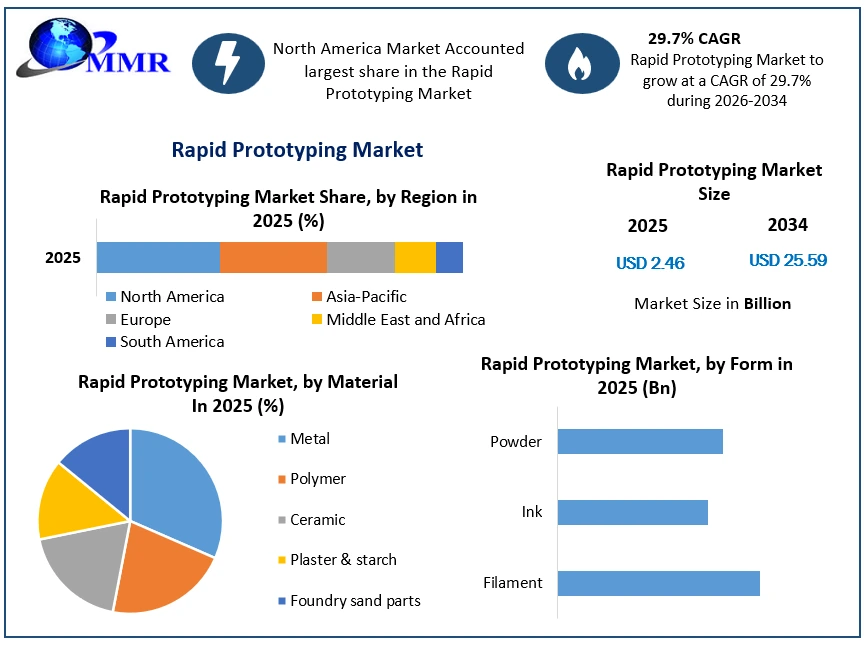
- The global Rapid Prototyping Market was valued at USD 2.46 Billion in 2025 and is expected to reach nearly USD 25.59 Billion by 2034, growing at a CAGR of 29.7% from 2026 to 2034. This growth creates a major opportunity for prototyping-service providers, additive-manufacturing companies, engineering firms, electronics OEMs, semiconductor equipment suppliers, and industrial manufacturers.
- Rapid prototyping allows companies to create, test, modify, and validate product designs before committing to full-scale production. Its commercial value lies in reducing development time and limiting the cost of late-stage design changes.
- Electronics and semiconductor companies face shorter product cycles and higher design complexity. Rapid prototyping can help teams test housings, fixtures, thermal components, mechanical parts, enclosures, and product concepts before mass manufacturing.
- Additive manufacturing and digital design tools are expanding the speed and flexibility of prototype production. This can help engineering teams move from concept to physical validation more quickly.
- Supply-chain volatility is increasing interest in localized and on-demand production capabilities. Rapid prototyping can reduce dependence on long prototype lead times and support faster engineering decisions.
- The supplied report does not disclose a dominant segment, fastest-growing segment, leading region, segment share, named company list, or detailed regional market figures. These data points are omitted rather than inferred.
Why This Matters Now
Electronics companies are being pushed to develop products faster while managing more complex hardware, tighter component tolerances, and shorter market windows. A design that takes too long to validate can lose its commercial value before it reaches production.
The Rapid Prototyping Market was valued at USD 2.46 Billion in 2025 and is expected to reach nearly USD 25.59 Billion by 2034 at a CAGR of 29.7% from 2026 to 2034. The business implication is clear: rapid prototyping is becoming a larger strategic tool for companies that need to compress development cycles, reduce engineering risk, and respond faster to product and supply-chain changes.
For semiconductor manufacturers, electronics OEMs, contract manufacturers, and technology investors, the market is not only about making models. It is about speeding decisions. Rapid prototyping allows teams to test form, fit, function, thermal performance, assembly processes, and product usability before major capital commitments are made.
Market Overview
Rapid prototyping refers to methods used to quickly create physical models, components, or product versions from digital designs. These prototypes can be used for design evaluation, engineering validation, functional testing, manufacturing planning, customer demonstrations, and early product development.
The market serves industries that need faster product iteration. Electronics, automotive, aerospace, healthcare, industrial equipment, consumer products, and manufacturing companies can use rapid prototyping to reduce the time between design concepts and physical testing.
In the electronics sector, rapid prototyping can support device enclosures, circuit-board fixtures, test jigs, connectors, housings, thermal-management parts, sensor mounts, packaging concepts, and production tooling. These applications matter because hardware development often involves multiple rounds of mechanical and functional changes.
The market is expanding because product design has become more complex. Devices are smaller, more connected, and more specialized. Engineers must balance performance, thermal requirements, material selection, manufacturability, reliability, and user experience. Rapid prototyping can help identify problems earlier in the development cycle.
The supplied report establishes market size and forecast but does not provide detailed technology shares, application rankings, material trends, end-user shares, or regional market performance. This article therefore focuses on the strategic role of rapid prototyping without assigning unsupported leadership to specific segments or geographies.
Key Trends Driving Growth
Shorter innovation cycles are a central driver. Electronics OEMs face intense pressure to release new products quickly, especially in consumer devices, industrial electronics, automotive systems, healthcare technology, and connected products. Rapid prototyping helps teams test designs before they become expensive production commitments.
The commercial benefit is reduced rework. Problems identified during prototype testing are generally easier to address than problems found after tooling, procurement, or production ramp-up. Companies that improve early validation can reduce delays and improve product-launch discipline.
Additive manufacturing is increasing the speed of prototype creation. Digital designs can be converted into physical components without the same tooling requirements associated with conventional manufacturing. This makes it easier to test multiple design options and make changes between iterations.
For electronics manufacturers, this flexibility is valuable. Product teams may need to modify enclosures, mounting structures, heat-management components, cable routes, display frames, or device ergonomics. Rapid prototyping can support these adjustments without waiting for long tooling cycles.
Supply-chain dynamics are also changing the market. Global component shortages, logistics disruption, and longer procurement lead times have increased the value of local engineering capabilities. Rapid prototyping can help companies make faster decisions when they need to redesign parts, validate alternatives, or adapt production plans.
Smart-device adoption adds further pressure. Connected products often combine sensors, wireless modules, batteries, displays, processors, and mechanical components in compact spaces. Prototyping helps engineering teams test how these elements fit together before final manufacturing decisions are made.
IoT ecosystems can also benefit. IoT devices often require application-specific housings, sensor configurations, mounting systems, and environmental protection. Rapid prototyping supports customization, especially when companies are developing products for industrial, healthcare, logistics, building-management, and consumer applications.
The supplied report does not identify AI chip demand, high-performance computing, foundry investments, advanced packaging, chiplet architecture, high-bandwidth memory, semiconductor sovereignty, or fabrication-capacity expansion as direct market drivers. These themes should not be treated as report findings. Their relevance is limited to the broader technology environment in which faster product development and hardware validation are increasingly important.
Sustainability is another strategic consideration. Prototyping can reduce material waste when it helps companies avoid late-stage product changes and failed production runs. The supplied report does not provide sustainability metrics, recycling data, or e-waste figures, so no numerical claims are made. However, more efficient development processes can support better resource management.
Request a Free Sample Report for Comprehensive Market Insights
Segment Insights
- Dominant Segment: Not disclosed in the supplied report — The report does not provide market-share data by technology, material, service type, application, end user, product category, or region.
- Fastest-Growing Segment: Not disclosed in the supplied report — The report does not identify a fastest-growing rapid prototyping technology, material category, application, end-user group, or regional segment.
- Core Technology Area: Digital-to-Physical Product Development — Rapid prototyping converts design concepts into physical models or components for testing and validation.
- Core Demand Area: Electronics Product Development — Electronics teams use prototypes to assess enclosure design, component fit, thermal management, assembly, and usability.
- Core Demand Area: Additive Manufacturing — Additive manufacturing can support faster prototype production and more frequent design iterations.
- Core Demand Area: Industrial and Consumer Innovation — Companies use rapid prototyping to test product concepts before committing to tooling and mass production.
Regional Growth Story
The supplied report does not disclose regional market shares, regional growth rates, country-level demand, leading geography, or fastest-growing region. It is therefore not possible to rank the United States, Taiwan, South Korea, China, Japan, Germany, India, or any other geography using the approved source alone.
The market has global relevance because product-development speed is a competitive issue across major manufacturing economies. Countries with strong electronics, automotive, aerospace, industrial equipment, medical technology, and consumer-product sectors are likely to view rapid prototyping as a useful engineering capability, but the supplied report does not provide country-level evidence to quantify this position.
For supply-chain leaders, rapid prototyping can improve resilience. Companies can test alternative materials, redesign parts, validate substitute components, and adjust production methods more quickly. This can be important when supply disruptions force manufacturers to reconsider established product designs.
Electronics manufacturing services providers can also benefit. EMS companies increasingly support design-for-manufacturing, engineering validation, pilot production, and product industrialization. Rapid prototyping can strengthen their role by allowing them to work with OEMs earlier in the development process.
Competitive Landscape
The supplied report does not disclose named companies, market shares, acquisitions, partnerships, product launches, research initiatives, manufacturing investments, or regional competitive developments. This article therefore does not attribute market activity to individual companies.
Competition in rapid prototyping depends on speed, accuracy, material capability, design support, manufacturing quality, and ability to handle complex customer requirements. A prototype provider must deliver more than a physical object. It must help customers make better engineering decisions.
Technology leadership will favor companies that connect digital design tools with fast and reliable physical production. The strongest providers can support iterative development, functional testing, design refinement, and transition to manufacturing. Their advantage comes from reducing the gap between concept and production-ready design.
Pricing power depends on urgency and technical value. Customers may accept higher costs when rapid prototyping helps avoid launch delays, tooling errors, or expensive redesigns. However, providers must also demonstrate repeatability, quality control, and the ability to support production-scale requirements.
The market depends on ecosystem development. Designers, engineers, materials suppliers, software providers, additive-manufacturing companies, machine suppliers, and contract manufacturers all influence the prototype-to-production workflow. Companies that integrate these capabilities can gain a stronger position.
Recent Developments
- The Rapid Prototyping Market was valued at USD 2.46 Billion in 2025. The market size confirms that fast product validation is becoming a meaningful category in industrial and electronics development.
- The market is expected to reach nearly USD 25.59 Billion by 2034, growing at a CAGR of 29.7% from 2026 to 2034. The forecast signals strong demand for faster design cycles, engineering flexibility, and prototype manufacturing capacity.
- Additive manufacturing and digital design tools are helping companies create and modify prototypes more quickly.
- Electronics, industrial equipment, healthcare technology, consumer products, and connected-device development can benefit from faster physical validation.
- The supplied report does not disclose specific company launches, acquisitions, foundry investments, advanced-packaging initiatives, government incentives, sustainability programs, or named competitive actions.
Strategic Implications
For semiconductor and electronics companies, rapid prototyping can reduce product-development risk. It supports faster validation of enclosures, thermal solutions, test fixtures, device architecture, and assembly methods before expensive production decisions are made.
For OEMs, the market creates a path to faster innovation. Product teams can test multiple design options, respond to customer feedback, and refine products before launch. The key challenge is connecting prototype speed with disciplined engineering and manufacturing readiness.
For electronics manufacturing services providers, rapid prototyping creates a higher-value service opportunity. EMS companies can move beyond production assembly by supporting design validation, pilot builds, tooling preparation, and transition-to-volume manufacturing.
For investors, the market offers exposure to the wider shift toward digital manufacturing, additive production, localized engineering, and faster product cycles. The strongest companies will likely be those that can combine speed with quality, material expertise, and scalable manufacturing support.
Future Outlook
The Rapid Prototyping Market is becoming a core capability for companies that compete on product speed and engineering agility. Its future will depend on the ability of providers to improve accuracy, expand material options, integrate digital workflows, and support customers from early concept through production readiness.
Future leaders will use rapid prototyping to turn design cycles into a strategic advantage across electronics and advanced manufacturing, while laggards will lose time and margin to competitors that can validate, redesign, and industrialize products at digital speed.
Analyst Perspective
“Rapid prototyping is changing how companies develop products by allowing engineering teams to test, refine, and validate designs before full-scale manufacturing. Its value is rising as electronics, industrial systems, and connected devices demand faster development cycles and greater design flexibility,” said Rucha Deshpande, Analyst.
About Maximize Market Research
Maximize Market Research Pvt. Ltd. (MMR) is a global market research and consulting company that provides reliable, data-focused, and practical business insights. The firm serves a wide range of industries, including healthcare, pharmaceuticals, technology, automotive, electronics, chemicals, personal care, and consumer goods. Through market forecasts, competitive analysis, strategic consulting, and industry impact assessments, MMR helps organizations understand changing market conditions, identify growth opportunities, and make informed business decisions for long-term success.
Contact Us
2nd Floor, Navale IT Park Phase 3
Pune Banglore Highway, Narhe
Pune, Maharashtra 411041, India
+91 9607365656
sales@maximizemarketresearch.com
