Key Highlights
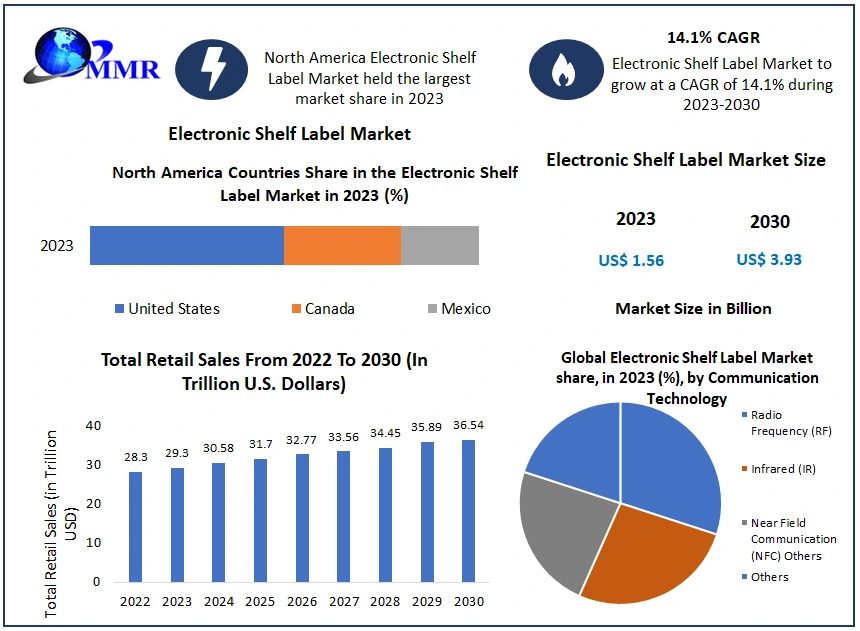
- The global Electronic Shelf Label Market was valued at USD 1.56 billion in 2023 and is expected to reach USD 3.93 billion by 2030, growing at a CAGR of 14.1%; the expansion signals that digital shelf infrastructure is moving from pilot deployments to a strategic retail operating system.
- North America dominated the market in 2023 and is expected to retain leadership; this positions the region as a key deployment market for display suppliers, wireless connectivity providers and retail software platforms.
- Displays are expected to dominate the component segment; display quality, readability and real-time updating capability are becoming central to retailer purchasing decisions.
- LCD ESLs dominated the market in 2023; their established supplier ecosystem and visual performance give manufacturers an advantage in high-volume retail installations.
- IoT integration and automation are emerging as the defining market trend; retailers are using connected labels to link shelf data with pricing, inventory and customer engagement systems.
Why This Matters Now
Retailers are turning store shelves into connected digital assets as manual price changes become too slow for omnichannel commerce. The Electronic Shelf Label Market, valued at USD 1.56 billion in 2023 and projected to reach USD 3.93 billion by 2030, shows that shelf-edge technology is becoming a competitive tool for retailers seeking faster pricing decisions, tighter inventory control and more consistent customer experiences.
The projected 14.1% CAGR from 2024 to 2030 carries a direct business implication: suppliers that combine displays, wireless connectivity, software integration and retail analytics can gain access to a larger share of store digitization budgets. For electronics manufacturers, the opportunity extends beyond selling labels. It includes displays, batteries, transceivers, microprocessors, communication systems and integration services.
Market Overview
Electronic shelf labels are digital display systems that replace paper-based price tags in retail stores. They use e-ink displays and wireless communication technologies to update product prices and information in real time. This changes the economics of shelf management by reducing dependence on manual price changes and lowering the risk of mismatches between online and in-store prices.
The market’s rise is tied to the retail sector’s wider shift toward automation and digitization. Retailers need systems that can update pricing across multiple locations, manage promotions quickly and provide accurate product information at the point of purchase. ESL platforms answer those needs by connecting shelf displays with inventory management systems, point-of-sale infrastructure and e-commerce platforms.
The market’s forecast value of USD 3.93 billion by 2030 indicates that ESL adoption is no longer limited to premium retail formats. The technology is becoming relevant for supermarkets, hypermarkets, specialty stores and non-food retailers that need to improve operational efficiency while responding to fast-changing demand conditions.
Key Trends Driving Growth
The integration of IoT and automation is reshaping the Electronic Shelf Label Market. ESLs are increasingly part of a connected retail environment where sensors, gateways, displays and software platforms exchange data continuously. This enables real-time price updates, inventory visibility and automated decision-making at the store level.
For technology providers, this creates demand for reliable wireless communication, low-power components and secure data infrastructure. ESL systems need to operate across large store networks without interruption, making system uptime, battery life and cybersecurity important product differentiators.
Dynamic pricing is another central market driver. Retailers can adjust pricing and promotions remotely, respond to changing inventory levels and synchronize physical stores with online channels. This gives retailers more flexibility in managing margins, reducing pricing errors and improving promotion execution.
Display technology is also becoming a competitive factor. ESLs use LCD and e-ink technologies to present pricing, promotions and detailed product information. The ability to provide readable, high-resolution and energy-efficient displays gives retailers more control over how product information is presented at the shelf.
Sustainability is adding another layer of demand. Electronic shelf labels reduce dependence on paper price tags and support retailers seeking more eco-friendly store operations. The business case is not only environmental; fewer paper labels and fewer manual replacements can improve process efficiency across large retail networks.
Request a Free Sample Report for Comprehensive Market Insights
Segment Insights
- Dominant Segment: Displays
Displays are expected to dominate the market during the forecast period because they are the primary interface between retailers, products and shoppers. Their quality, readability and functionality directly influence how effectively retailers can communicate pricing, promotions and product details. - Dominant Product Type: LCD ESLs
LCD ESLs dominated the market in 2023. Their high-resolution displays, vibrant colors and ability to support real-time updates make them suitable for retailers that need visible and flexible shelf communication. - Fastest-Growing Segment: Not specified in the supplied report
The report identifies market segments by component, product type, display size, communication technology and store type, but does not specify a fastest-growing segment. The available evidence instead points to rising demand for IoT-connected and automated ESL systems. - Communication Opportunity
Radio frequency, infrared and near field communication are included in the market scope. This creates opportunities for connectivity suppliers that can support reliable, scalable and secure communication across retail environments. - Store Deployment Opportunity
Hypermarkets, supermarkets, non-food retail stores and specialty stores are included in the market structure. Each format requires different display sizes, communication architectures and integration models.
Regional Growth Story
North America dominated the Electronic Shelf Label Market in 2023 and is expected to maintain its position through the forecast period. The region’s large base of established brick-and-mortar retailers, supermarkets, hypermarkets and specialty stores provides a broad deployment base for digital shelf technologies.
North American retailers are early adopters of technologies that improve customer convenience and operational performance. Their willingness to invest in advanced retail systems gives ESL providers a strong market for connected displays, pricing software and inventory integration tools.
The region also benefits from strong economic conditions, high consumer spending and regulatory frameworks that support technology innovation. For ESL suppliers, this means North America remains a key market for scaling deployments, developing partnerships and testing advanced retail applications.
The report covers Asia Pacific markets including China, South Korea, Japan, India and Taiwan, as well as major European markets such as Germany, the United Kingdom, France and Italy. These regions matter because they combine electronics manufacturing capacity, display technology expertise and large retail ecosystems. However, the supplied report does not provide regional market-size data or country-level growth rankings beyond North America’s leadership.
Competitive Landscape
Competition in the Electronic Shelf Label Market is centered on display innovation, IoT integration, customer service and sustainable product design. Key companies include SES-imagotag, Pricer AB, Displaydata Ltd., E Ink Holdings Inc. and Altierre Corp. Their positioning signals that the market is becoming a contest over platform capability rather than hardware supply alone.
SES-imagotag, Pricer and Displaydata compete in the European retail technology ecosystem, where large store networks require scalable deployments and reliable pricing synchronization. Their competitive advantage depends on the ability to combine labels with software, cloud connectivity and retailer-specific integration.
E Ink Holdings brings display technology strength from Taiwan, reinforcing the importance of low-power display innovation in ESL systems. Its role shows that display manufacturers can capture value as retailers demand longer battery life, better visibility and more flexible digital content.
Altierre and other North American suppliers operate in a market shaped by large-scale retail modernization. Their opportunity lies in helping retailers connect shelf labels with inventory systems, customer data and omnichannel pricing strategies.
Asian companies including Samsung Electro-Mechanics, LG Innotek, LG Display, Panasonic, Huawei, Solum and Toshiba indicate that the ESL market is linked to broader electronics supply chains. Their presence signals that component manufacturing, display technology and wireless communication expertise will shape future market leadership.
Recent Developments
- IoT integration is expanding the role of ESLs from digital price tags to connected retail data points.
- Retailers are increasing the use of real-time price updates to improve consistency between physical stores and e-commerce channels.
- Advanced display technologies, including LCD and e-ink, are improving visibility, energy efficiency and product information delivery.
- ESL providers are emphasizing partnerships and geographic expansion to strengthen their market positions.
- Sustainability-focused product development is gaining importance as retailers seek alternatives to paper-based shelf labeling.
Strategic Implications
For retailers, the decision to deploy ESLs is becoming a broader operating model decision. The technology can reduce manual work, improve price accuracy and support inventory optimization, but it requires investment in hardware, software, installation, staff training and system integration.
Initial implementation costs remain a major market restraint. Large retailers must assess the cost of labels, infrastructure upgrades, store layout changes, maintenance and compatibility with legacy systems. This makes return on investment analysis critical, especially for businesses operating with narrow margins.
For electronics suppliers, the market rewards companies that can provide integrated solutions. Displays alone are not enough. Buyers increasingly need batteries, transceivers, microprocessors, wireless systems, security features and software integration that can operate reliably across thousands of store locations.
For investors, the market’s opportunity lies in the convergence of retail automation, IoT infrastructure, display innovation and data-driven pricing. Companies that control the technology stack from display hardware to retail software may gain stronger pricing power and longer customer relationships.
Future Outlook
The Electronic Shelf Label Market is moving toward a connected retail model in which shelves become active participants in pricing, inventory management and customer communication. The shift will favor suppliers that can deliver dependable displays, secure connectivity and scalable software platforms.
Retailers that adopt ESL systems can use real-time information to improve operational agility and customer trust. Those that delay may face higher manual costs, slower pricing execution and greater difficulty synchronizing physical stores with digital channels.
The next competitive divide will separate retailers and technology suppliers that turn shelf data into real-time commercial decisions from those still managing stores through static labels and fragmented systems.
Analyst Perspective
“Electronic shelf labels are changing the shelf edge from a static pricing tool into a connected retail interface. Retailers are increasingly looking for technologies that improve pricing accuracy, automate operations and connect in-store activity with digital commerce,” said Rucha Deshpande, Analyst at Maximize Market Research.
About Maximize Market Research
Maximize Market Research Pvt. Ltd. (MMR) is a global market research and consulting company that provides reliable, data-focused, and practical business insights. The firm serves a wide range of industries, including healthcare, pharmaceuticals, technology, automotive, electronics, chemicals, personal care, and consumer goods. Through market forecasts, competitive analysis, strategic consulting, and industry impact assessments, MMR helps organizations understand changing market conditions, identify growth opportunities, and make informed business decisions for long-term success.
Contact Us
2nd Floor, Navale IT Park Phase 3
Pune Banglore Highway, Narhe
Pune, Maharashtra 411041, India
+91 9607365656
sales@maximizemarketresearch.com
