Key Highlights
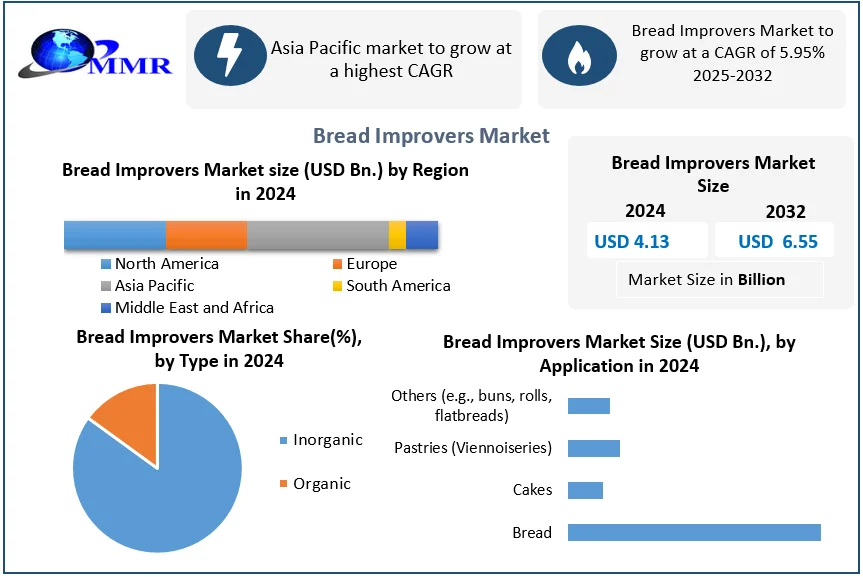
The global bread improvers market was valued at USD 4.13 billion in 2024 and is expected to reach nearly USD 6.55 billion by 2032, signaling sustained demand for bakery performance ingredients.
Asia-Pacific dominated the market in 2024, supported by rising bread consumption, higher disposable income, and food-processing investment. That gives suppliers a clear route to volume, localization, and R&D-led expansion.
Inorganic bread improvers held the dominant position by type, driven by cost-effectiveness, stability, and use in industrial baking. That keeps price-sensitive mass production anchored to legacy formulations.
Clean-label and enzyme-based improvers are gaining momentum as consumers and regulators push for cleaner ingredient lists. That is forcing formulators to defend margins through higher-value, customized products.
The competitive field is consolidating around R&D, regional expansion, and clean-label innovation. That raises the bar for smaller players that cannot fund product development or local manufacturing at scale.
Why This Matters Now
Bread improvers are no longer just a technical fix for dough handling. They are now a front-line response to packaged bakery growth, clean-label scrutiny, and the need for industrial bakeries to deliver consistency at scale.
The market’s growth to USD 6.55 billion by 2032 shows that bakeries are paying for reliability, shelf life, and processing efficiency. For ingredient suppliers, that shifts the battle from commodity supply to formulation leadership.
Market Overview
Bread improvers size enzymes, emulsifiers, and related compounds to improve dough quality, loaf volume, shelf life, and uniformity. The report says these products are essential in both industrial and artisan baking because they help producers meet rising demand for convenient baked goods.
The market is being pulled in two directions at once. One side wants lower-cost, scalable solutions for mass baking; the other wants cleaner labels, natural enzymes, and additive-free positioning. That tension is shaping procurement, R&D, and brand strategy across the sector.
Key Trends Driving Growth
Packaged bakery consumption is rising, and that directly supports demand for bread improvers that extend freshness and stabilize output. The report also ties growth to urban population expansion in developing countries, where bakery consumption is increasing alongside modern retail and food-processing capacity.
Health awareness is changing ingredient choices. The report highlights movement toward clean labels, naturally formulated improvers, and enzyme-based systems, which means manufacturers must reformulate without sacrificing dough tolerance or shelf life.
Industrialization is another clear force. Larger-scale baking facilities in developing regions need performance-based improvers that reduce waste, improve consistency, and support automation, which favors suppliers with technical service and customization capabilities.
Request a Free Sample Copy or View Report Summary: https://www.maximizemarketresearch.com/request-sample/27595/
Segment Insights
Dominant Segment: Inorganic bread improvers dominated by type in 2024 because they are cost-effective, stable, and widely used in industrial baking. That implies the biggest revenue pools still reward scale, pricing discipline, and broad manufacturing reach.
Fastest-Growing Segment: Organic bread improvers are growing on the back of clean-label demand in Western markets. That signals a premium opportunity for enzyme-led and natural-positioned formulations.
By ingredient, the report highlights emulsifiers, enzymes, oxidizing agents, reducing agents, and other functional inputs. Enzymes stand out strategically because they align with the move away from chemical additives.
By form, the market covers powder, liquid, and paste. That matters commercially because industrial users typically buy for process fit, not just ingredient content.
By application, bread remains central, with cakes, pastries, and other baked goods also covered. That broadens the addressable market for suppliers that can adapt one platform across multiple bakery formats.
Regional Growth Story
Asia-Pacific held the highest share in 2024. The report links that position to growing bread consumption, rising incomes, food-processing investment, and the presence of players such as Angel Yeast, AB Mauri India, and Riken Vitamin.
The implication is clear: APAC is not just a demand center; it is becoming a formulation and localization arena. Companies that pair local R&D with clean-label innovation are positioned to win shelf space and supply contracts in the next cycle.
North America and Europe remain important because they are pushing the clean-label agenda hardest. That makes them strategic markets for higher-margin enzyme systems, even if volume growth is slower than in Asia-Pacific.
Competitive Landscape
The report shows a market where Puratos, Lesaffre, Corbion, and AB Mauri are using innovation and expansion to defend share. Puratos has focused on enzyme-based and natural fermentation improvers, while Lesaffre is emphasizing fermentation science and enzyme-based alternatives.
That signals a market shift from product breadth to technical credibility. Rivals now need more than distribution; they need clean-label pipelines, local application support, and faster response to bakery customers that are reformulating.
Recent moves also point to a regional race. Corbion’s acquisition of Novotech Food Ingredients in India strengthens its Asia-Pacific position, while AB Mauri’s BakeQik platform shows that data-led customization is becoming part of the sales pitch.
Over the next 12–24 months, that should pressure mid-sized competitors. Players without R&D depth or a regional footprint may be forced into niche positioning, alliances, or acquisition discussions.
Recent Developments
In March 2025, Puratos Group added fermentation-based natural solutions to its clean-label bread improver range. That suggests a push to capture premium bakery demand tied to ingredient transparency.
In February 2025, Lesaffre launched reformers with enzymes for dough tolerance and longer shelf life. That points to a market where performance and clean-label positioning must now be delivered together.
In January 2025, Corbion acquired Novotech Food Ingredients in India. That signals a stronger bet on Asia-Pacific localization and a deeper competitive push in one of the market’s fastest-growing regions.
In March 2025, AB Mauri launched BakeQik, a real-time flour analysis and diagnostics platform. That shows ingredient suppliers are moving upstream into bakery decision-making, not just product supply.
In November 2024, Bakels Group launched Lecimax 3000 and Lecisoft Rye. That reinforces the trend toward targeted formulations for specific bread profiles.
Strategic Implications
For suppliers, the market now rewards three things: cleaner formulations, technical service, and regional execution. Bread improvers that can improve loaf quality while meeting label expectations will win the highest-value accounts.
For bakers, the message is harsher. Ingredient choice is becoming a strategic procurement decision, because the wrong improver mix can weaken shelf life, inflate waste, or fail clean-label tests.
For investors, the clearest signal is that scale alone is not enough. The winners will be companies that combine enzyme science, local market access, and product customization.
Future Outlook
The market’s path to USD 6.55 billion by 2032 points to continued demand for bakery performance ingredients, but the growth will not be evenly shared.
The next phase will favor companies that can replace legacy formulations with cleaner, enzyme-led systems without compromising economics. Those that cannot will lose relevance as industrial bakers and branded food companies tighten ingredient standards.
Related Reports
Global Waterproof Headphones Market https://www.maximizemarketresearch.com/market-report/global-waterproof-headphones-market/53538/
global tissue vending machine market https://www.maximizemarketresearch.com/market-report/global-tissue-vending-machine-market/68363/
Global Fanfold Labels Market https://www.maximizemarketresearch.com/market-report/global-fanfold-labels-market/86921/
Analyst Perspective
“Bread improvers are moving from a background ingredient to a board-level formulation issue, because the market now rewards clean-label performance, regional customization, and industrial-scale consistency at the same time,” said Siddhi Dole, Analyst.
About Maximize Market Research
Maximize Market Research Pvt. Ltd. (MMR) is a global market research and consulting company that provides reliable, data-focused, and practical business insights. The firm serves a wide range of industries, including healthcare, pharmaceuticals, technology, automotive, electronics, chemicals, personal care, and consumer goods. Through market forecasts, competitive analysis, strategic consulting, and industry impact assessments, MMR helps organizations understand changing market conditions, identify growth opportunities, and make informed business decisions for long-term success.
2nd Floor, Navale IT Park Phase 3
Pune Banglore Highway, Narhe
Pune, Maharashtra 411041, India
+91 9607365656
sales@maximizemarketresearch.com
