Key Highlights
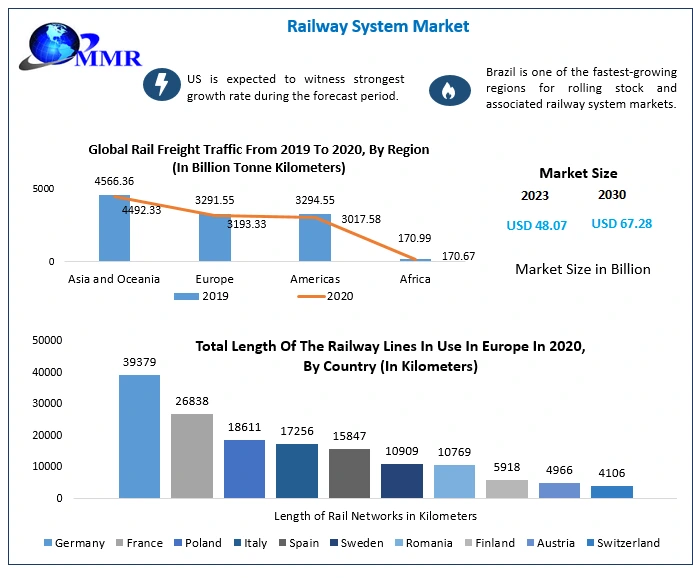
- The global Railway System Market was valued at USD 48.07 billion in 2023 and is projected to reach nearly USD 67.28 billion by 2030, growing at a CAGR of 4.92%; this creates a larger addressable market for rail electronics, automation platforms, rolling-stock suppliers and infrastructure contractors.
- Passenger transportation held more than 60% of the market in 2023 and is expected to retain its lead through 2030; this keeps passenger-focused systems such as onboard controls, HVAC, safety platforms and train information systems at the center of procurement.
- Passenger transportation is projected to grow at a CAGR of 5.21% during the forecast period; the implication is sustained demand for metro, suburban and intercity rail capacity.
- Freight transportation is expected to record rapid growth during the forecast period; this expands opportunities for freight wagons, locomotives, logistics software and rail-network modernization.
- North America is expected to lead the global market, while the United States is expected to grow rapidly within the region; rail modernization spending is creating demand for safety, control and operational technologies.
- Artificial intelligence, robotics, blockchain and big data analytics are changing rail maintenance and logistics; suppliers that convert operational data into safer and more reliable service can gain strategic relevance.
Why This Matters Now
Railways are becoming digital infrastructure assets rather than fixed transport networks. As cities confront congestion, rising fuel prices, air-quality pressure and greenhouse-gas emissions, governments are moving toward metro systems, rail freight and upgraded passenger networks that require more electronics, automation and data systems.
The Railway System Market was valued at USD 48.07 billion in 2023 and is expected to reach nearly USD 67.28 billion by 2030. That expansion signals a long-cycle opportunity for rail OEMs, power-system suppliers, onboard electronics manufacturers, software providers and investors positioned around transport modernization.
The market is also changing the role of semiconductor and electronics suppliers. Modern rail projects increasingly require train information systems, train safety systems, onboard vehicle control, HVAC, auxiliary power and propulsion systems. These systems depend on reliable electronics, sensors, communications equipment and control technologies that can operate across long asset lifecycles.
Market Overview
Rail transport remains a reliable mode of transportation because trains operate on fixed routes and schedules and are less affected by weather conditions such as rain and fog than some alternatives. This reliability gives rail a central role in moving passengers and goods while supporting economic development.
Passenger railways, urban metro railways and goods carriages are expected to drive market growth through 2030. The business implication is that demand will not be limited to one rail format. Suppliers can target metro systems, suburban networks, freight corridors, locomotives, passenger coaches and supporting infrastructure.
Urbanization is adding urgency. Major cities face infrastructure constraints, congestion, rising gasoline prices and pressure to reduce emissions. Public transport offers a more energy-efficient alternative to private vehicles, creating a policy and investment case for metros, light rail, electric multiple units and diesel multiple units.
Rail networks also support industrial and trade activity. Freight rail allows producers to move raw materials, intermediate goods and finished products to markets. This makes rail investment relevant not only to passenger mobility but also to manufacturing competitiveness, export logistics and regional economic integration.
Key Trends Driving Growth
Digitalization is becoming the strongest technology shift in the Railway System Market. Artificial intelligence, robotics, blockchain and big data analytics are being applied to end-to-end logistics and rail operations. The strategic impact is clear: rail operators can move from reactive maintenance toward earlier detection of faults, lower disruption risk and more efficient asset use.
Autonomous rail technology is also moving into trials. Robots with automatic drives can inspect tracks, identify issues and help reduce maintenance costs and delays. For electronics manufacturers, this creates demand for sensors, onboard processing, connectivity equipment and automated inspection technologies.
AI-enabled maintenance changes the economics of railway operations. Traditional maintenance often addresses track problems after they occur, creating long disruptions and high costs. AI and robotics can help identify issues before accidents or derailments, improving safety for passengers, freight operators and maintenance workers.
The rail sector is also benefiting from the wider shift toward sustainable transport. Policymakers are prioritizing freight rail because of its safety and environmental advantages. In emerging economies, shifting freight from roads to rail and inland waterways is seen as a strategy to reduce greenhouse-gas emissions and support national climate commitments.
Metro expansion is another major market catalyst. India, China, Egypt and Brazil are making substantial investments in metro infrastructure to reduce road traffic. These systems require advanced train information systems, safety systems and HVAC systems, creating recurring opportunities for rail electronics and systems suppliers.
Request a Free Sample Report for Comprehensive Market Insights
Segment Insights
- Dominant Segment: Passenger Transportation
Passenger transportation held more than 60% of the global Railway System Market in 2023. Its dominance means passenger-focused rolling stock, metro systems, onboard controls, safety systems and passenger information technologies remain central to market demand. - Passenger Transportation Growth
The passenger transportation segment is expected to grow at a CAGR of 5.21% during the forecast period and maintain its leading position by 2030. Rising demand for daily commuting, leisure travel, tourism and regional connectivity supports continued investment in passenger rail capacity. - Fastest-Growing Segment: Freight Transportation
Freight transportation is expected to witness rapid growth during the forecast period. Growing imports, exports and industrial activity are increasing demand for rail freight, strengthening the case for freight wagons, locomotives, logistics systems and rail-port connectivity. - System-Level Opportunity
The market includes auxiliary power systems, HVAC, propulsion systems, onboard vehicle control, train information systems and train safety systems. This broad system mix gives electronics suppliers multiple entry points across rolling stock and rail infrastructure. - Type-Level Opportunity
Locomotives, metros, monorails, trams, freight wagons and passenger coaches are covered by the market. Each category requires different control architectures, power systems and passenger or freight operating technologies.
Regional Growth Story
North America is expected to lead the global Railway System Market during the forecast period. The region’s position is reinforced by the United States, which is expected to witness rapid growth in the North American market. For suppliers, this makes the United States a priority market for modernization programs, safety upgrades and passenger rail investment.
The United States has the world’s largest railway network, with more than 250,000 kilometers of operational route length. Freight lines account for around 80% of the country’s rail network, creating a large installed base for freight technology, locomotive systems, network monitoring and maintenance solutions.
The U.S. passenger network extends approximately 35,000 kilometers, while Amtrak connects 500 locations across 46 states through more than 30 train lines. This creates a broad operational environment for passenger information systems, train safety technologies and rolling-stock upgrades.
The U.S. government has been active in renovation, expansion and modernization of transportation systems. The report cites USD 80 billion in government funds for rail system overhaul under the U.S. President’s USD 2.3 trillion infrastructure renovation plan. The business implication is that public funding can accelerate procurement cycles for safety systems, passenger rail equipment and network upgrades.
China offers lucrative growth opportunities during the forecast period. Its rail network exceeds 100,000 kilometers, including more than 10,000 kilometers of high-speed lines. The scale of this network supports demand for rail systems that can manage large passenger flows and bulk freight movement.
China’s rail economy is linked to coal, coke, metal ores, iron and steel, petroleum products, grain and fertilizers. These materials are suited to rail transport, making freight systems strategically important to industrial supply chains. China’s growing purchasing power and dense urban regions also support intercity passenger travel.
India, Japan, South Korea, Taiwan, Germany and other major rail markets are included in the report’s regional scope. The supplied source does not provide country-level market values or semiconductor investment figures for these markets, but their inclusion confirms the broad geographic reach of rail-system demand.
Competitive Landscape
Competition is shifting toward digitalization, sustainability and cost-efficient performance. The report identifies CRRC, Alstom, Siemens, Hyundai Rotem, Knorr Bremse, Hitachi, Toshiba, Stadler Rail, Wabtec Corporation, ABB, Bombardier, Mitsubishi Heavy Industries and others among market participants.
This competitive structure signals that railway leadership increasingly depends on systems integration. Rolling-stock manufacturers need to combine propulsion, onboard controls, safety systems, HVAC, train information systems and digital maintenance tools into reliable operating platforms.
CRRC’s presence highlights China’s role in rail manufacturing scale. Alstom, Siemens and Knorr Bremse reinforce Europe’s position in rail engineering, mobility systems and braking technology. Hitachi, Toshiba and Mitsubishi Heavy Industries show how Japanese industrial technology remains connected to rail electrification, control systems and rolling-stock capability.
Hyundai Rotem represents South Korea’s role in advanced rail manufacturing. Wabtec and General Electric Company strengthen the U.S. technology base in freight rail and locomotive-related systems. ABB’s inclusion signals the importance of electrical systems and power technologies in rail modernization.
The competitive advantage will increasingly belong to companies that combine hardware with data. Suppliers that can integrate AI-based maintenance, onboard control, safety monitoring and freight optimization can build deeper relationships with rail operators and create stronger long-term pricing power.
Recent Developments
- Railway operators are adopting artificial intelligence, robotics, blockchain and big data analytics across logistics and operational workflows.
- Autonomous rail and robotic inspection trials are targeting lower maintenance costs, faster fault detection and reduced service disruption.
- Metro investments in India, China, Egypt and Brazil are increasing demand for train information, safety and HVAC systems.
- Governments are prioritizing rail infrastructure as part of congestion reduction, public transport expansion and emissions-reduction strategies.
- Market participants are focusing on innovation, strategic collaboration, cost efficiency and sustainability to strengthen their positions.
Strategic Implications
The market’s main opportunity lies in system modernization rather than simple rail-network expansion. Rail operators need technologies that improve safety, capacity, energy efficiency and maintenance performance. This favors suppliers of onboard controls, power electronics, sensing systems, communications platforms and analytics software.
High capital costs remain a major restraint. Rail networks require substantial investment in construction, maintenance and overheads, particularly when governments or operators build entire new systems. Suppliers must therefore show measurable operational value through lower maintenance needs, improved reliability and better asset utilization.
Rail’s fixed-track structure also limits door-to-door service and can create added loading, unloading and handling costs. Freight operators will need stronger links between rail terminals, ports, warehouses and road networks. This creates opportunities for logistics integration and digital freight management.
For investors, the market offers exposure to public infrastructure spending, sustainable mobility and industrial freight demand. The strongest opportunities sit with companies that supply mission-critical systems rather than isolated components, because rail operators need integrated platforms that can perform over long operating cycles.
Future Outlook
The Railway System Market is moving toward an era in which physical rail assets are paired with digital intelligence. Passenger expansion, freight modernization, metro construction and sustainability targets will continue to shape procurement decisions through 2030.
The next phase will depend on whether operators can turn AI, robotics, data analytics and automated inspection into lower-cost, safer and more reliable railway operations. Technology leaders will build connected rail platforms that convert data into uptime and capacity, while laggards will remain exposed to higher maintenance costs, fragmented systems and slower network performance.
Analyst Perspective
“Railway systems are moving beyond traditional transport infrastructure toward connected, technology-driven mobility networks. The next wave of market opportunity will come from passenger capacity expansion, freight modernization, AI-enabled maintenance and sustainable rail investment,” said Rucha Deshpande, Analyst at Maximize Market Research.
About Maximize Market Research
Maximize Market Research Pvt. Ltd. (MMR) is a global market research and consulting company that provides reliable, data-focused, and practical business insights. The firm serves a wide range of industries, including healthcare, pharmaceuticals, technology, automotive, electronics, chemicals, personal care, and consumer goods. Through market forecasts, competitive analysis, strategic consulting, and industry impact assessments, MMR helps organizations understand changing market conditions, identify growth opportunities, and make informed business decisions for long-term success.
Contact Us
2nd Floor, Navale IT Park Phase 3
Pune Banglore Highway, Narhe
Pune, Maharashtra 411041, India
+91 9607365656
sales@maximizemarketresearch.com
