Metal Powder Market: Additive Manufacturing and Lightweight Engineering Redefine Industrial Manufacturing
Manufacturers are redesigning production strategies as additive manufacturing moves from prototyping to full-scale industrial production. At the same time, industries are accelerating the transition toward lightweight, high-performance components that improve efficiency, reduce waste, and support sustainability goals.
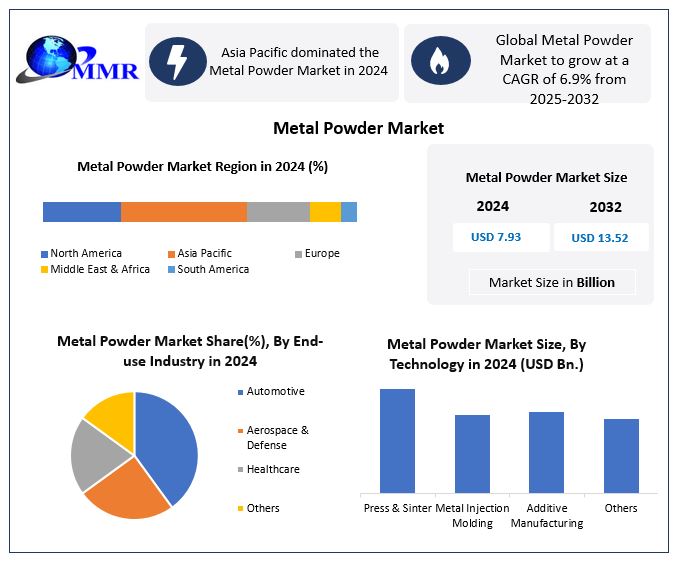
According to the Maximize Market Research report, the Metal Powder Market is projected to grow from USD 7.93 billion to USD 13.52 billion by 2032, expanding at a CAGR of 6.9%. This growth signals increasing industrial investment in advanced manufacturing technologies, enabling producers to achieve greater design flexibility, material efficiency, and cost optimization across multiple sectors.
Key Highlights
- Metal Powder Market expected to reach USD 13.52 billion by 2032.
- Market projected to expand at a CAGR of 6.9%.
- Rising adoption of additive manufacturing is accelerating industrial demand.
- Lightweight component production continues to reshape automotive and aerospace manufacturing.
- Powder metallurgy remains central to precision engineering applications.
- Technology innovation is improving manufacturing efficiency and product performance.
- Industrial investments continue to strengthen advanced material supply chains.
Why This Matters Now
Industrial manufacturing is entering a new investment cycle centered on digital production and advanced materials. Companies are seeking manufacturing methods that shorten development timelines, reduce raw material losses, and deliver increasingly complex product geometries without compromising quality.
Metal powders have become a critical enabler of this transformation. Their expanding role in additive manufacturing, powder metallurgy, and precision engineering is allowing manufacturers to rethink production economics while improving product performance. As industries pursue efficiency, sustainability, and supply chain resilience simultaneously, demand for specialized metal powders continues to strengthen.
Market Overview
The Metal Powder Market Size is evolving beyond conventional metallurgy into a strategic segment supporting next-generation industrial manufacturing. Demand is being driven by the increasing commercialization of additive manufacturing technologies alongside broader adoption of lightweight engineering solutions across transportation, industrial equipment, healthcare, and advanced manufacturing sectors.
Growing investment in industrial automation is reinforcing this trend. Manufacturers increasingly require materials capable of delivering consistent quality, high mechanical performance, and production flexibility. Metal powders provide these capabilities while supporting precision manufacturing processes that reduce waste and improve production efficiency.
The market’s projected expansion to USD 13.52 billion reflects more than increasing material consumption. It represents a broader shift toward digital manufacturing ecosystems where material innovation and production technologies operate together to improve industrial competitiveness.
Key Trends Driving Growth
Additive manufacturing continues to reshape industrial production by enabling complex component designs that traditional manufacturing methods often cannot achieve economically. As adoption expands from prototype development to commercial production, demand for high-quality metal powders continues to increase across multiple industries.
Lightweight engineering has also become a strategic priority. Manufacturers are reducing component weight while maintaining structural integrity to improve operational efficiency, lower energy consumption, and enhance product performance. This trend supports broader industrial efforts to optimize manufacturing processes and lifecycle performance.
Powder metallurgy remains another important growth driver. Industries requiring high precision, dimensional accuracy, and efficient material utilization continue to expand their use of powder-based manufacturing technologies. These processes support large-scale production while minimizing machining requirements and material waste.
Technology innovation is equally influencing competitive positioning. Continuous improvements in powder production techniques, material quality, particle consistency, and manufacturing reliability are expanding commercial applications across increasingly sophisticated industrial sectors.
Segment Insights
- Dominant Segment: The report identifies the market’s dominant segment based on its comprehensive segmentation analysis.
- Fastest-Growing Segment: The report identifies the fastest-growing segment driving future expansion.
- Additive manufacturing applications continue creating new commercial opportunities across advanced manufacturing.
- Powder metallurgy supports precision production requirements across industrial sectors.
- Lightweight component manufacturing remains an important source of long-term demand.
- Advanced material requirements continue expanding application diversity.
Regional Growth Story
The Metal Powder Market reflects varying industrial priorities across major manufacturing economies.
North America continues investing in advanced manufacturing technologies, industrial automation, and additive manufacturing capabilities that support aerospace, automotive, healthcare, and precision engineering applications. Manufacturers increasingly focus on digital production methods that improve efficiency while reducing production waste.
Europe remains focused on sustainable manufacturing and lightweight engineering. Industrial producers continue integrating advanced material technologies into manufacturing strategies designed to improve competitiveness, support resource efficiency, and strengthen high-value production capabilities.
Asia-Pacific continues benefiting from expanding manufacturing capacity, industrial modernization, and increasing technology adoption. Major manufacturing economies are investing in production efficiency, advanced engineering capabilities, and modern industrial infrastructure that support growing demand for metal powders.
Industrial development across emerging markets is also creating additional opportunities as manufacturers seek improved production technologies capable of supporting higher-quality manufacturing while maintaining operational efficiency.
Competitive Landscape
Competition is increasingly centered on technological capability rather than production volume alone. Companies are strengthening research and development activities to improve powder quality, manufacturing consistency, and application performance across increasingly demanding industrial environments.
Strategic investments in production capacity indicate confidence in sustained long-term demand driven by additive manufacturing and advanced engineering applications. Capacity expansion also signals intensifying competition as suppliers position themselves closer to major industrial customers and growing manufacturing clusters.
Technology partnerships and product innovation demonstrate that future market leadership will depend on delivering specialized materials that support increasingly complex production requirements. Companies capable of combining advanced material science with scalable manufacturing capabilities are likely to strengthen their competitive position as industrial adoption accelerates.
The competitive landscape also reflects growing emphasis on operational efficiency, supply chain resilience, and product quality. These factors are becoming as important as pricing in winning long-term industrial contracts.
Recent Developments
- Continued investments supporting additive manufacturing capabilities.
- Expansion of advanced powder production technologies.
- Greater focus on lightweight engineering solutions.
- Ongoing innovation in powder metallurgy applications.
- Increasing industrial adoption across precision manufacturing sectors.
- Rising emphasis on production efficiency and material optimization.
Strategic Implications
Manufacturers face a strategic decision between incremental process improvements and broader production transformation. Organizations investing in advanced material capabilities today are positioning themselves to respond more effectively to changing customer requirements and increasingly sophisticated manufacturing standards.
For industrial investors, the market’s projected expansion highlights growing opportunities across material production, manufacturing equipment, process optimization, and industrial technology integration. Businesses supporting additive manufacturing ecosystems may benefit from expanding adoption across multiple end-use industries.
Supply chain resilience is becoming another strategic priority. Companies capable of securing reliable access to high-quality metal powders while maintaining production flexibility are likely to strengthen their competitive positioning as industrial demand continues to evolve.
Technology adoption also creates opportunities beyond manufacturing efficiency. Companies integrating advanced material technologies into broader digital manufacturing strategies can improve responsiveness, accelerate innovation, and optimize long-term production economics.
Future Outlook
The next phase of industrial manufacturing will increasingly depend on advanced materials that enable digital production, lightweight engineering, and precision manufacturing at commercial scale. Metal powders are expected to remain central to this transformation as industries continue modernizing production systems and expanding additive manufacturing capabilities.
Industrial competitiveness will increasingly be determined by the ability to combine material innovation with scalable manufacturing technologies. Companies that invest early in advanced production capabilities will shape the next generation of industrial manufacturing, while slower adopters risk losing strategic relevance as digital manufacturing becomes the new competitive baseline.
Analyst Perspective
“The Metal Powder Market is transitioning from a specialized materials segment into a strategic pillar of advanced manufacturing. As additive manufacturing and lightweight engineering continue expanding across industrial sectors, companies investing in material innovation, production quality, and manufacturing capability will be best positioned to capture long-term value,” says Neha Nalawade, Analyst at Maximize Market Research.
About Maximize Market Research
Maximize Market Research Pvt. Ltd. (MMR) is a global market research and consulting company that provides reliable, data-focused, and practical business insights. The firm serves a wide range of industries, including healthcare, pharmaceuticals, technology, automotive, electronics, chemicals, personal care, and consumer goods. Through market forecasts, competitive analysis, strategic consulting, and industry impact assessments, MMR helps organizations understand changing market conditions, identify growth opportunities, and make informed business decisions for long-term success.
2nd Floor, Navale IT Park Phase 3
Pune Banglore Highway, Narhe
Pune, Maharashtra 411041, India
+91 9607365656
sales@maximizemarketresearch.com
