Key Highlights
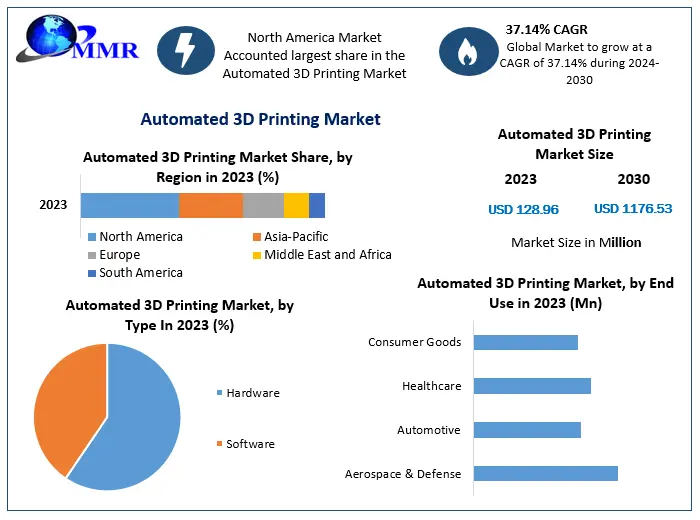
- Automated 3D Printing Market is moving from prototyping into production automation, and the shift is forcing manufacturers to rethink tooling, inventories and localized supply chains. The market was worth USD 128.96 Mn in 2023 and is expected to reach nearly USD 1176.53 Mn by 2030, creating a high-growth opportunity for additive manufacturing suppliers and industrial automation providers.
- Automated 3D Printing Market is forecast to grow at a 37.14% CAGR from 2024 to 2030, signaling rapid adoption across healthcare, aerospace and defense, automotive, consumer goods, construction, packaging, food and industrial end uses.
- Selective Laser Sintering dominated by technology because it can produce precise and delicate structures using powder-based laser fusion.
- Medical end use is expected to see strong demand and grow at a 35.1% CAGR, driven by organ fabrication, anatomical models, personalized prosthetics, medicines and tablets.
- North America dominated in 2023 and remains a major developer of 3D printing, robotics and artificial intelligence technologies.
Why This Matters Now
Automated 3D printing is becoming a manufacturing sovereignty tool. It can shorten production runs, reduce tooling dependence and shift critical parts closer to point-of-use, which matters for semiconductor equipment, aerospace components, healthcare devices and industrial supply chains.
The electronics and semiconductor relevance is system-level rather than wafer-level. The public MMR page does not disclose AI chip demand, high-performance computing trends, foundry investments, advanced packaging, chiplets, HBM, display technology, memory and logic chip trends or chip manufacturing capacity expansion, but it does disclose adoption across automation, robotics, healthcare, automotive and aerospace.
Market Overview
Automated 3D printing uses additive manufacturing systems to create parts with less manual intervention and higher repeatability. MMR states that automated 3D printers are gaining popularity because they are versatile, easy to use and allow faster task completion.
Automated 3D Printing Market is segmented by technology into Stereolithography, Selective Laser Sintering, Electron Beam Melting, Fused Deposition Modeling, Digital Light Processing, Laser Metal Deposition, PolyJet Printing, Laminated Object Manufacturing and others. It is segmented by type into hardware and software, and by end use into aerospace and defense, automotive, healthcare, consumer goods, architecture and construction, printing and packaging, food and beverage, industrial and others.
The public page contains a visible headline-panel inconsistency. The panel lists USD 128.96 Mn as forecast market size, while the overview and scope table state USD 128.96 Mn in 2023 and USD 1176.53 Mn by 2030; this article uses the overview and scope figures because they match the supplied market-size statement.
Key Trends Driving Growth
Healthcare is the first demand engine. MMR links growth to transplantation, drug delivery, 3D printed organs, implant customization during surgical procedures, rising R&D spending and wider acceptance of 3D printing in medical applications.
Automation is the second driver. Automated 3D printing offers accuracy, productivity and the ability to increase manufacturing runs, giving factories a way to move beyond manual prototyping into more repeatable production workflows.
Lower system costs can expand adoption. MMR states that the market will rise as application variety grows and the cost of 3D printing and printers decreases, making equipment economics central to market penetration.
The main restraint remains capital cost. Business and industrial printers used in healthcare can cost over USD 10,000, while processes such as stereolithography, laser beam, electron beam, photopolymerization and droplet deposition remain expensive.
Request a Detailed Industry Report Sample Instantly
Segment Insights
- Dominant Segment Selective Laser Sintering: SLS dominated the Automated 3D Printing Market compared with other technology types. The process uses powdered material and laser fusion to build objects layer by layer, supporting plastic, metal and ceramic structures.
- Fastest-Growing Segment: The public MMR page does not identify a fastest-growing technology, type or end-use segment through a complete comparative ranking. Medical end use is disclosed as growing at a 35.1% CAGR, but the page does not label it as the fastest-growing segment.
- High-Growth End Use Healthcare: Medical applications include organ fabrication, anatomical models, personalized prosthetics, medications, tablets, tissue engineering, hearing aids, surgical guides, dental implants and drug screening.
- Industrial Signal Rapid Prototyping: The industrial end use has used 3D printing for product prototypes for decades, with large rapid prototyping machines helping companies make models and molds.
- Type Scope Hardware and Software: Hardware and software are included in the market scope, but the public page does not disclose type-level shares or growth rates.
Regional Growth Story
North America dominated the Automated 3D Printing Market in 2023. MMR identifies the region as one of the leading developers and pioneers in 3D printing, robotics and artificial intelligence, with many patent and application inventors based in the United States.
The United States is also supported by public-sector initiatives. MMR cites funding for 3D printing research and development in universities through America Makes and support through SBIR, which links the market to government-backed innovation infrastructure.
The report states that the U.S. imports about USD 3 trillion worth of goods each year, with USD 1.4 trillion of imports made up of leading industries likely to be affected by 3D printing automation, including industrial, automotive, healthcare and aerospace. That makes automated 3D printing relevant to supply-chain localization and import substitution.
Asia Pacific covers China, India, Japan, South Korea, Australia, ASEAN and the rest of APAC; Europe covers the UK, France, Germany, Italy, Spain, Sweden, Austria, Turkey, Russia and the rest of Europe. Country-level values, electronics manufacturing data, semiconductor incentives and export dynamics are not disclosed on the public page.
Competitive Landscape
Key players include Stratasys, 3D Systems, EOS, Concept Laser, Sisma, ExOne, Arcam, SLM Solutions, Materialise, Proto Labs, Citim, Digital Mechanics Sweden, Voxeljet, Optomec, ARC Group Worldwide, Groupe Gorgé, EnvisionTEC, Mcor Technologies, Beijing Tiertime Technology, Renishaw, XYZprinting and Ultimaker.
Competition is shaped by product capability, price, financial position, product portfolio, growth strategy and regional presence. That signals a market where suppliers must compete on workflow automation, materials compatibility, print precision, throughput and service capability rather than printer hardware alone.
SLS leadership gives vendors with laser, powder and process-control expertise stronger positioning. Healthcare growth gives companies with medical-grade materials, validation support and application engineering a route to premium demand.
No named acquisition, partnership, product launch, fab investment, advanced packaging development, chip manufacturing capacity expansion or AI-specific hardware initiative is disclosed in the visible MMR article. The visible competitive direction is automation, healthcare expansion, rapid prototyping and technology breadth across SLS, SLA, EBM, FDM and other additive processes.
Recent Developments
- Healthcare Use Case: Engineers from South Korea’s Pohang University of Science and Technology manufactured bio-blood-vessels using material collected from the human body as a template and a 3D printer.
- Government Support: The United States has financed 3D printing research and development in universities through America Makes and promoted initiatives through SBIR.
- Industrial Adoption: Automated 3D printing is gaining demand across aerospace and defense, automotive, healthcare, consumer goods, energy and other industries because of accuracy, productivity and higher manufacturing-run capability.
- No Named Dated Deals Disclosed: The public page does not disclose specific recent acquisitions, partnerships, product launches or semiconductor manufacturing investments by key players.
Strategic Implications
For semiconductor and electronics suppliers, automated 3D printing is not disclosed as a chip-demand market. Its relevance sits in advanced manufacturing, automation hardware, robotics, machine control, industrial software and localized part production.
For healthcare manufacturers, the business case is customization. Implant personalization, anatomical modeling, prosthetics, dental implants and drug-delivery applications can shift 3D printing from design support into patient-specific manufacturing.
For investors, the market offers exposure to automation, medical additive manufacturing, aerospace, automotive tooling, rapid prototyping and industrial productivity. The key risk is equipment affordability, because industrial printers and advanced printing processes remain expensive for many facilities.
Future Outlook
The Automated 3D Printing Market is forecast to grow from USD 128.96 Mn in 2023 to nearly USD 1176.53 Mn by 2030 at a 37.14% CAGR. Growth will come from healthcare customization, SLS adoption, industrial prototyping, lower printer costs, higher automation, R&D activity and wider application coverage.
The next phase will test whether suppliers can convert automated 3D printing from expensive equipment into scalable production infrastructure. Future technology leaders will control the automated additive manufacturing layer behind localized healthcare, aerospace and industrial supply chains; laggards will remain tied to slow prototyping models in a market moving toward automated production.
Analyst Perspective
“Automated 3D printing is becoming a high-growth industrial automation market as healthcare, aerospace, automotive and industrial manufacturers demand faster, more accurate and more customizable production,” said Rucha Deshpande, Analyst at Maximize Market Research. “The strongest suppliers will combine SLS capability, software integration, materials expertise, workflow automation and application-specific engineering.”
About Maximize Market Research
Maximize Market Research Pvt. Ltd. (MMR) is a global market research and consulting company that provides reliable, data-focused, and practical business insights. The firm serves a wide range of industries, including healthcare, pharmaceuticals, technology, automotive, electronics, chemicals, personal care, and consumer goods. Through market forecasts, competitive analysis, strategic consulting, and industry impact assessments, MMR helps organizations understand changing market conditions, identify growth opportunities, and make informed business decisions for long-term success.
Contact Us
2nd Floor, Navale IT Park Phase 3
Pune Banglore Highway, Narhe
Pune, Maharashtra 411041, India
+91 9607365656
sales@maximizemarketresearch.com
