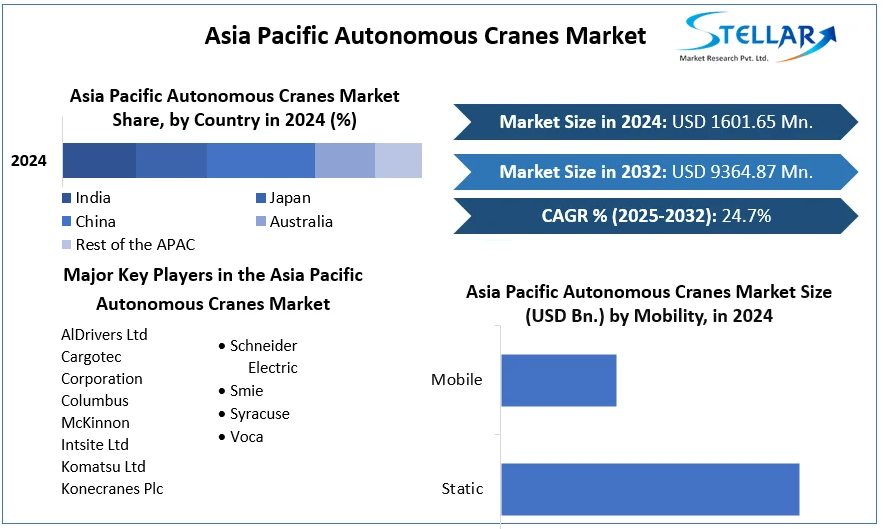
The Asia Pacific Autonomous Cranes Market is emerging as a key segment of the region’s industrial automation landscape. Autonomous cranes leverage artificial intelligence (AI), machine vision, Internet of Things (IoT), sensors, and advanced control systems to perform lifting, positioning, and material handling tasks with minimal human intervention. These systems improve operational efficiency, workplace safety, and productivity across ports, warehouses, construction sites, mining operations, and manufacturing facilities.
Rapid urbanization, expanding infrastructure projects, and increasing investments in smart factories and automated ports are accelerating the adoption of autonomous crane technologies throughout Asia Pacific. As industries focus on reducing operational costs while enhancing precision and safety, demand for intelligent lifting solutions continues to rise.
Infrastructure Development Fuels Market Growth
One of the primary drivers of the Asia Pacific Autonomous Cranes Market is the region’s extensive investment in infrastructure development. Governments are undertaking large-scale transportation, energy, commercial, and industrial construction projects that require efficient material handling equipment.
Autonomous cranes are widely deployed in:
Construction projects
Container ports
Manufacturing plants
Warehouses
Steel production facilities
Mining operations
Shipyards
Logistics and distribution centers
The growing complexity of infrastructure projects is encouraging contractors to adopt automated lifting solutions that improve efficiency and reduce project timelines.
𝐃𝐨𝐰𝐧𝐥𝐨𝐚𝐝 𝐅𝐫𝐞𝐞 𝐏𝐃𝐅 𝐁𝐫𝐨𝐜𝐡𝐮𝐫𝐞: https://www.stellarmr.com/report/req_sample/Asia-Pacific-Autonomous-Cranes-Market/750
Smart Ports and Logistics Accelerate Adoption
Asia Pacific is home to some of the world’s busiest ports, where automation is becoming a strategic priority. Autonomous cranes improve cargo handling speed, reduce vessel turnaround times, and enhance operational accuracy.
Benefits include:
Faster container movement
Reduced labor dependency
Improved cargo tracking
Lower operational costs
Enhanced worker safety
Higher equipment utilization
Real-time fleet monitoring
Predictive maintenance capabilities
The rapid growth of e-commerce and international trade is further increasing demand for automated material handling systems across logistics hubs.
Artificial Intelligence Enhances Crane Performance
Technological innovation continues to transform the Asia Pacific Autonomous Cranes Market. AI-powered control systems enable cranes to identify loads, optimize movement paths, avoid collisions, and operate with greater precision.
Key technologies include:
Artificial intelligence (AI)
Machine vision
LiDAR sensors
Internet of Things (IoT)
GPS positioning
Digital twin technology
Predictive maintenance analytics
Edge computing
These technologies improve operational efficiency while reducing downtime, maintenance costs, and safety risks.
𝐃𝐨𝐰𝐧𝐥𝐨𝐚𝐝 𝐅𝐫𝐞𝐞 𝐏𝐃𝐅 𝐁𝐫𝐨𝐜𝐡𝐮𝐫𝐞: https://www.stellarmr.com/report/req_sample/Asia-Pacific-Autonomous-Cranes-Market/750
Industry 4.0 Supports Manufacturing Automation
Manufacturers across Asia Pacific are integrating autonomous cranes into smart factory environments as part of broader Industry 4.0 initiatives. Connected lifting systems streamline production workflows, improve inventory management, and enable real-time coordination with automated guided vehicles (AGVs), robotics, and warehouse management systems.
Industrial automation helps manufacturers increase throughput while maintaining high standards of precision and workplace safety.
Sustainability and Safety Become Strategic Priorities
Autonomous cranes contribute to sustainability by optimizing energy consumption, minimizing operational inefficiencies, and reducing equipment wear. Electric-powered crane systems and intelligent load management technologies help organizations lower emissions while improving overall operational performance.
Additionally, automated crane operations significantly reduce workplace accidents by limiting human exposure to hazardous lifting environments and ensuring consistent adherence to safety protocols.
Regional Market Insights
China
China dominates the Asia Pacific Autonomous Cranes Market due to extensive infrastructure development, large-scale port operations, rapid industrial automation, and strong investments in smart manufacturing and logistics.
Japan
Japan remains a leading market driven by advanced robotics, precision engineering, automated manufacturing facilities, and continuous innovation in intelligent industrial equipment.
South Korea
South Korea is witnessing strong market growth through smart port development, shipbuilding modernization, semiconductor manufacturing expansion, and digital industrial transformation.
India and Southeast Asia
India, Singapore, Thailand, Indonesia, Malaysia, and Vietnam are investing heavily in infrastructure, logistics modernization, and industrial automation, creating significant opportunities for autonomous crane deployment across multiple sectors.
Competitive Landscape
The Asia Pacific Autonomous Cranes Market is highly competitive, with crane manufacturers, industrial automation providers, robotics companies, and software developers investing in intelligent lifting technologies.
Major competitive strategies include:
AI-powered crane automation
Smart port solutions
Digital fleet management
Remote crane operation
Predictive maintenance systems
Strategic technology partnerships
Manufacturing capacity expansion
Integrated automation platforms
Companies continue focusing on improving lifting precision, system reliability, energy efficiency, and autonomous operational capabilities.
Emerging Opportunities
Several trends are expected to shape future market growth:
Remote-operated cranes
AI-powered load optimization
5G-enabled industrial automation
Electric autonomous cranes
Digital twin-enabled operations
Fully automated container terminals
Smart warehouse logistics
Autonomous heavy lifting systems
These innovations are expected to enhance productivity while supporting digital transformation across industrial sectors.
Future Outlook
The future of the Asia Pacific Autonomous Cranes Market remains highly promising as governments and industries continue investing in infrastructure modernization, smart logistics, and advanced manufacturing technologies. Rising demand for automation, labor optimization, workplace safety, and sustainable industrial operations will continue driving market expansion.
Advancements in AI, IoT, robotics, cloud computing, and real-time analytics are expected to further improve autonomous crane performance and create new opportunities for equipment manufacturers, technology providers, logistics companies, and construction firms.
Conclusion
The Asia Pacific Autonomous Cranes Market is revolutionizing material handling by enabling safer, more efficient, and highly automated lifting operations across construction, manufacturing, ports, mining, and logistics. Intelligent crane systems are helping organizations improve productivity, reduce operational costs, and support sustainable industrial development.
As Asia Pacific continues to lead global investments in automation and smart infrastructure, the Autonomous Cranes Market is expected to experience sustained growth, creating substantial opportunities for manufacturers, technology innovators, infrastructure developers, and investors throughout the region.
