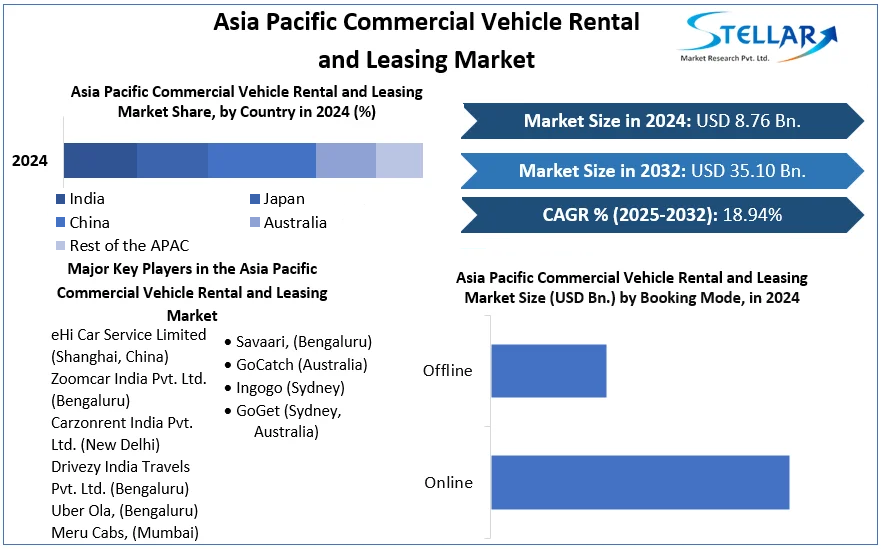
The Asia Pacific Commercial Vehicle Rental and Leasing Market is experiencing significant expansion due to rapid urbanization, growing industrialization, and the rising need for cost-efficient transportation solutions. Businesses across logistics, construction, retail, manufacturing, healthcare, and e-commerce are increasingly choosing rental and leasing services to optimize fleet operations while minimizing capital expenditure. Commercial vehicle rental and leasing provide organizations with greater operational flexibility, predictable maintenance costs, and access to modern vehicle fleets without substantial upfront investments.
The growing adoption of digital fleet management platforms, telematics, connected vehicles, and electric commercial vehicles is further transforming the market, enabling fleet operators to improve efficiency, reduce downtime, and enhance customer service.
E-Commerce and Logistics Expansion Drive Market Growth
One of the primary drivers of the Asia Pacific Commercial Vehicle Rental and Leasing Market is the rapid growth of e-commerce and third-party logistics (3PL) services. Rising online shopping activity has significantly increased demand for reliable transportation solutions capable of supporting last-mile delivery and regional distribution networks.
Commercial vehicle rental and leasing services are widely utilized for:
Freight transportation
Last-mile delivery
Construction projects
Retail distribution
Cold chain logistics
Industrial transportation
Healthcare logistics
Infrastructure development
Businesses increasingly prefer leasing arrangements that allow them to scale fleets according to seasonal demand and changing operational requirements.
𝐃𝐨𝐰𝐧𝐥𝐨𝐚𝐝 𝐅𝐫𝐞𝐞 𝐏𝐃𝐅 𝐁𝐫𝐨𝐜𝐡𝐮𝐫𝐞: https://www.stellarmr.com/report/req_sample/Asia-Pacific-Commercial-Vehicle-Rental-and-Leasing-Market/752
Fleet Leasing Improves Financial Flexibility
Rental and leasing models help organizations reduce capital investment while providing access to technologically advanced commercial vehicles. Leasing also simplifies vehicle replacement cycles, maintenance management, and regulatory compliance.
Key advantages include:
Lower upfront costs
Predictable operating expenses
Fleet scalability
Reduced maintenance burden
Access to modern vehicles
Improved cash flow
Flexible contract options
Enhanced operational efficiency
These benefits are encouraging small and medium-sized enterprises (SMEs) as well as large corporations to adopt fleet leasing solutions.
Digital Fleet Management Accelerates Market Transformation
Technological innovation is reshaping the Asia Pacific Commercial Vehicle Rental and Leasing Market through intelligent fleet management and connected mobility solutions.
Key technologies include:
GPS fleet tracking
Telematics systems
Artificial intelligence (AI)
Internet of Things (IoT)
Predictive maintenance
Fleet analytics
Cloud-based fleet management
Digital booking platforms
These technologies enable fleet operators to monitor vehicle performance, optimize routes, reduce fuel consumption, improve driver safety, and maximize asset utilization.
𝐃𝐨𝐰𝐧𝐥𝐨𝐚𝐝 𝐅𝐫𝐞𝐞 𝐏𝐃𝐅 𝐁𝐫𝐨𝐜𝐡𝐮𝐫𝐞: https://www.stellarmr.com/report/req_sample/Asia-Pacific-Commercial-Vehicle-Rental-and-Leasing-Market/752
Electric Commercial Vehicles Create New Opportunities
The transition toward sustainable transportation is encouraging fleet operators to integrate electric commercial vehicles (ECVs) into rental and leasing portfolios. Government incentives, emissions regulations, and corporate sustainability goals are accelerating the adoption of electric vans, trucks, and delivery vehicles.
Rental and leasing companies are expanding electric vehicle offerings to help businesses meet environmental targets while reducing operating costs associated with fuel and maintenance.
This trend is expected to significantly reshape the regional commercial vehicle market over the coming years.
Infrastructure Development Supports Fleet Demand
Massive investments in infrastructure, manufacturing, logistics parks, smart cities, and industrial corridors across Asia Pacific continue to increase demand for commercial transportation services.
Improved road networks, expanding warehousing facilities, and integrated multimodal logistics systems are supporting long-term growth in vehicle rental and leasing activities across the region.
Regional Market Insights
China
China dominates the Asia Pacific Commercial Vehicle Rental and Leasing Market due to its extensive logistics network, thriving e-commerce industry, large manufacturing sector, and ongoing investments in smart transportation infrastructure.
India
India is emerging as one of the fastest-growing markets, driven by expanding infrastructure projects, rising logistics demand, rapid urbanization, and increasing adoption of organized fleet leasing services.
Japan
Japan continues to experience stable growth through advanced fleet management technologies, strong commercial transportation networks, and increasing demand for operational efficiency among businesses.
South Korea and Southeast Asia
South Korea, Singapore, Thailand, Indonesia, Malaysia, and Vietnam are witnessing growing demand supported by industrial expansion, cross-border trade, logistics modernization, and increasing foreign investment.
Competitive Landscape
The Asia Pacific Commercial Vehicle Rental and Leasing Market is highly competitive, with fleet operators, vehicle leasing companies, logistics providers, financial institutions, and mobility service companies continuously expanding their service portfolios.
Major competitive strategies include:
Digital fleet management
Electric vehicle leasing
Strategic partnerships
Fleet expansion
Flexible leasing models
Connected vehicle technologies
AI-powered fleet optimization
Customer-centric mobility solutions
Companies continue investing in advanced telematics, predictive maintenance, and digital customer platforms to strengthen operational performance and market competitiveness.
Emerging Opportunities
Several trends are expected to shape future market growth:
Electric commercial vehicle leasing
Subscription-based fleet services
AI-powered fleet optimization
Connected commercial vehicles
Autonomous commercial fleets
Green logistics
Mobility-as-a-Service (MaaS)
Smart transportation ecosystems
These innovations are expected to improve fleet efficiency while supporting sustainable commercial transportation.
Future Outlook
The future of the Asia Pacific Commercial Vehicle Rental and Leasing Market remains highly promising as businesses increasingly prioritize operational flexibility, cost optimization, and sustainable transportation solutions. Continued investments in digital fleet management, electric mobility, logistics infrastructure, and intelligent transportation systems will support long-term market expansion.
Organizations that focus on technology integration, customer-centric services, and environmentally sustainable fleet solutions will be well positioned to capitalize on the region’s evolving mobility landscape.
Conclusion
The Asia Pacific Commercial Vehicle Rental and Leasing Market is playing a vital role in supporting regional economic growth by providing flexible, efficient, and scalable transportation solutions for businesses across multiple industries. The integration of connected vehicle technologies, telematics, AI, and electric commercial vehicles is transforming fleet management while improving operational performance.
As Asia Pacific continues to strengthen its logistics infrastructure and embrace digital mobility, the Commercial Vehicle Rental and Leasing Market is expected to experience sustained growth, creating significant opportunities for fleet operators, vehicle manufacturers, logistics providers, investors, and mobility technology companies.
