Key Highlights
- Detonator demand is shifting from basic initiation hardware to digitally controlled blasting systems where timing, safety, sustainability and regulatory compliance decide procurement. The MMR overview values the Detonator Market at USD 1.8 Bn in 2023 and forecasts nearly USD 10.19 Bn by 2030 at a 5.8% CAGR, although the same public page also shows conflicting scope and FAQ values that should be read with caution.
- Industrial electric detonators are identified as the dominant product segment and are linked to construction, mining, quarrying and defense applications where precision and reliability matter.
- Asia Pacific is expected to hold the highest regional share, supported by China, South Korea, Japan, India, Australia, Indonesia, Malaysia, Vietnam, Taiwan, Bangladesh and Pakistan in the regional scope.
- Digital detonators and electronic initiation systems are the strongest electronics-linked demand drivers because they improve timing, sequencing, safety and cost efficiency in blasting operations.
- Orica’s Exel Neo lead-free non-electric detonator range signals a market shift toward sustainable blasting solutions and lower environmental impact.
Why This Matters Now
Mining, infrastructure and defense customers are no longer buying detonators only for initiation. They are buying control, timing accuracy, environmental compliance and safer blast outcomes.
That shift gives the Detonator Market an electronics and process-control angle. Digital detonators and electronic initiation systems support more precise sequencing, greater reliability and lower operating risk, while the public MMR page does not disclose AI chip demand, high-performance computing, foundry investments, advanced packaging, chiplet architecture, HBM, semiconductor capacity expansion, memory or logic chip trends.
Market Overview
A detonator is a device used to initiate an explosive charge at a predetermined time and, where required, in a specific sequence. The report identifies three main detonator types used in mining: non-electric, electric and electronic systems.
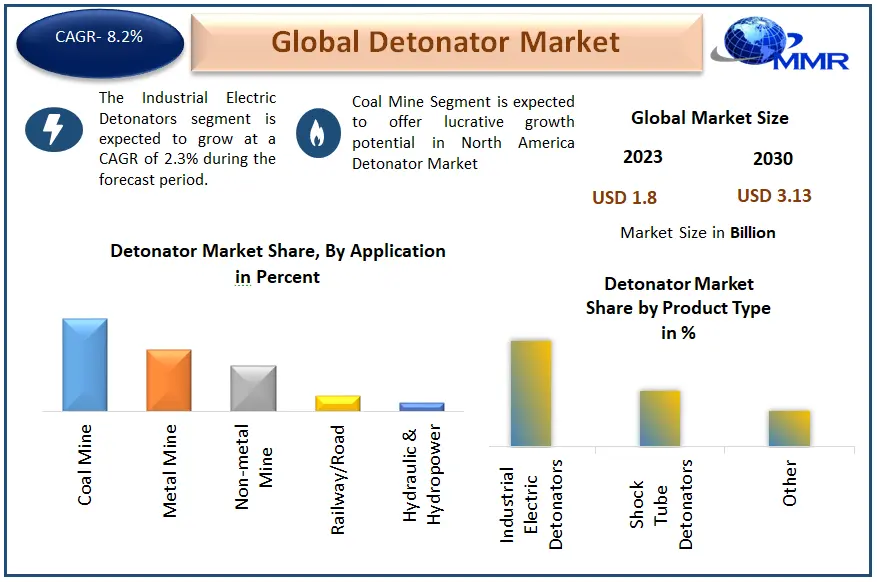
The market is segmented by product type into industrial electric detonators, shock tube detonators and others. Applications include coal mine, metal mine, non-metal mine, railway and road, and hydraulic and hydropower projects.
The public page contains material inconsistency. The overview states USD 1.8 Bn in 2023, 5.8% CAGR and USD 10.19 Bn by 2030, while the scope table and FAQ state 8.2% CAGR and USD 3.13 Bn by 2030. This article uses the user-supplied and overview figures but flags the inconsistency because forecast interpretation affects investment screening.
Key Trends Driving Growth
The first shift is from analog to digital initiation. MMR states that digital detonators offer better accuracy, precision and user-friendliness than traditional analog detonators, giving operators improved blasting outcomes and better safety economics.
Electronic initiation systems are also gaining relevance. They support precise timing and sequencing, which can improve blasting efficiency, reduce cost and limit environmental impact in mining, construction and demolition projects.
Mining and quarrying remain core demand engines. Rising demand for minerals, ores and aggregates requires controlled blasting systems that improve extraction efficiency, safety and resource utilization.
Construction adds a second demand base. Urbanization and infrastructure development increase the need for demolition, excavation and foundation-related blasting, pushing demand toward detonators that provide controlled and predictable performance.
Sustainability is moving into a traditionally heavy industrial category. MMR identifies rising demand for eco-friendly detonation solutions and cites manufacturers developing greener products to meet environmental criteria and stricter regulations.
Access Reliable Industry Insights with a Free Sample
Segment Insights
- Dominant Segment Industrial Electric Detonators: Industrial electric detonators dominate the market, with the report linking their lead to construction, mining, quarrying and defense applications that require accuracy, timing and safety.
- Fastest-Growing Segment Industrial Electric Detonators: The page states industrial electric detonators are “dominating” with the highest CAGR during the forecast period. This wording creates overlap between dominance and fastest growth, so the segment should be treated as both the strongest disclosed product signal and the only disclosed high-CAGR product type.
- Product Scope Shock Tube Detonators: Shock tube detonators are included in the product scope, but the public page does not disclose their market share, CAGR or application ranking.
- Application Scope Mining and Infrastructure: Coal mine, metal mine, non-metal mine, railway and road, and hydraulic and hydropower applications are covered. Application-level values and rankings are not disclosed.
- Electronics Signal Digital and Electronic Initiation: Digital detonators and electronic initiation systems are the clearest technology signal, but the page does not quantify semiconductor content, embedded electronics value or chip-level demand.
Regional Growth Story
Asia Pacific is expected to hold the highest share in the Detonator Market. The regional scope includes China, South Korea, Japan, India, Australia, Indonesia, Malaysia, Vietnam, Taiwan, Bangladesh, Pakistan and the rest of APAC.
China has several listed market participants, including Shanxi Huhua Group, Nanling Civil Explosive, Poly Permanent Union Holding, Sichuan Yahua, Yunnan Civil Explosive and CNIGC. That supplier base signals a strong regional industrial explosives ecosystem, although country-level revenues are not disclosed.
India is represented by IDEAL Industrial Explosive and VK Explosive among listed players. India’s relevance is tied to mining, infrastructure and industrial development demand, but the public page does not provide India-specific market size or forecast data.
Europe includes the UK, France, Germany, Italy, Spain, Sweden, Austria and the rest of Europe, with MAXAM listed as a major contributor. North America covers the United States, Canada and Mexico, but the public page does not disclose U.S. revenue, defense demand values, semiconductor incentive data or export dynamics.
Competitive Landscape
Key players include MAXAM, Shanxi Huhua Group, Nanling Civil Explosive, Poly Permanent Union Holding, Sichuan Yahua, Yunnan Civil Explosive, CNIGC, Orica, Dyno Nobel/IPL, IDEAL Industrial Explosive and VK Explosive. The market is concentrated around mining explosives, civil infrastructure blasting and industrial detonation expertise rather than broad semiconductor manufacturing.
Competition is shifting toward safer, more precise and more sustainable detonation systems. Orica’s Exel Neo launch signals that product differentiation is moving beyond blast performance into lead-free chemistry, sustainability credentials and regulatory alignment.
Digital and electronic initiation capability is the other competitive divider. Suppliers that can deliver reliable timing, sequencing and safety features will be better positioned for complex mines, urban infrastructure projects, defense modernization and oil and gas well operations.
No foundry investment, advanced packaging breakthrough, chiplet roadmap, HBM development, chip manufacturing capacity expansion, AI hardware program or electronics manufacturing services activity is disclosed on the public page. The visible electronics direction is embedded timing control, digital initiation and safer electronic detonation systems.
Recent Developments
- September 7, 2023 Orica: Orica released Exel Neo, described by MMR as the world’s first lead-free non-electric detonator range, produced in Gyttorp, Sweden, using Non-Primary Explosives Detonator technology.
- Sustainability Shift: Exel Neo removes lead from the formulation without compromising performance, signaling demand for greener blasting products in mining and civil infrastructure.
- Digital Transition: The market is moving from analog detonators to digital detonators because customers seek better accuracy, precision, user-friendliness, safety and cost efficiency.
- 3D Printing Innovation: MMR identifies 3D printing as an innovation driver because it can lower production cost, shorten lead times and enable more precise customized detonator components.
Strategic Implications
For mining operators, the main business case is productivity with risk control. More precise initiation systems can improve extraction efficiency and safety while reducing unintended environmental impacts.
For construction and infrastructure firms, detonator technology affects project certainty. Urban demolition, excavation and foundation work need controlled blasts, which raises demand for reliable timing and sequencing systems.
For defense and oil and gas customers, the market is tied to mission reliability. MMR identifies defense use in munitions, ordnance disposal and artillery shells, and oil and gas use in well stimulation and perforating operations; both require dependable initiation systems.
For electronics and semiconductor suppliers, the opportunity is indirect. Electronic initiation systems may create demand for embedded control and timing electronics, but the source does not disclose chip content, PCB sourcing, semiconductor demand, memory use, logic use or supply-chain metrics.
Future Outlook
The Detonator Market is forecast in the MMR overview to grow from USD 1.8 Bn in 2023 to nearly USD 10.19 Bn by 2030 at a 5.8% CAGR, while the same public page separately lists USD 3.13 Bn by 2030 and 8.2% CAGR in the scope table and FAQ. That inconsistency should be resolved before financial modeling, but the strategic direction remains clear: demand is moving toward digital initiation, electronic timing, sustainability and safer blasting systems.
Growth will come from mining, quarrying, infrastructure construction, defense modernization, oil and gas operations, electronic initiation systems and eco-friendly detonator development. Future technology leaders will control the safer, programmable and sustainable initiation layer behind mining and infrastructure blasting; laggards will remain exposed to analog products in a market moving toward precision, compliance and digital control.
Analyst Perspective
“Detonator technology is moving toward digital initiation, precision timing and safer blast control as mining, construction, defense and oil and gas customers demand higher reliability,” said Rucha Deshpande, Analyst at Maximize Market Research. “The strongest suppliers will combine electronic initiation capability, sustainability, regulatory compliance and proven field performance.”
About Maximize Market Research
Maximize Market Research Pvt. Ltd. (MMR) is a global market research and consulting company that provides reliable, data-focused, and practical business insights. The firm serves a wide range of industries, including healthcare, pharmaceuticals, technology, automotive, electronics, chemicals, personal care, and consumer goods. Through market forecasts, competitive analysis, strategic consulting, and industry impact assessments, MMR helps organizations understand changing market conditions, identify growth opportunities, and make informed business decisions for long-term success.
Contact Us
2nd Floor, Navale IT Park Phase 3
Pune Banglore Highway, Narhe
Pune, Maharashtra 411041, India
+91 9607365656
sales@maximizemarketresearch.com
