Key Highlights
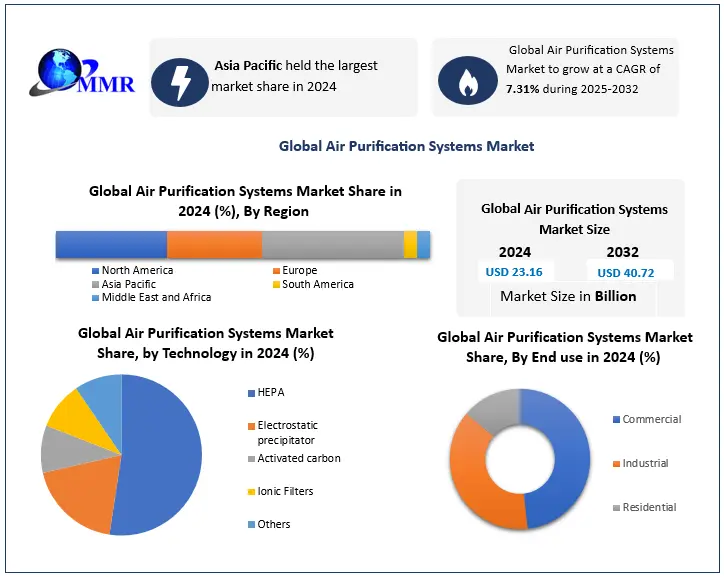
Market Valuation: The global market reached USD 23.16 billion in 2024 and is projected to expand to USD 40.72 billion by 2032.
Sustained Growth Momentum: Revenue is accelerating at a compound annual growth rate (CAGR) of 7.31% over the 2025 to 2032 forecast period.
Commercial Sector Dominance: Commercial end-uses held a substantial 48% market share in 2024, driven by institutional adoption in hospitality, healthcare, and education.
Technology Leadership: High-Efficiency Particulate Air (HEPA) filters remain the primary technology platform due to their recognized filtration reliability and efficiency.
Geographic Concentrator: The Asia-Pacific region controls the largest piece of the global market, underpinned by rapid industrialization and urban population growth.
Why This Matters Now
Global industrial operators and utility infrastructure developers face an unprecedented intersection of stricter emission compliance laws and sweeping facility electrification mandates. Industrial filtration is no longer a secondary facility requirement; it is a core operational priority directly affecting energy consumption and regulatory approval. As modern power generation shifts toward high-efficiency networks and distributed energy systems, large-scale air purification systems must be integrated directly into smart buildings and industrial HVAC frameworks.
Industrial buyers are replacing standalone, inefficient air filters with internet-of-things (IoT) connected systems that dynamically balance air throughput with grid power conditions. This shift changes air purification from an isolated maintenance cost into a flexible load asset capable of optimizing plant efficiency. For institutional investors and utility operators, tracking this capital expenditure provides a clear signal of where industrial capacity is expanding and which regional grids will face increased base-load demand from advanced filtration infrastructures.
Market Overview
The global Air Purification Systems Market Size stood at USD 23.16 billion in 2024 and is moving along a 7.31% growth trajectory from 2025 to 2032, which will lift total market value to USD 40.72 billion by the end of the forecast period. These systems use internal mechanical fans and multi-stage filter configurations to continuously cycle polluted ambient air, removing micro-particulates, volatile organic compounds, and biological pathogens before recirculating the cleaned air. Rising public and private investments are modernizing baseline manufacturing facilities, prompting commercial and industrial buyers to view advanced air filtration as an essential defense against chronic health liabilities and operational downtime.
The market expansion highlights a broader structural transformation within corporate real estate, public health infrastructure, and industrial production zones. High-efficiency filtration units require continuous power, making them a significant factor in facility energy load management. Consequently, manufacturers are engineering units that offer maximum pollutant removal while drawing minimal current, aligning equipment design with corporate carbon reduction initiatives and national energy efficiency goals.
Key Trends Driving Growth
A primary catalyst driving the market is the rapid deployment of smart features and IoT connectivity across commercial and industrial product portfolios. Operators are moving away from manual, schedule-based filter replacements toward data-driven, predictive maintenance models that utilize precise particle sensors to monitor actual filter degradation in real time. This operational shift reduces unnecessary component waste, lowers the long-term total cost of ownership, and ensures consistent air quality compliance across complex facility networks without requiring continuous human oversight.
Concurrently, tightening government frameworks and statutory ambient air targets are forcing high-emission manufacturing, logistics, and processing sectors to upgrade their exhaust containment architectures. Regulatory agencies are steadily lowering allowable indoor particulate thresholds, turning advanced multi-stage air purification into a strict operational necessity for factory lines, commercial spaces, and transport hubs. This shifting regulatory environment creates a robust pipeline for technology developers who can deliver certified systems capable of capturing fine particulate matter and gaseous hazards simultaneously.
Segment Insights
Dominant Technology Segment [HEPA]: High-Efficiency Particulate Air (HEPA) systems emerged as the leading technology platform due to their verified efficiency in capturing sub-micron particulate matter and allergens across residential, medical, and industrial facilities.
Dominant End-Use Segment [Commercial]: The commercial sector secured a commanding 48% value share in 2024, with extensive infrastructure deployment across hospitality networks, educational facilities, healthcare hubs, offices, and entertainment complexes.
Fastest-Growing Segment [Smart and Connected Residential Systems]: The residential application area is expanding rapidly as rising consumer awareness of urban pollution and respiratory risks drives the adoption of smart, energy-efficient home purification units.
Secondary Technology Segment [Activated Carbon & UV Filtration]: Multi-stage systems combining carbon layers and ultraviolet light are experiencing increased procurement for specialized industrial applications requiring the eradication of volatile organic compounds and living microorganisms.
Regional Growth Story
The Asia-Pacific region dominates the global industry landscape, driven by high urbanization rates, concentrated industrial manufacturing belts, and substantial population hubs across China and India. The regional market handles intense environmental pressures, as legacy domestic heating practices, oil-based transportation networks, and industrial emissions create high concentrations of airborne particulates. Private industrial groups and state utilities are investing heavily in large-scale air treatment systems to mitigate the domestic economic impacts of poor ambient air quality and protect workforce health.
In contrast, mature markets across North America and Europe are focusing capital on upgrading existing commercial real estate and upgrading institutional HVAC systems. Municipal clean-air regulations and strict workforce safety laws drive consistent replacement demand for certified HEPA and carbon filtration systems within these territories. Meanwhile, developing urban infrastructure projects across the Middle East and South America are presenting new expansion fields for global suppliers targeting large-scale commercial developments and regional transportation networks.
Competitive Landscape
The global competitive structure features highly capitalized international engineering firms working alongside nimble consumer technology developers to capture market share. Major entities such as Honeywell International Inc., Daikin Industries, and Philips NV are focusing their strategies on modular, high-capacity commercial and industrial systems that integrate directly into existing building management networks. This technological positioning changes the product line from simple equipment sales into long-term service contracts tied to energy efficiency metrics and air purity guarantees.
Simultaneously, major consumer brand operators, including Xiaomi Corporation, Gree Electric Appliances, and Haier Electronics Group, are leveraging high-volume manufacturing capabilities to capture the residential and light-commercial segments. This intense competitive activity emphasizes a broader market consolidation, where technology leadership is determined by a firm’s ability to maximize volumetric air processing capacity while minimizing mechanical noise and electrical drag. To maintain pricing advantages, leading market participants are forging strategic partnerships with regional component suppliers and establishing localized assembly plants within high-demand economic corridors.
Recent Developments
High-Volume Product Intros: In March 2023, Xiaomi Corporation launched its MIJIA full-effect air purifier within the Chinese domestic market, featuring a high volumetric output capacity of 12,500 liters of purified air per minute.
Pathogen Elimination Advances: Recent product testing indicates that modern multi-stage commercial filtration units achieve certified viral and bacterial eradication efficiencies exceeding 99%.
Sensor Integration Trends: Tier-one industrial filtration suppliers are standardizing integrated laser particle counters across premium product lines to provide real-time air quality metrics to facility automation platforms.
Strategic Implications
For utility operators and energy infrastructure investors, the continuous scaling of the air purification market represents a permanent change in commercial and industrial base-load power requirements. Large-scale mechanical filtration systems run on continuous duty cycles, which increases the baseline electrical demand of manufacturing facilities, hospitals, and office towers. As real estate developers execute deep electrification strategies, the addition of high-capacity air purifiers requires close coordination with utility providers to ensure local distribution transformers can handle the increased load profiles.
For industrial companies, building an advanced air purification architecture provides a clear path to buffering operations against shifting environmental compliance penalties and potential litigation risks. Companies that invest early in high-efficiency, low-drag filtration hardware insulate their supply chains from sudden regulatory shutdowns while simultaneously lowering overall corporate energy costs compared to peers using outdated equipment. This operational distinction transforms air quality management into a core component of long-term asset risk mitigation.
Future Outlook
The global market is moving toward an architectural inflection point where standalone air purifiers will give way to fully automated, building-wide air treatment ecosystems. Future market growth will depend on material science breakthroughs that lower the airflow resistance of high-efficiency filters, enabling superior particulate collection without requiring larger, energy-intensive fan motors. As net-zero building codes become standard across major economies, the air purification sector will merge completely with the smart HVAC and industrial automation industries.
Ultimately, the market will split based on technological integration and operational cost efficiency. Forward-looking industrial operators who integrate automated, low-drag purification systems into unified energy management platforms will successfully reduce operational risks and lock in lower structural utility costs. Conversely, organizations relying on fragmented, inefficient filtration hardware will face rising energy compliance expenses and higher equipment maintenance overhead.
Analyst Perspective
“The global air purification systems market is undergoing a fundamental structural transition driven by the convergence of public health mandate enforcement and industrial decarbonization goals. Modern facility operators are treating clean air as a continuous utility service rather than an intermittent maintenance item, creating long-term opportunities for technology developers who can deliver high-volume throughput alongside verifiable energy efficiency metrics.” — Neha Nalawade, Principal Industry Analyst, Maximize Market Research
About Maximize Market Research
Maximize Market Research Pvt. Ltd. (MMR) is a global market research and consulting company that provides reliable, data-focused, and practical business insights. The firm serves a wide range of industries, including healthcare, pharmaceuticals, technology, automotive, electronics, chemicals, personal care, and consumer goods. Through market forecasts, competitive analysis, strategic consulting, and industry impact assessments, MMR helps organizations understand changing market conditions, identify growth opportunities, and make informed business decisions for long-term success.
2nd Floor, Navale IT Park Phase 3
Pune Banglore Highway, Narhe
Pune, Maharashtra 411041, India
+91 9607365656
sales@maximizemarketresearch.com
