Key Highlights
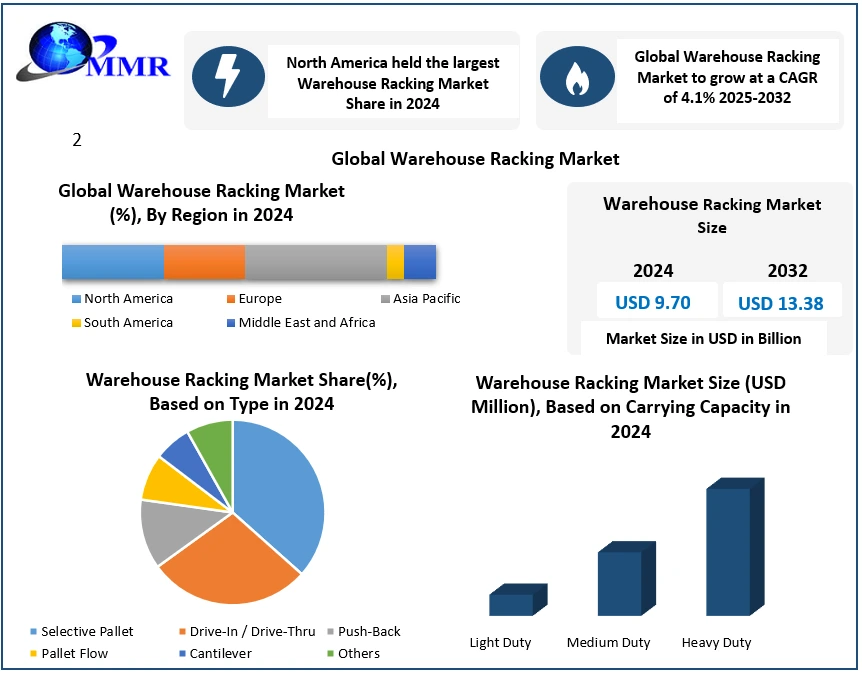
Global Warehouse Racking Market size was valued at USD 9.70 Bn in 2024, confirming racking as a substantial global capex category rather than a minor line item in logistics budgets.
Total market revenue is expected to grow by 4.1% from 2024 to 2032, reaching nearly USD 13.38 Bn, signaling steady structural demand driven by network expansion and modernization rather than short-term spikes.
Racking demand is closely linked to growth in FMCG, food & beverage, and e-commerce warehousing, where storage density, safety, and pick efficiency directly affect cost-to-serve and service levels.
The market covers a spectrum of solutions—selective pallet racks, high-density systems, and specialized formats for cold and ambient storage—giving operators multiple levers to tune capacity and productivity.
Why This Matters Now
A category growing from USD 9.70 Bn to almost USD 13.38 Bn at 4.1% through 2032 looks modest compared to headline tech, but it quietly decides who can ship on time, at cost, and at scale. Every racking decision sets the geometry of FMCG and food & beverage warehouses for a decade, locking in throughput, safety, and adaptability.
For C-suite executives, warehouse racking is no longer just a procurement task. It is a capital allocation question that touches network design, omnichannel strategy, and automation readiness. Under-invest and you choke growth with congestion and accidents; over-invest in the wrong systems and you freeze cash in inflexible assets just as demand and SKUs shift.
Market Overview
The Global Warehouse Racking Market size, valued at USD 9.70 Bn in 2024, is projected to reach nearly USD 13.38 Bn by 2032 at a 4.1% growth rate. This disciplined expansion reflects a blend of new warehouse builds, retrofits, and upgrades as FMCG and food & beverage players align infrastructure with changing demand patterns.
Racking systems form the structural backbone of warehousing, determining pallet positions, aisle design, and the interface with material-handling equipment and automation. As inventories grow and product mixes diversify, operators are increasingly forced to reconsider whether legacy selective pallet racks alone can support modern order profiles and service promises.
Key Trends Driving Growth
Network expansion and consolidation are central growth drivers. FMCG and food & beverage companies are either building new nodes to serve e-commerce and regional demand or consolidating older sites into modern hubs. Every move requires racking designed for specific volumes and service requirements.
SKU proliferation and packaging variety push warehouses toward more flexible and mixed racking solutions. Narrow assortments that once fit simple racks have given way to multi-temperature, multi-size portfolios. That complexity requires racking layouts built for both bulk storage and high-frequency picks.
Health, safety, and compliance pressures are rising. Regulators, insurers, and corporate safety teams scrutinize racking integrity, load ratings, and layout standards more than ever. That scrutiny converts deferred maintenance and ad hoc installations into formal, budgeted racking programs.
Sustainability enters via land and energy constraints. Companies want to increase storage density to avoid endless greenfield construction, and they want racking compatible with energy-efficient lighting, automation, and temperature management. Vertical space becomes an efficiency and ESG play.
E-commerce and direct-to-consumer models drive higher picking intensity and more frequent replenishments, especially in FMCG and food categories. Racking systems must support fast turns, multi-channel flows, and often separate B2B and B2C operations in the same building.
Request a Free Sample Copy or View Report Summary: https://www.maximizemarketresearch.com/request-sample/104726/
Segment Insights
Dominant Segment: Selective pallet racking in ambient warehouses – Traditional selective systems remain the largest installed base and revenue contributor, particularly in dry FMCG and general food storage. Their dominance means most operators still rely on aisle-accessible pallets for flexibility, despite density trade-offs.
Fastest-Growing Segment: High-density and automation-ready racking solutions – Systems designed for drive-in, shuttle, or automated handling are growing fastest as operators look to squeeze more capacity into existing footprints and prepare for robotics and AS/RS. This segment points to where future margin and competitive differentiation will sit.
Cold chain racking – Specialized racking for refrigerated and frozen environments is expanding as perishable and frozen categories grow. These installations demand tighter engineering and align closely with food & beverage strategies.
Light and medium-duty racking – Used for smaller loads, packaging materials, and e-commerce pick faces, these systems support high-frequency operations and are increasingly vital near fulfillment zones.
Regional Growth Story
Regional growth in warehouse racking tracks industrialization, retail modernization, and e-commerce penetration. Mature markets with established FMCG supply chains focus on retrofits and densification—upgrading old racks, adding levels, and integrating automation into existing footprints.
Emerging markets see more greenfield build-out. As modern trade, organized food distribution, and third-party logistics expand, new warehouses come online with racking decisions built into design rather than added after the fact. These decisions set the baseline for how efficiently fast-growing markets will move goods.
Regions with strong e-commerce growth, especially in consumables, experience a dual effect: more urban or near-urban fulfillment centers with lighter, more flexible racking, and larger regional hubs handling bulk inbound flows. Both layers require different racking strategies, increasing complexity for global operators.
Competitive Landscape
The competitive field includes global racking manufacturers, regional fabricators, integrated intralogistics providers, and design-build firms. Larger players offer complete solutions—from design and engineering to installation and often integration with automation systems—making them attractive to FMCG giants seeking standardization across networks.
Regional and mid-sized manufacturers compete on cost, lead times, and customization, tailoring racks to local building codes, product mixes, and operator preferences. Their proximity and flexibility help them win projects where global providers are perceived as slower or more expensive.
Integrated intralogistics firms bring racking into broader solutions that include conveyors, shuttles, robotics, and software. For them, racking is one component of a system sale, signaling that competitive advantage is migrating from metal alone to how that metal interacts with automation.
Over the next 12–24 months, competitive moves will likely center on capacity investments, regional expansion, and partnerships with automation vendors. Players that can prove racking compatibility with robotics, shuttles, and AS/RS will be in a stronger position as FMCG warehouses digitize and mechanize.
Recent Developments
Roll-out of denser, shuttle-ready racking solutions in large FMCG and food distribution centers, designed to boost pallet counts without expanding footprints.
Projects focused on cold-storage racking upgrades, aligning freezer and chiller capacity with rising demand for frozen and chilled foods.
Increased bundling of racking with warehouse design services and automation, simplifying procurement but raising the stakes on vendor choice.
Growing emphasis on racking systems that can be reconfigured or expanded as networks and product mixes evolve, reflecting a move away from single-purpose designs.
Strategic Implications
For FMCG and food & beverage leaders, warehouse racking is a structural constraint and opportunity. The 4.1% growth rate through 2032 means capex will continue, but the key question is whether investments support future omnichannel and automation goals or merely replicate past layouts.
Network strategy teams must treat racking design as a core element of supply chain planning. Decisions on selective versus high-density racking, cold versus ambient capacity, and automation-ready systems determine what is possible in inventory and service strategy.
Finance and operations should collaborate to shift from lowest-cost racking procurement to total cost of ownership analysis. Better-designed racks may reduce accidents, improve picks per hour, and enable automation, paying back faster than basic systems that appear cheaper upfront.
Sustainability and real estate pressures suggest vertical optimization and footprint discipline will matter more. Companies that can stack more safely and smartly within existing sites avoid costly new builds and improve energy efficiency per unit stored.
Future Outlook
By 2032, with the Global Warehouse Racking Market expected to reach nearly USD 13.38 Bn, racking will be more tightly integrated with automation, data, and ESG goals. Operators that design warehouses as configurable platforms—where racking can evolve with SKUs and channels—will have a structural advantage.
E-commerce growth and SKU complexity will continue to push logistics toward mixed-use facilities, requiring racking that can serve bulk storage, case picking, and piece picking simultaneously. Automation will spread, and racking compatibility with new technologies will become a core selection criterion.
The high-stakes conclusion is straightforward: winners will be the FMCG and food & beverage companies that treat warehouse racking as strategic infrastructure for speed, safety, and flexibility, while losers will keep bolting cheap steel into old layouts and wonder why their logistics costs and service failures keep climbing.
Related Reports
Global Compostable Packaging Materials Market https://www.maximizemarketresearch.com/market-report/global-compostable-packaging-materials-market/87381/
Global Hermetic Laser Packaging Market https://www.maximizemarketresearch.com/market-report/global-hermetic-laser-packaging-market/102413/
Analyst Perspective
“Between 2024 and 2032, warehouse racking shifts from static steel to strategic infrastructure; a market rising from USD 9.70 Bn to nearly USD 13.38 Bn at 4.1% growth will reward only those FMCG and food & beverage players that turn density, safety, and automation readiness into hard, defensible logistics advantage,” said Siddhi Dole, Analyst.
About Maximize Market Research
Maximize Market Research Pvt. Ltd. (MMR) is a global market research and consulting company that provides reliable, data-focused, and practical business insights. The firm serves a wide range of industries, including healthcare, pharmaceuticals, technology, automotive, electronics, chemicals, personal care, and consumer goods. Through market forecasts, competitive analysis, strategic consulting, and industry impact assessments, MMR helps organizations understand changing market conditions, identify growth opportunities, and make informed business decisions for long-term success.
2nd Floor, Navale IT Park Phase 3
Pune Banglore Highway, Narhe
Pune, Maharashtra 411041, India
+91 9607365656
sales@maximizemarketresearch.com
