Key Highlights
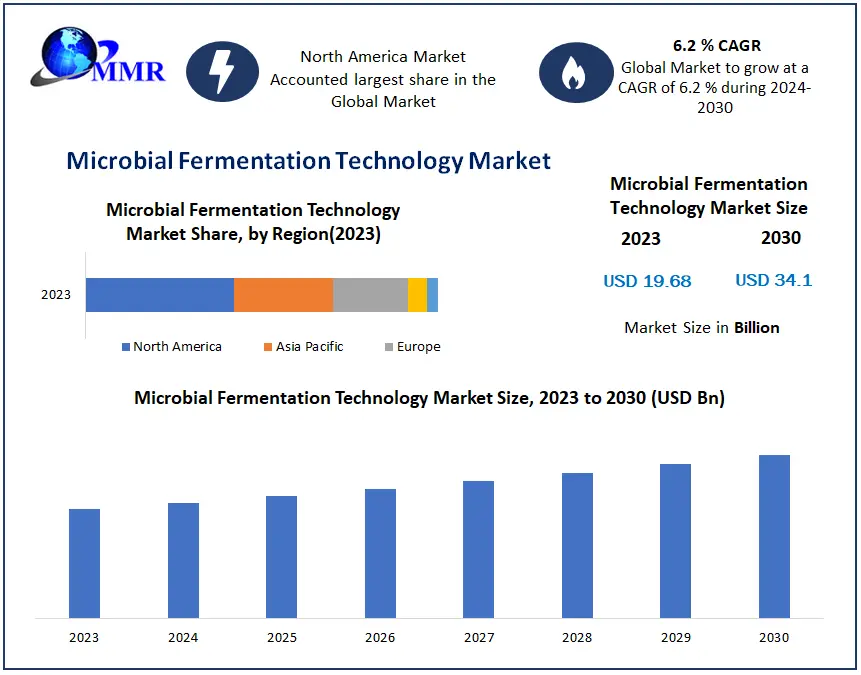
Microbial Fermentation Technology Market size was valued at USD 19.68 Billion in 2023. This confirms fermentation as a major global industrial platform, not just a niche production method.
Market revenue is expected to reach USD 34.1 Billion by 2030 at a 6.2% CAGR, signaling robust, technology-led growth that will reshape production economics across food, beverage, pharma, and biotech.
Fermentation already supports critical outputs—enzymes, organic acids, vitamins, flavors, probiotics—and its growth strengthens the role of bio-based processes in FMCG and food & beverage innovation.
Capex and partnership decisions in microbial fermentation now directly influence future product pipelines, cost structures, and sustainability claims.
Why This Matters Now
A market scaling from USD 19.68 Billion to USD 34.1 Billion at 6.2% CAGR is not back-office engineering; it is the hardware and know-how behind the next generation of food and beverage products. Every investment in fermentation capacity and capability determines who can launch new bio-based SKUs first and at scale.
For C-suite executives in FMCG and food & beverage, microbial fermentation technology sits at the intersection of innovation, cost, and ESG. It drives everything from alternative proteins and functional ingredients to shelf-life solutions and flavor compounds. The strategic choice is stark: treat fermentation as outsourced utility, or build it into the core of the company’s future product engine.
Market Overview
The Microbial Fermentation Technology Market size, at USD 19.68 Billion in 2023 and heading to USD 34.1 Billion by 2030, is growing in line with the broader shift toward biotechnology-driven manufacturing. A 6.2% CAGR in a capital-intensive field signals persistent demand for scalable, reliable bioprocesses.
Fermentation technology spans upstream activities (strain selection, media design, bioreactor engineering) and downstream operations (purification, formulation). Output ranges from traditional products such as antibiotics and vitamins to newer categories like functional food ingredients and high-value specialty compounds. For food and beverage companies, this infrastructure is increasingly the route to differentiated, stable, and sustainable ingredients.
Key Trends Driving Growth
Demand for high-purity, consistent functional ingredients is a central driver. Fermentation offers reproducible production of enzymes, organic acids, flavors, and nutraceutical actives, reducing reliance on inconsistent agricultural or petrochemical inputs. This makes supply chains more predictable and regulatory compliance more manageable.
Health and wellness trends in food and beverage amplify the role of fermentation. Probiotic cultures, fermented functional ingredients, and bioactive compounds are used to build products with tangible benefits—digestion, immunity, energy. Fermentation technology is the production backbone for these claims.
Clean-label expectations favor ingredients with natural or fermentation-based origins over synthetic analogues. Microbial fermentation allows companies to produce “fermentation-derived” ingredients that fit clean-label narratives while maintaining performance in processing and sensory profiles.
Sustainability pressures push companies toward lower-footprint production methods. Fermentation can, in many cases, reduce land use, chemical inputs, and waste compared to traditional extraction or chemical synthesis. As ESG reporting intensifies, fermentation capacity becomes part of the sustainability toolkit.
Digitalization of bioprocessing—better sensors, process control, and data models—improves yields and reliability. This reduces costs and risk, making fermentation-based solutions more competitive versus incumbent methods, especially in high-value applications.
Request a Free Sample Copy or View Report Summary: https://www.maximizemarketresearch.com/request-sample/3779/
Segment Insights
Dominant Segment: Pharmaceutical and high-value industrial fermentation – Production of antibiotics, vaccines, and industrial enzymes currently accounts for the largest share of fermentation revenues. For FMCG and food & beverage leaders, this dominance signals that capacity is anchored in strict regulatory and quality environments that can be repurposed for food-grade ingredients.
Fastest-Growing Segment: Food, beverage, and nutraceutical fermentation applications – Fermented ingredients and cultures targeting functional foods, beverages, and dietary supplements are expected to grow fastest as consumer health and clean-label demands rise. This segment shows where new revenue pools are forming for FMCG-aligned fermentation players.
Bulk metabolites and organic acids – Used in food preservation, acidity control, and flavor enhancement, these products leverage fermentation’s scalability and consistency to support large supply contracts.
Specialty molecules and bioactives – Targeted compounds for niche health applications and high-value formulations offer strong margins, but demand advanced strain engineering and purification capabilities.
Regional Growth Story
Regional dynamics in microbial fermentation technology reflect industrial maturity, biotech ecosystems, and regulatory frameworks. Markets with strong pharma and biotech industries house large fermentation capacities that can be extended into food and beverage ingredients.
Emerging economies investing in biomanufacturing and bioeconomy initiatives are building new fermentation facilities and clusters. These sites can become important suppliers of fermentation-based food ingredients, especially as local FMCG players look for competitive, regional sourcing.
Regulatory regimes shape the pace of food and beverage applications. Regions with clear rules on fermentation-derived ingredients and strong safety oversight enable faster scaling of novel products. Where regulations lag or are fragmented, fermentation adoption in consumer products proceeds more cautiously.
Competitive Landscape
The competitive field combines large biopharmaceutical and industrial biotech companies, specialized fermentation CDMOs (contract development and manufacturing organizations), ingredient suppliers, and increasingly food-focused fermentation startups.
Large incumbents leverage existing bioreactor fleets, quality systems, and process expertise to supply or co-develop fermentation-based ingredients. Their advantage lies in scale and regulatory track record, but they must adapt to the different economics and speed of FMCG innovation.
Specialized fermentation service providers offer development and production capacity to brands that do not own fermenters. For food & beverage companies, partnering with these players can accelerate entry into fermentation-based products without heavy upfront capex.
Ingredient companies use fermentation to differentiate their portfolios with stable, high-performance, and often proprietary compounds. Their success signals where value is migrating: away from commoditized raw materials toward tailored, fermentation-derived solutions.
Over the next 12–24 months, competitive moves will likely center on capacity expansions, co-development agreements between biotech and FMCG firms, and acquisitions of niche fermentation technology specialists. Each deal will indicate which application spaces—functional foods, flavors, alternative proteins—are expected to deliver the next wave of growth.
Recent Developments
Investments in new fermentation lines and bioreactor farms designed to serve both pharmaceutical and food-grade applications, enhancing flexibility of asset use.
Co-innovation projects between ingredient suppliers and food & beverage brands to develop fermentation-derived flavors, textures, and functional compounds.
Rising interest from FMCG players in contract fermentation partnerships for pilot and scale-up phases of new product pipelines.
Continuous improvements in process control and analytics to reduce variability and improve yields, making fermentation more economically attractive for wider ingredient applications.
Strategic Implications
For FMCG and food & beverage leaders, microbial fermentation technology is now a strategic capability, not just a supplier attribute. The 6.2% CAGR to 2030 signals that companies investing early in fermentation partnerships, assets, or IP will have more options for future product development.
Executives must decide whether to build proprietary fermentation capacity, rely on partners, or pursue hybrid models. Owning the capability can secure supply and protect IP; partnering can reduce capital load and accelerate access to diverse technologies.
R&D and innovation teams need to treat fermentation as a core path to new products—functional ingredients, alternative proteins, novel flavors—not an exotic backup option. This may mean recruiting fermentation scientists, process engineers, and regulatory specialists into consumer-centric organizations.
Supply chain and ESG teams should quantify the sustainability and resilience benefits of fermentation versus existing sourcing approaches. Where fermentation reduces environmental impact and supply volatility, it becomes a compelling lever for both brand narrative and risk management.
Future Outlook
By 2030, with Microbial Fermentation Technology Market revenue expected to reach USD 34.1 Billion, fermentation will be more deeply embedded across ingredient and product architectures in food and beverage. The category’s growth will be shaped by how effectively companies translate bioprocess capabilities into consumer-perceived value—better health, better taste, better planet.
Regulatory scrutiny and consumer expectations will tighten around safety, transparency, and sustainability of fermentation-derived ingredients. Companies that invest in clear communication, robust data, and responsible sourcing will be better positioned to lead.
The high-stakes outcome is clear: winners will be the FMCG and food & beverage players that treat microbial fermentation technology as a strategic engine for innovation, resilience, and ESG performance, while losers will keep seeing it as a technical detail in a market that is growing and quietly rewriting the rules of how food is made.
Related Reports
PLA Cup Market https://www.maximizemarketresearch.com/market-report/pla-cup-market/146528/
Global Food Processing Blades Market https://www.maximizemarketresearch.com/market-report/global-food-processing-blades-market/77786/
Analyst Perspective
“From 2023 to 2030, microbial fermentation technology moves from invisible infrastructure to a visible competitive weapon; a market rising from USD 19.68 Billion to USD 34.1 Billion at 6.2% CAGR will reward only those companies that turn bioprocess capabilities into differentiated food and beverage offerings, not just compliant ingredients,” said Siddhi Dole, Analyst.
About Maximize Market Research
Maximize Market Research Pvt. Ltd. (MMR) is a global market research and consulting company that provides reliable, data-focused, and practical business insights. The firm serves a wide range of industries, including healthcare, pharmaceuticals, technology, automotive, electronics, chemicals, personal care, and consumer goods. Through market forecasts, competitive analysis, strategic consulting, and industry impact assessments, MMR helps organizations understand changing market conditions, identify growth opportunities, and make informed business decisions for long-term success.
2nd Floor, Navale IT Park Phase 3
Pune Banglore Highway, Narhe
Pune, Maharashtra 411041, India
+91 9607365656
sales@maximizemarketresearch.com
