Key Highlights
- AI-enabled optical sorting is turning factory quality control into a real-time machine-vision stack. For electronics suppliers, the market creates demand for cameras, lasers, sensors, hyperspectral imaging, NIR systems and software-driven intelligence rather than basic mechanical separation.
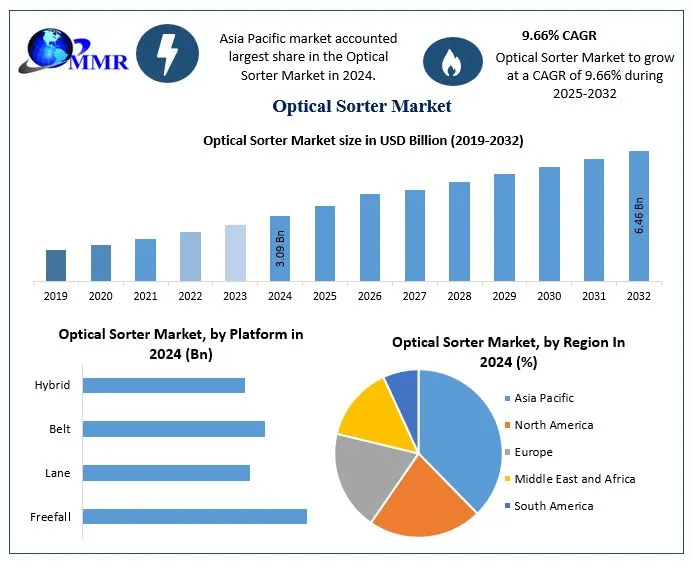
- The Optical Sorter Market was valued at USD 3.09 Bn in 2024 and is expected to reach nearly USD 6.46 Bn by 2032, giving automation vendors a clear industrial growth cycle.
- The market is forecast to grow at a 9.66% CAGR from 2025 to 2032, supported by food safety rules, labor-cost pressure, recycling automation and mining-sector sensor adoption.
- Food industry contributes the major market share because processors need contamination control, traceability and quality inspection across grains, nuts, coffee, fruit, meat and seafood.
- Hyperspectral cameras are expected to grow at an 11.45% CAGR by 2032, making advanced imaging the clearest disclosed high-growth product signal.
Why This Matters Now
Optical sorting is becoming an AI inspection layer for industrial supply chains. Food processors, recycling plants and mining operators are using cameras, lasers, sensors and image-processing intelligence to reduce waste, lift throughput and replace manual inspection with automated decisions.
The semiconductor connection is indirect but practical. The public MMR page does not disclose AI chip demand, HPC trends, foundry investments, advanced packaging, chiplets, HBM, memory or logic chip trends, but it does disclose AI-based sorting, hyperspectral and multispectral imaging, NIR detection, cameras, lasers and sensors.
Market Overview
An optical sorter is an automated system that sorts solid products using cameras, lasers or sensors with software-driven image processing. It identifies color, size, shape, structural properties and chemical composition, giving industrial users faster inspection and separation than manual sorting.
The Optical Sorter Market is segmented by product type into lasers, NIR sorters, cameras, hyperspectral cameras and combined sorters. Platforms include freefall, lane, belt and hybrid systems, while applications include recycling, mining, food and others.
The public page has a visible header inconsistency. The top panel lists USD 3.09 Bn as forecast market size, while the overview and scope table state USD 3.09 Bn in 2024 and USD 6.46 Bn by 2032; this article uses the overview and scope-table values because they match the supplied market-size statement.
Key Trends Driving Growth
Food safety is the first growth driver. MMR states that government and regulatory initiatives for strict food-quality standards are increasing demand for optical sorters, while traceability systems monitor food at processing, production and distribution stages.
Productivity is the second driver. Optical sorting reduces delivery and processing time, improves product quality, maximizes throughput over manual sorting and helps companies remove inferior-quality materials from production lines.
Recycling is adding another automation lane. Optical sorting technology supports clean commodity recovery, higher throughput and lower labor costs, while rising industrial-waste recovery is pushing adoption in waste recycling plants.
Mining is becoming a sensor-based sorting opportunity. NIR detection and infrared imaging help scan chemical and biological mineral composition, improving reliability and accuracy in mineral sorting procedures.
Request a Free Sample Report for Comprehensive Market Insights
Segment Insights
- Dominant Segment Food Application: Food industry contributes the major share in the market. Demand comes from food safety systems, contamination reduction, traceability and sorting requirements across agricultural seeds, grains, nuts, coffee, confectionery, fruit, meat and seafood.
- Dominant Platform Freefall: Optical sorters for freefall platforms are expected to hold the dominant position during the forecast period, with freefall-based systems identified as most suitable for foods.
- Fastest-Growing Segment Hyperspectral Cameras: Hyperspectral cameras are expected to grow at an 11.45% CAGR by 2032. Their growth is tied to sorting tasks that traditional systems could not solve and to rising use in quality control, sorting and recycling.
- Technology Signal AI-Based Sorting: Asia Pacific companies are developing AI-based sorting technology to provide more intelligent industrial solutions with analytics, monitoring and process automation.
- Product Scope Lasers, NIR, Cameras and Combined Sorters: The page covers all product groups, but share by product type is not disclosed.
Regional Growth Story
Asia Pacific is projected to lead the global Optical Sorter Market. Growth is driven by adoption of intelligent solutions, fast digitalization and integration of AI technology into equipment for analytics, monitoring and process automation.
The Asia Pacific scope includes China, South Korea, Japan, India, Australia, Indonesia, Malaysia, Vietnam, Taiwan, Bangladesh and Pakistan. The public page does not disclose country-level revenues, export data, semiconductor incentives, electronics manufacturing activity or chip supply-chain metrics for these markets.
North America covers the United States, Canada and Mexico, while Europe covers the UK, France, Germany, Italy, Spain, Sweden, Austria and the rest of Europe. These regions are included in the report scope, but the public page does not provide regional revenue shares beyond Asia Pacific leadership.
Competitive Landscape
Key players include Buhler, BINDER+CO, Tomra, Key Technology, Allgaier Werke, Satake, CP Manufacturing, Cimbria, Greefa, Pellenc ST, Newtec, National Recovery Technologies, Raytec Vision, Steinert, Sesotec, Machinex, Aweta, Unitec and Hefei Taihe Intelligent Technology Group.
Competition is shifting from standalone sorting equipment to integrated automation. MMR states that companies are using mergers, acquisitions, collaborations, expansion and diversification, while some players partner with other companies to develop innovative solutions.
Machinex’s partnership with RDT Engineering, Re. Group and SRWRA to integrate automation in the MRF signals where the market is heading. Sorting vendors are moving closer to full materials-recovery workflows where sensors, software, robotics and throughput economics decide technology leadership.
No fab investment, advanced-packaging breakthrough, chiplet roadmap, HBM development, chip manufacturing capacity expansion or semiconductor R&D initiative is disclosed. The visible competitive direction is AI-based sorting, hyperspectral imaging, recycling automation, NIR detection and application-specific machine vision.
Recent Developments
- Machinex Automation Partnerships: Machinex partnered with RDT Engineering, Re. Group and SRWRA to integrate automation processes in the MRF, signaling stronger demand for intelligent recycling workflows.
- Hyperspectral Camera Growth: Hyperspectral cameras are expected to grow at an 11.45% CAGR by 2032 as manufacturers develop systems with hyperspectral and multispectral imaging.
- AI Sorting in Asia Pacific: Companies in Asia Pacific are developing AI-based sorting technology for analytics, monitoring and automated industrial operations.
- No Named Semiconductor Deals Disclosed: The public page does not disclose fab investments, chip-capacity expansions, advanced-packaging developments or semiconductor partnerships.
Strategic Implications
For electronics and sensor suppliers, optical sorting is a machine-vision demand market. Cameras, lasers, NIR modules, hyperspectral systems, sensors and image-processing software are the core technology stack.
For food processors, the business case is quality assurance and compliance. Optical sorters help reduce contamination risk, increase food safety on production lines and separate inferior-quality materials before they reach customers.
For recyclers and mining operators, the value is throughput and resource recovery. Automated optical sorting can reduce labor dependency, recover cleaner commodities and improve mineral separation accuracy.
Future Outlook
The Optical Sorter Market is forecast to grow from USD 3.09 Bn in 2024 to nearly USD 6.46 Bn by 2032 at a 9.66% CAGR. Growth will come from food safety, recycling automation, mining sensor-based sorting, AI-based analytics, NIR detection, hyperspectral imaging and freefall food-sorting platforms.
The next phase will test whether suppliers can combine optical hardware, AI software and application engineering into reliable industrial decision systems. Future technology leaders will control the machine-vision sorting layer behind safer food, cleaner recycling and smarter mining; laggards will remain trapped selling mechanical sorting equipment into markets moving toward sensor-driven automation.
Analyst Perspective
“Optical sorters are becoming intelligent industrial inspection systems as food processors, recyclers and mining operators demand higher throughput, better quality control and lower labor dependency,” said Rucha Deshpande, Analyst at Maximize Market Research. “The strongest suppliers will combine sensors, cameras, NIR detection, hyperspectral imaging, AI analytics and application-specific automation.”
About Maximize Market Research
Maximize Market Research Pvt. Ltd. (MMR) is a global market research and consulting company that provides reliable, data-focused, and practical business insights. The firm serves a wide range of industries, including healthcare, pharmaceuticals, technology, automotive, electronics, chemicals, personal care, and consumer goods. Through market forecasts, competitive analysis, strategic consulting, and industry impact assessments, MMR helps organizations understand changing market conditions, identify growth opportunities, and make informed business decisions for long-term success.
Contact Us
2nd Floor, Navale IT Park Phase 3
Pune Banglore Highway, Narhe
Pune, Maharashtra 411041, India
+91 9607365656
sales@maximizemarketresearch.com
