Key Highlights
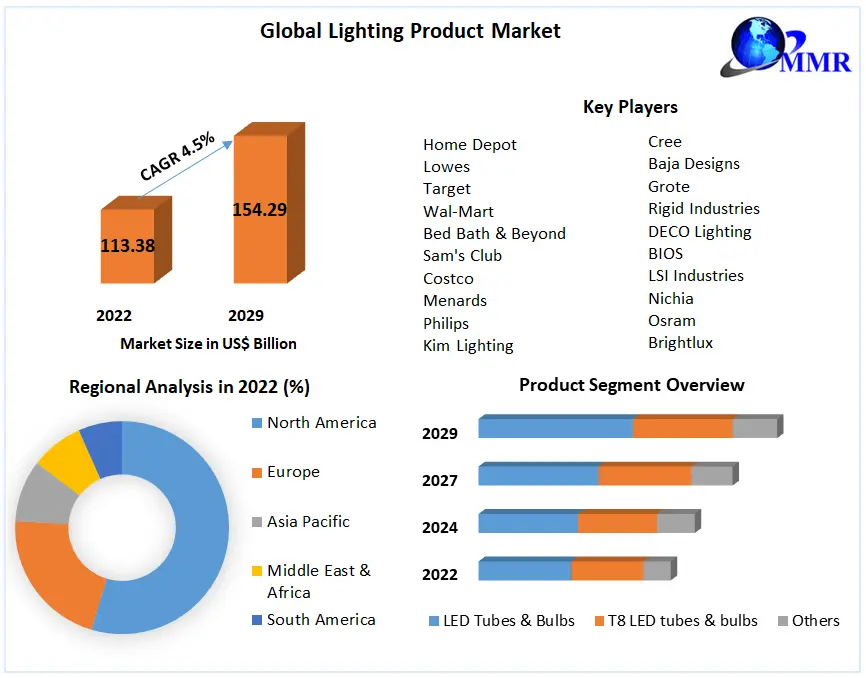
- Lighting has become a semiconductor-linked infrastructure market as LEDs, IoT controls and smart-city systems move illumination from simple hardware to connected energy management. The Lighting Product Market was valued at USD 132.97 Bn in 2024 and is expected to reach USD 179.47 Bn by 2032, creating a broad opportunity for LED suppliers, lighting OEMs, fixture makers and smart-building technology vendors.
- The market is forecast to grow at a 3.82% CAGR from 2025 to 2032, making it a slower but large-scale electronics market driven by efficiency, regulation, infrastructure and urbanization.
- Asia Pacific dominated in 2024, supported by infrastructure projects, demand for LED lighting, regional energy-saving initiatives and construction activity in China, Japan and India.
- Ceiling fixtures are expected to hold the largest fixture share by 2030, giving interior lighting suppliers a strong disclosed segment opportunity.
- LED tubes and bulbs are expected to grow rapidly because some governments restrict inefficient bulbs and promote energy-efficient replacements.
Why This Matters Now
The lighting market is moving from replacement bulbs to connected lighting platforms. LEDs, sensors, wireless control and data analytics are turning buildings, streets and vehicles into managed illumination networks.
For electronics and semiconductor executives, the disclosed opportunity sits in LED systems, smart controls, IoT integration, flexible LED foils, Li-Fi, micro-LEDs and OLEDs. The public MMR page does not disclose AI chip demand, high-performance computing, foundry investments, advanced packaging, chiplets, HBM, memory or logic chip trends, or chip manufacturing capacity expansion.
Market Overview
Lighting products include LED tubes and bulbs, T8 LED tubes and bulbs, incandescent lamps, high-intensity discharge systems, ceiling fixtures, recessed lighting fixtures, strip light fixtures, chandeliers, pendants and other lighting products. Applications include residential lighting, table lamps, floor lamps, desk lamps, commercial lighting, industrial lighting and outdoor lighting such as street lights, parking garages and landscape lighting.
LEDs are central to the market because they provide high light output while consuming very little power. MMR identifies technological advancement in LED and smart lighting, government incentives, environmental awareness, urbanization, infrastructure projects, lower LED costs, renewable-energy integration and lighting controls as major growth drivers.
The market’s investment logic is clear. Large installed lighting bases are shifting toward products that save energy, support remote control, meet green-building standards and reduce operational cost.
Key Trends Driving Growth
LED technology is the primary growth driver. MMR states that LEDs have improved in efficiency, longevity and cost-effectiveness, making them preferred across residential, commercial and industrial applications.
Smart lighting is the second driver. Integration with IoT devices allows remote control, energy savings and user convenience, while smart LED streetlights use IoT sensors to collect data for urban planning, air-quality monitoring, traffic flow and security.
Smart-city investment adds another demand layer. MMR cites the U.S. Department of Energy’s plan to invest almost USD 10 Mn to support smart, energy-efficient and low-emission cities using smart-city technologies, creating policy support for advanced lighting deployments.
Lighting innovation is broadening beyond efficiency. MMR lists new DC LED chips that eliminate external drivers, dynamic beam spread systems, flexible in-molded LED foils with printed electronics, Li-Fi data transmission, automotive LED expansion, quantum dots, micro-LEDs and OLEDs as technology developments.
High upfront cost remains the main restraint. LED and smart lighting systems require higher initial investment than traditional incandescent or fluorescent bulbs, which can slow adoption among residential consumers, businesses and public infrastructure projects with limited budgets.
Download an Industry-Focused Sample Report Today
Segment Insights
- Dominant Segment Ceiling Fixtures: Ceiling fixtures are expected to hold the largest lighting fixture share by 2030. Their lead is linked to widespread use in households, hospitals, corporate offices, retail malls and educational institutions.
- Fastest-Growing Segment: LED tubes and bulbs are expected to grow rapidly, and other fixtures such as chandeliers and pendants are also expected to grow rapidly, but exact CAGRs are shown as “xx%.” No precise fastest-growing segment is inferred.
- High-Growth Product Signal LED Tubes and Bulbs: LED tubes and bulbs are supported by regulations restricting inefficient bulbs and encouraging replacement with energy-efficient alternatives.
- Technology Signal Smart LEDs: Smart LED systems support remote control, device integration and energy savings, making them central to smart homes, smart buildings and smart-city infrastructure.
- End-Use Scope Residential, Commercial and Industrial: The report covers all three end uses, but public segment-level values and rankings are not disclosed.
Regional Growth Story
Asia Pacific dominated the Lighting Product Market in 2024. Growth is driven by infrastructure projects in emerging markets, demand for LED lighting solutions and energy-saving initiatives by regional governments.
China, Japan and India are identified as key economies where construction activity contributes to regional market growth. The presence of manufacturers focused on launching new products also strengthens the region’s lighting industry.
The United States shows a strong efficiency case. MMR states that LED lighting could save 190 terawatt hours of electricity each year by 2030, equal to USD 15 Bn in energy costs; that translates lighting upgrades into a cost-reduction and energy-policy opportunity.
MMR also states that 58% of Americans prefer LED bulbs over other lighting types and that residential lighting holds 71% of total U.S. lamp inventory. That makes residential replacement demand a major installed-base opportunity in the U.S. market.
The report covers Europe, including the UK, France, Germany, Italy, Spain, Sweden, Austria, Turkey and Russia, and Asia Pacific, including China, India, Japan, South Korea, Australia and ASEAN. Country-level revenues, semiconductor incentives, export dynamics, fabrication investments and component supply-chain metrics are not disclosed.
Competitive Landscape
Key players include Home Depot, Lowe’s, Target, Walmart, Bed Bath & Beyond, Sam’s Club, Costco, Menards, Kim Lighting, Innovative Lighting, Cree, Baja Designs, Grote, Rigid Industries, DECO Lighting, BIOS, LSI Industries, Nichia, Osram, Brightlux and Everlight. The list shows a market split between retailers, fixture suppliers, automotive lighting companies and LED component manufacturers.
Retailers control access to residential buyers and replacement demand. LED and fixture manufacturers compete on efficiency, design, reliability, light quality, smart controls and product cost.
Nichia, Osram, Brightlux and Everlight signal the component and LED manufacturing side of competition. Cree, LSI Industries and specialist U.S. lighting firms signal product and fixture differentiation in commercial, industrial and outdoor lighting.
No named acquisitions, partnerships, fab investments, advanced-packaging breakthroughs, chip capacity expansions or semiconductor R&D initiatives are disclosed on the public page. The visible competitive direction is LED efficiency, smart integration, flexible form factors, automotive lighting, Li-Fi and smart-city deployment.
Recent Developments
- Driverless DC LED Chips: New DC LED chips can handle power requirements directly, reducing the need for external circuit board drivers and enabling more compact packaging.
- Flexible LED Foils: A roll-to-roll process developed in Finland enables flexible in-molded LED foils with printed electronics, reducing manufacturing costs for flexible LED displays.
- Li-Fi Commercialization: Li-Fi uses modulated LED light for high-rate data transmission and is positioned for home and architectural networks.
- Automotive LED Expansion: LEDs are now widely used across car lines for rear, forward and interior lighting, improving styling, passenger safety and long life.
Strategic Implications
For semiconductor and electronics suppliers, lighting remains a volume market linked to LED chips, printed electronics, smart controls, sensors and wireless communication. The public source does not quantify chip content, so the opportunity should be read as product-level electronics demand rather than disclosed wafer demand.
For city planners and infrastructure operators, smart lighting can lower energy use, improve reliability and add sensing infrastructure for traffic, air quality and security. That turns street lighting from a utility cost into a data and safety platform.
For investors, the market offers exposure to LED replacement, smart homes, commercial retrofits, green buildings, smart cities, Li-Fi, automotive LEDs, micro-LEDs and OLEDs. The key risk is adoption friction from upfront cost, especially where financing or subsidies are limited.
Future Outlook
The Lighting Product Market is forecast to grow from USD 132.97 Bn in 2024 to nearly USD 179.47 Bn by 2032 at a 3.82% CAGR. Growth will come from LED efficiency, smart lighting, IoT controls, energy regulations, infrastructure projects, smart cities, automotive lighting, flexible LED foils, Li-Fi, micro-LEDs and OLEDs.
The next phase will test whether suppliers can combine efficient light output, embedded intelligence, low-cost manufacturing and connected controls at scale. Future technology leaders will control the smart lighting layer behind buildings, vehicles and cities; laggards will remain tied to commodity fixtures in a market moving toward intelligent, semiconductor-enabled illumination.
Analyst Perspective
“Lighting products are becoming connected electronics systems as LED technology, IoT controls, smart-city infrastructure and energy-efficiency programs reshape demand,” said Rucha Deshpande, Analyst at Maximize Market Research. “The strongest suppliers will combine LED performance, smart controls, design flexibility, cost discipline and regional distribution reach.”
About Maximize Market Research
Maximize Market Research Pvt. Ltd. (MMR) is a global market research and consulting company that provides reliable, data-focused, and practical business insights. The firm serves a wide range of industries, including healthcare, pharmaceuticals, technology, automotive, electronics, chemicals, personal care, and consumer goods. Through market forecasts, competitive analysis, strategic consulting, and industry impact assessments, MMR helps organizations understand changing market conditions, identify growth opportunities, and make informed business decisions for long-term success.
Contact Us
2nd Floor, Navale IT Park Phase 3
Pune Banglore Highway, Narhe
Pune, Maharashtra 411041, India
+91 9607365656
sales@maximizemarketresearch.com
