Key Highlights
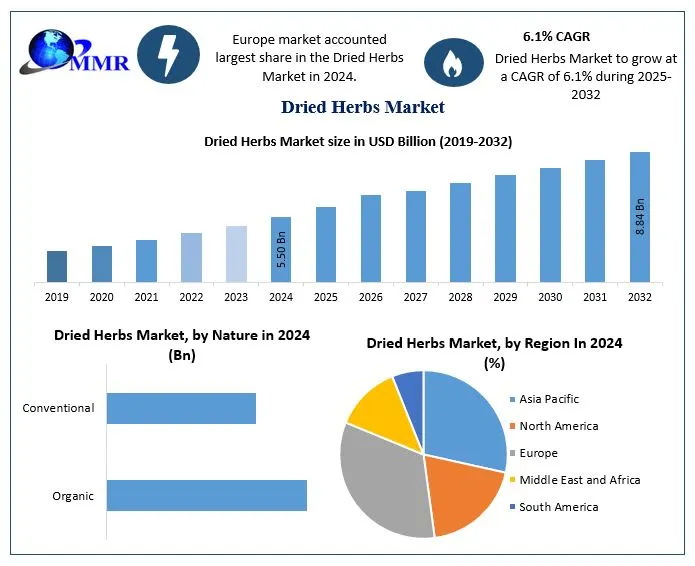
The Dried Herbs Market size was valued at USD 5.50 Billion in 2024, confirming herbs as a sizeable global ingredient category rather than a minor seasoning niche.
Total dried herbs revenue is expected to grow at a CAGR of 6.1% from 2025 to 2032, reaching nearly USD 8.84 Billion, signaling steady, demand-led expansion.
Growth is driven by rising use of herbs in food, beverage, and wellness products for flavor, aroma, and perceived health benefits with long shelf life.
Dried herbs now sit at the intersection of taste, health positioning, and clean-label reformulation, directly influencing product design and manufacturing economics.
Why This Matters Now
A category rising from USD 5.50 Billion to around USD 8.84 Billion at 6.1% CAGR is no longer just a cost line in the seasoning budget; it is a strategic field where flavor, wellness, and brand trust converge. Every herb decision—type, origin, format—now affects how convincingly a product can claim “natural,” “flavorful,” and “better for you.”
For C-suite executives, dried herbs compress several strategic questions into one ingredient platform: how far to move away from synthetic flavors, how to embed health cues without tipping into medicinal territory, and how to use herbs to differentiate mainstream SKUs. Treat them as low-cost commodities and you concede flavor and health territory to competitors who treat them as branded assets.
Market Overview
The Global Dried Herbs Market size, valued at USD 5.50 Billion in 2024 and forecast to reach nearly USD 8.84 Billion by 2032 at a 6.1% CAGR, is in a solid growth phase. This trajectory reflects broadening use of herbs across prepared foods, snacks, sauces, beverages, and wellness products, far beyond traditional home cooking.
Dried herbs offer concentrated flavor, aroma, and perceived health benefits with extended shelf life and logistics-friendly formats. For FMCG and food & beverage manufacturers, they provide controlled, repeatable flavor systems that can be scaled across factories and markets. This makes herbs both a creative tool for product developers and a risk variable for procurement.
Key Trends Driving Growth
Health-conscious consumers increasingly favor natural flavoring and seasoning over artificial additives. Dried herbs fit this shift: they provide recognizable, plant-derived ingredients that can be highlighted on front-of-pack and ingredient lists.
Clean-label demand pushes formulators away from “E-number” flavor enhancers and toward herbs and spices that can carry taste, aroma, and color. A move from “flavorings” to named herbs like basil, oregano, thyme, and rosemary is not just cosmetic; it changes how retailers and regulators view the product.
Herbs are also linked with wellness narratives—digestive support, antioxidant content, perceived anti-inflammatory benefits—even when the product is not formally positioned as medicinal. This allows brands to sit closer to the health continuum without crossing regulatory lines.
Lifestyle shifts toward home cooking, meal kits, and convenient but “authentic” flavors support herb usage across retail and industrial channels. Consumers using herbs at home become more receptive to herb-forward flavors in packaged foods, creating a feedback loop between domestic and commercial kitchens.
E-commerce penetration in food, seasoning, and wellness products opens direct channels for herb-based blends and premium ingredient propositions. For manufacturers, this signals where future flavor trends are forming before they show up in supermarket planograms.
Request a Free Sample Copy or View Report Summary: https://www.maximizemarketresearch.com/request-sample/32978/
Segment Insights
Dominant Segment: Food & beverage applications of dried herbs – Herbs used in prepared foods, snacks, sauces, soups, ready meals, and beverages account for the largest share of demand. Their dominance means category strategies in these applications drive pricing, supply requirements, and innovation focus.
Fastest-Growing Segment: Herb blends and value-added herb products for health and convenience – Blended herbs, infused seasonings, and herb-based functional mixes are rising fastest as brands build distinctive flavor signatures and health cues into easy-to-use formats. This segment shows where margin and brand equity concentrate.
Single-herb products – Core herbs like basil, oregano, thyme, parsley, and rosemary remain staples, anchoring classic profiles in snacks, bakery, and sauces.
Cross-category herb formats – Herbs are increasingly used in snacks, ready-to-drink beverages, plant-based proteins, and better-for-you convenience meals, expanding their role beyond traditional savory cooking.
Regional Growth Story
Regional patterns in dried herb demand reflect culinary traditions, agricultural bases, and health awareness. Regions with strong herb usage in traditional cuisine—Europe, the Mediterranean, parts of the Middle East and Asia—provide a deep cultural foundation for herb-forward products.
In developed markets, growing interest in natural ingredients and premium, globally inspired flavors drives uptake across retail and foodservice. Herbs support “restaurant-style” experiences in ready meals, sauces, and snacks, encouraging manufacturers to invest in more diverse and higher-quality herb portfolios.
Emerging markets see rising herb demand as packaged food categories expand and consumers seek tastier, more health-aligned options. As modern trade and convenience formats spread, dried herbs help bridge local culinary preferences with industrial product formats.
Competitive Landscape
The dried herbs space is contested by global ingredient companies, specialist herb processors, seasoning brands, and increasingly plant-based and wellness players. Large incumbents leverage scale, quality systems, and global sourcing networks to supply consistent herbs and blends.
Specialist herb firms differentiate through origin, organic certification, fair sourcing, and unique drying or processing technologies. Their positioning suggests that value is migrating from generic herbs to provenance-rich ingredients with story and standards.
Seasoning and flavor houses use herbs as building blocks for complex flavor systems tailored to specific applications and regions. For FMCG manufacturers, these partners determine how far herb-based differentiation can go versus standard formulations.
Over the next 12–24 months, competitive moves are likely to revolve around origin branding, premium organic lines, and collaborations with plant-based and health-focused brands. Each deal signals where companies expect herbs to deliver the next wave of value—snacks, ready meals, functional beverages, or cross-category flavor platforms.
Recent Developments
Increased use of dried herbs in better-for-you snacks and plant-based products to lift flavor without adding artificial ingredients.
Expansion of organic and sustainably sourced herb ranges targeting premium retail and foodservice segments.
Growth in online herb and seasoning brands that test new blends and flavor concepts directly with consumers.
Investments in improved drying, cutting, and blending technologies to enhance flavor intensity, uniformity, and shelf stability for industrial users.
Strategic Implications
For FMCG and food & beverage leaders, a 6.1% CAGR to 2032 makes dried herbs a lever for both risk and advantage. Product pipelines that do not systematically integrate herbs as natural flavor and health cues will struggle to keep pace with clean-label and taste expectations.
Portfolio teams should map where herbs already play a role—soups, sauces, snacks, ready meals—and where they could replace synthetic flavorings or create new herb-forward propositions. This mapping turns scattered reformulations into coherent flavor and health strategies.
Procurement and supply chain need longer-term herb sourcing plans. Climatic variability, farming practices, and geopolitical issues can disrupt herb availability and quality. Diversifying origin, investing in supplier partnerships, and considering sustainable farming practices becomes a resilience priority.
Marketing and R&D must coordinate on claims. Herbs can carry “natural,” “authentic,” and “traditionally inspired” messaging; over-claiming health benefits or obscuring origin undermines trust. Clear, honest communication about what herbs do—taste, aroma, culinary lineage—is essential.
Future Outlook
By 2032, as the Dried Herbs Market approaches nearly USD 8.84 Billion at 6.1% growth, herbs will be embedded across mainstream products, from everyday snacks and sauces to plant-based proteins and functional meals. Their role will expand from seasoning to signature—defining how brands taste and how they talk about food.
As health and sustainability narratives sharpen, herbs will sit at the center of debates about naturalness, farming impact, and global flavor trends. Companies that invest in high-quality, transparently sourced herbs and build distinct herb-forward products will shape consumer expectations.
The high-stakes contrast is straightforward: winners will be the FMCG and food & beverage companies that treat dried herbs as strategic tools for flavor identity, health signaling, and clean-label reformulation, while losers will keep using them as generic seasoning in a market where taste, trust, and transparency are becoming decisive.
Related Reports
Global Water Free/Waterless Urinals Market https://www.maximizemarketresearch.com/market-report/global-water-free-waterless-urinals-market/44934/
Elliptical Market https://www.maximizemarketresearch.com/market-report/global-elliptical-market/86812/
Analyst Perspective
“From 2024 to 2032, dried herbs move from low-visibility seasoning to high-impact strategic ingredients; a market rising from USD 5.50 Billion to nearly USD 8.84 Billion at 6.1% CAGR will reward only those FMCG and food & beverage players that turn herb quality, origin, and blend design into differentiated flavor and credible health stories,” said Siddhi Dole, Analyst.
About Maximize Market Research
Maximize Market Research Pvt. Ltd. (MMR) is a global market research and consulting company that provides reliable, data-focused, and practical business insights. The firm serves a wide range of industries, including healthcare, pharmaceuticals, technology, automotive, electronics, chemicals, personal care, and consumer goods. Through market forecasts, competitive analysis, strategic consulting, and industry impact assessments, MMR helps organizations understand changing market conditions, identify growth opportunities, and make informed business decisions for long-term success.
2nd Floor, Navale IT Park Phase 3
Pune Banglore Highway, Narhe
Pune, Maharashtra 411041, India
+91 9607365656
sales@maximizemarketresearch.com
