Key Highlights
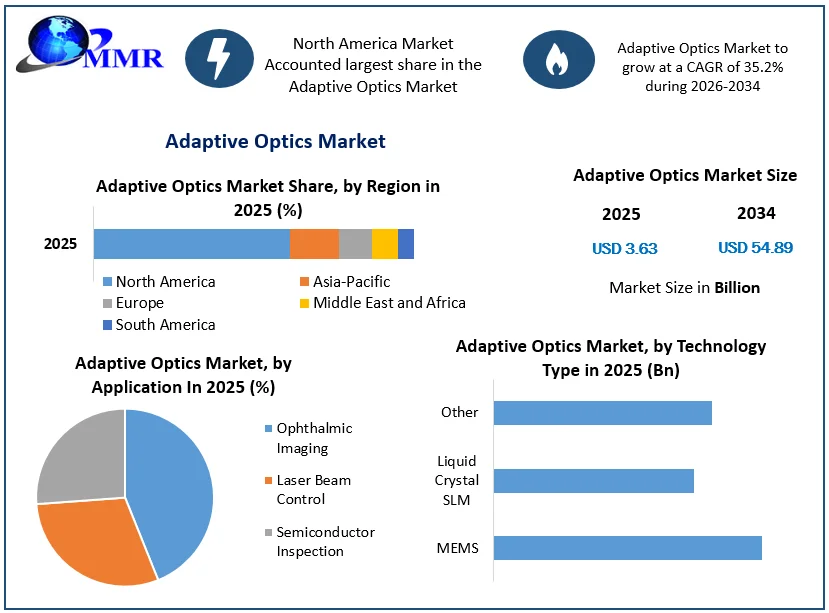
- Adaptive optics is becoming a precision-control layer for semiconductor inspection, laser communication, retinal imaging and defense optics. The market was valued at USD 3.63 Bn in 2025 and is expected to reach nearly USD 54.89 Bn by 2034, creating a high-growth opportunity for photonics, optical components and inspection-equipment suppliers.
- The market is forecast to grow at a 35.2% CAGR from 2026 to 2034, linking demand to advanced ophthalmic imaging, laser beam control and semiconductor inspection.
- Control systems dominated the component segment in 2025 because they process wavefront-sensor data and drive wavefront modulators for real-time optical correction.
- Ophthalmic imaging dominated by application, while laser beam control is growing significantly across defense, laser communication and biomedical use cases.
- North America dominated in 2025, supported by research institutions, universities, high-tech industries, observatories, space agencies, defense, healthcare and aerospace demand.
Why This Matters Now
The semiconductor and photonics industries are running into the same constraint: optical distortion limits performance. Wafer inspection, high-power laser systems, retinal imaging and deep-space observation all need sharper, faster and more stable wavefront correction.
Adaptive optics market corrects optical aberrations in real time, improving image quality, resolution and sensitivity. For semiconductor manufacturers and inspection-equipment suppliers, that matters because the report identifies semiconductor inspection as a key application where adaptive optics improves imaging accuracy during wafer and chip manufacturing, especially as electronics become more miniaturized.
Market Overview
Adaptive optics systems use components such as wavefront modulators, wavefront sensors, control systems and other optical hardware to detect and correct distortions. The market is segmented by technology type into MEMS, liquid crystal SLM and others, and by application into ophthalmic imaging, laser beam control and semiconductor inspection.
End-user industries include consumer electronics, astronomy and space observation, biomedical, military and defense, industrial and manufacturing, communications and others. This gives the market a cross-sector profile, from eye diagnostics and observatories to laser systems and chip inspection.
The public page contains a visible header inconsistency: the top panel lists USD 3.63 Bn as forecast market size, while the overview and scope table state USD 3.63 Bn in 2025 and USD 54.89 Bn by 2034. This article uses the overview and scope-table figures because they match the supplied market-size statement.
Key Trends Driving Growth
Astronomy remains a core technology driver. The report states that adaptive optics is crucial for correcting atmospheric distortions in real time, allowing telescopes to produce sharper images of exoplanets, galaxies and black holes.
The Overwhelmingly Large Telescope is a major demand signal. Its spectroscopy and imaging capabilities rely on adaptive optics to concentrate light and achieve diffraction-limited performance, while the market trajectory is tied to a three-generation implementation plan covering Natural Guide Stars, Multi-Conjugate Adaptive Optics and Laser Guide Stars.
Semiconductor inspection creates the most direct electronics opportunity. Adaptive optics improves imaging accuracy during wafer and chip manufacturing processes, making the technology relevant to yield control as device features shrink.
The main restraint is cost. AO systems require complex technology, specialized components, skilled installation, calibration, maintenance, upgrades and software support, which limits access for smaller institutions and industrial users.
The public page does not disclose AI chip demand, high-performance computing trends, foundry investments, advanced packaging, chiplets, HBM, chip manufacturing capacity expansion, memory or logic chip trends, EMS activity, IoT penetration or e-waste programs. The supported semiconductor story is inspection accuracy, optical alignment, laser control and manufacturing-quality improvement.
Start Your Market Research Journey with a Free Sample Report
Segment Insights
- Dominant Segment Control System: Control systems dominated the component segment in 2025. Their role is central because they process wavefront-sensor data and drive wavefront modulators to correct optical aberrations in real time.
- Dominant Application Ophthalmic Imaging: Ophthalmic imaging dominated because adaptive optics supports advanced eye-care diagnostics and retinal imaging, where higher resolution improves clinical visibility.
- Fastest-Growing Segment: Laser beam control is described as growing significantly, driven by defense, laser communication and biomedical applications, but the public page does not provide a comparative CAGR or explicitly label it as the fastest-growing segment.
- Key Application Semiconductor Inspection: Semiconductor inspection is identified as a key segment because adaptive optics improves imaging accuracy during wafer and chip manufacturing. Segment-level revenue and CAGR are not disclosed.
- Technology Scope MEMS and Liquid Crystal SLM: MEMS and liquid crystal SLM are included in the technology scope, but the public page does not disclose technology-level market shares or growth rates.
Regional Growth Story
North America dominated the Adaptive Optics Market in 2025. The region benefits from research institutions, universities, high-tech industries, astronomical observatories and space agencies that use AO systems for research and exploration missions.
The United States has the strongest disclosed company cluster. Listed U.S. players include Thorlabs, Northrop Grumman, Boston Micromachines, Iris AO, Baker Adaptive Optics, Synopsys, Celestron, Benchmark Electronics, 4D Technology and Zygo.
Europe includes the UK, France, Germany, Italy, Spain, Sweden, Austria and the rest of Europe. Listed European players include ALPAO in France, Sacher Lasertechnik and Schott in Germany, and Phasics in France, showing regional strength in optics, lasers and precision components.
Asia Pacific includes China, South Korea, Japan, India, Australia, ASEAN, Indonesia, the Philippines, Malaysia, Vietnam, Thailand and the rest of Asia Pacific. Japan is represented by Hamamatsu Photonics and Canon, but the public page does not disclose country-level revenue, export metrics, semiconductor incentives or fabrication investment data.
Competitive Landscape
Key players include Thorlabs, Northrop Grumman, Boston Micromachines, Iris AO, Imagine Optic, Baker Adaptive Optics, Synopsys, Celestron, Benchmark Electronics, 4D Technology, Zygo, ALPAO, Sacher Lasertechnik, Phasics, Schott, Hamamatsu Photonics and Canon. The market combines defense primes, optics specialists, photonics firms, semiconductor design software companies and precision manufacturing suppliers.
Competition is shifting toward tighter integration of optical hardware, control algorithms and manufacturing precision. Edmund Optics’ acquisition of son-x signals a push to strengthen ultra-precision optical component design and manufacturing for wavefront correction and advanced industrial applications.
Imagine Optic’s acquisition of Karthala System signals a move into deep-tissue bioimaging, where adaptive optics and ultra-fast multiphoton microscopy can improve biomedical imaging performance. Keysight’s partnership with Edmund Optics signals that calibration and optical alignment are becoming critical for complex adaptive optical configurations.
Hamamatsu’s rebranding of NKT Photonics into Hamamatsu Photonics A/S and creation of a Lasers & Fibers Business Unit signals deeper focus on specialized lasers and optics critical for quantum computing, semiconductor fabrication and medical imaging. That is the clearest disclosed link to next-generation computing and semiconductor manufacturing.
Recent Developments
- 17 January 2025 Edmund Optics: Edmund Optics acquired son-x to expand design and manufacturing capabilities for ultra-precision optical components, strengthening its position in wavefront correction and adaptive optics solutions.
- 08 December 2025 Imagine Optic: Imagine Optic acquired Karthala System, combining wavefront analysis and adaptive optics with ultra-fast multiphoton microscopy for deep-tissue bioimaging.
- 16 December 2025 Keysight Technologies: Keysight joined the Edmund Optics Trusted Optical Partnerships Program to enhance optical alignment and calibration for complex adaptive optical systems.
- 30 January 2026 Edmund Optics: Edmund Optics launched TECHSPEC Gemma Variable Beam Expanders for industrial laser applications, improving wavefront quality and laser beam coherence.
- 25 June 2026 Hamamatsu Photonics: Hamamatsu rebranded NKT Photonics as Hamamatsu Photonics A/S and created the Lasers & Fibers Business Unit for lasers and optics used in quantum computing, semiconductor fabrication and medical imaging.
Strategic Implications
For semiconductor inspection suppliers, adaptive optics offers a route to sharper imaging and better defect visibility. As chips become smaller and manufacturing tolerances tighten, optical correction can become part of inspection differentiation.
For healthcare and biomedical companies, AO improves retinal imaging and deep-tissue imaging. That creates demand for systems that combine wavefront correction, imaging hardware and software control into clinically useful diagnostic tools.
For defense and communications suppliers, laser beam control is the key opportunity. Precision wavefront correction can improve laser system performance in defense, laser communication and biomedical applications where beam quality directly affects mission outcome.
Future Outlook
The Adaptive Optics Market is forecast to grow from USD 3.63 Bn in 2025 to nearly USD 54.89 Bn by 2034 at a 35.2% CAGR. Growth will come from control systems, ophthalmic imaging, laser beam control, semiconductor inspection, astronomy, biomedical imaging, defense, communications, MEMS and liquid crystal SLM technologies.
The next phase will test whether suppliers can lower system cost while raising correction speed, optical precision and manufacturing reliability. Future technology leaders will control the wavefront-correction layer behind semiconductor inspection, laser communication and quantum-era optics; laggards will remain limited to high-cost systems that cannot scale into advanced manufacturing.
Analyst Perspective
“Adaptive optics is becoming a strategic photonics market as semiconductor inspection, retinal imaging, laser beam control and defense optics demand real-time correction and higher resolution,” said Rucha Deshpande, Analyst at Maximize Market Research. “The strongest suppliers will combine wavefront sensing, control algorithms, precision optics, calibration capability and manufacturing scale.”
About Maximize Market Research
Maximize Market Research Pvt. Ltd. (MMR) is a global market research and consulting company that provides reliable, data-focused, and practical business insights. The firm serves a wide range of industries, including healthcare, pharmaceuticals, technology, automotive, electronics, chemicals, personal care, and consumer goods. Through market forecasts, competitive analysis, strategic consulting, and industry impact assessments, MMR helps organizations understand changing market conditions, identify growth opportunities, and make informed business decisions for long-term success.
Contact Us
2nd Floor, Navale IT Park Phase 3
Pune Banglore Highway, Narhe
Pune, Maharashtra 411041, India
+91 9607365656
sales@maximizemarketresearch.com
