Key Highlights
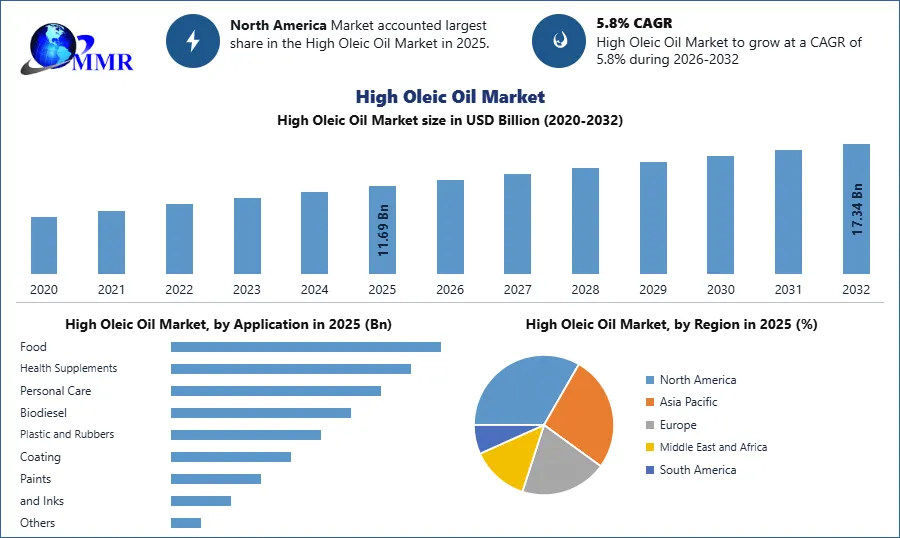
High Oleic Oil Market size was valued at USD 11.69 Billion in 2025, confirming these oils as a major global category rather than a niche specialty.
The market is expected to grow at a CAGR of 5.8% from 2026 to 2032, reaching nearly USD 17.34 Billion, signaling steady, health- and performance-led demand.
High oleic oils are characterized by elevated monounsaturated fat content and improved oxidative stability, making them suitable for high-heat and long-duration frying.
For FMCG and foodservice brands, every shift into high oleic oils is simultaneously a nutrition, shelf-life, and brand-risk decision.
Why This Matters Now
A market growing from USD 11.69 Billion to about USD 17.34 Billion at 5.8% CAGR sits directly inside high-visibility categories: snacks, QSR, ready meals, and packaged foods. This is not an invisible ingredient change; it affects labels, taste, texture, and health narratives consumers see every day.
For boardrooms, high oleic oils compress three strategic questions into one sourcing call: how aggressively to move away from conventional and partially hydrogenated oils, how to balance cost with performance and health, and how to defend brand relevance as regulators and consumers push harder on fat profiles. Delay the pivot and you accept higher regulatory and reputational risk in categories already under scrutiny.
Market Overview
The Global High Oleic Oil Market size, at USD 11.69 Billion in 2025 and projected to reach nearly USD 17.34 Billion by 2032, is expanding in line with shifting expectations around frying stability and fat quality. This trajectory is tied to both front-of-pack claims and back-of-plant performance.
High oleic variants of sunflower, canola, soybean, and other vegetable oils are bred or selected for elevated oleic acid content. That chemistry gives them higher oxidative stability and better performance in high-heat applications, with lower saturated fat and no trans-fat when used correctly. For food and beverage companies, this means fewer oil changes, more consistent product quality, and more defensible nutritional profiles.
Key Trends Driving Growth
Preventive health and heart-health narratives are central drivers. As consumers and regulators target saturated fat and trans-fat, high oleic oils offer a practical bridge: they look and behave like familiar frying oils but align more closely with heart-health guidelines.
Reformulation pressure in snacks and QSR categories is rising. Brands are being pushed to cut trans-fats, reduce saturated fat, and maintain taste. High oleic oils allow them to keep crunch, color, and flavor while shifting the fat profile, making them an attractive choice for chips, fries, coated products, and fried snacks.
Shelf-life and stability demands favor high oleic oils. Their resistance to oxidation and rancidity extends product life and preserves sensory quality. This directly affects waste, returns, and brand perception, particularly in global supply chains and hot climates.
Clean-label and “better oils” positioning is emerging as a consumer-facing story. Where once “no trans-fat” was enough, consumers now look for “high oleic,” “heart-healthy,” or “better-for-you” cues. Oils move from back-of-pack technical detail to front-of-pack marketing language.
Digital and e-commerce channels amplify education around fats. Health content, influencer messaging, and comparative product reviews highlight oil choices in snacks and ready meals. Companies that switch to high oleic and communicate it coherently gain narrative advantage.
Request a Free Sample Copy or View Report Summary: https://www.maximizemarketresearch.com/request-sample/187887/
Segment Insights
Dominant Segment: Food industry applications (snacks, QSR, packaged foods) – Use of high oleic oils in frying, roasting, and ingredient systems for chips, fries, baked snacks, coated products, and prepared meals represents the largest share of demand. This dominance means that large food manufacturers and QSR chains set the tone for pricing and supply.
Fastest-Growing Segment: Health-positioned and premium packaged foods using high oleic oils as a visible differentiator – Products that call out high oleic oils for heart-health or “better fat” profiles are expanding fastest, especially in snacks, ready meals, and plant-based categories. This segment shows where brands are turning a technical oil choice into a visible consumer proposition.
Industrial and B2B applications – High oleic oils used as ingredients in sauces, dressings, and bakery fats support more stable emulsions and better shelf life, quietly influencing numerous downstream products.
Emerging nutraceutical and functional applications – Oils positioned as part of preventive health regimes, or included in fortified and functional SKUs, add a new layer of value beyond cooking.
Regional Growth Story
North America and Europe lead in high oleic oil consumption, reflecting stronger regulatory pressure on trans-fat, higher consumer awareness of fat quality, and advanced processing infrastructure. This leadership means most early innovation and supply concentration sits in these regions.
In Europe, substitution of palm oil in certain applications and a push for more sustainable, health-aligned oils has accelerated high oleic adoption in food processing and private label brands. That trend signals ongoing momentum as large retailers demand better fat profiles.
Asia and other emerging regions show rising potential as middle classes expand and QSR and packaged food sectors grow. As preventive health narratives gain traction, high oleic oils can move from niche to mainstream, especially if local players partner with global suppliers and adopt best practices in high-heat applications.
Competitive Landscape
The competitive field includes global agribusiness and oilseed processors, mid-sized specialty oil companies, and regional refiners. Large players with breeding programs and integrated crushing and refining operations control much of the high oleic supply, giving them leverage in long-term contracts and price negotiations.
Competition focuses on consistency of oleic content, supply reliability, certification (non-GMO, organic, sustainable), and application support. Suppliers that can guarantee stable performance in specific frying lines, offer tailored blends, and align with ESG goals will capture more share for high oleic contracts.
For rivals, each new agreement with major snack, QSR, or packaged food companies signals strategic direction: capacity expansions aimed at particular seeds and regions, co-branding efforts around “better oils,” and geographic diversification. Over the next 12–24 months, expect more deals that lock high oleic supply into major food systems and more emphasis on online and B2C messaging about oil quality.
Recent Developments
Expanded use of high oleic sunflower and canola oils in mainstream snacks and QSR frying, driven by trans-fat elimination and saturated fat reduction policies.
Launches of packaged foods that explicitly highlight high oleic oils on front-of-pack as part of heart-health or “better-for-you” positioning.
Investments in breeding and agronomic programs to raise yields of high oleic oilseeds and reduce segregation costs between conventional and high oleic crops.
Growing presence of high oleic oils in online retail and direct-to-consumer cooking oil lines, targeting health-conscious home cooks.
Strategic Implications
For FMCG and food & beverage leaders, a 5.8% CAGR to 2032 turns high oleic oil into a strategic hinge for both health and operations. The key decision is whether to treat high oleic adoption as a patchwork of individual reformulations or as a platform-level shift for whole categories.
Portfolio teams should map where oils drive risk and opportunity—chips, fries, coated products, ready meals—and develop a phased plan to move these lines toward high oleic variants. Done systematically, this creates a coherent “better oils” narrative and reduces scattered, inconsistent claims.
Supply chain and procurement must plan for long-term high oleic sourcing, including diversification across crops and geographies. Yield penalties, segregation costs, and premium volatility can erode margins if managed transactionally rather than strategically.
R&D and quality teams need to optimize processes around high oleic performance: frying protocols, filtration, shelf-life modeling, and sensory benchmarks. The goal is to lock in health and stability benefits without compromising taste and texture.
Marketing and ESG teams must align on messaging around fats. High oleic adoption offers a credible step toward better nutrition and sustainability; over-claiming or failing to link changes to broader nutrition strategies risks consumer skepticism.
Future Outlook
By 2032, as the High Oleic Oil Market approaches USD 17.34 Billion at 5.8% growth, high oleic oils will be embedded across mainstream fried and baked products, from snacks and QSR menus to ready meals and plant-based offerings. Oil choice will be part of brand identity, not just a technical detail.
Regulatory and consumer pressure on fat quality will intensify, pushing more brands to treat high oleic as baseline rather than premium. At the same time, agricultural and cost challenges will demand smarter sourcing, risk-sharing with farmers, and ongoing process optimization.
The high-stakes contrast is direct: winners will be the FMCG and food & beverage companies that treat high oleic oils as a strategic platform for healthier, more stable, and more defensible products across portfolios, while losers will stay locked into legacy fats in a market where every frying choice shows up on labels, in audits, and in consumer trust.
Related Reports
Drawer Slides Market https://www.maximizemarketresearch.com/market-report/drawer-slides-market/187538/
Tumble Dryer Market https://www.maximizemarketresearch.com/market-report/tumble-dryer-market/146660/
Analyst Perspective
“From 2025 to 2032, high oleic oils move from quiet formulation tweak to visible strategic pivot; a market rising from USD 11.69 Billion to nearly USD 17.34 Billion at 5.8% CAGR will reward only those FMCG and food & beverage players that turn better fat profiles, frying performance, and long-term supply agreements into durable health and brand advantages,” said Siddhi Dole, Analyst.
About Maximize Market Research
Maximize Market Research Pvt. Ltd. (MMR) is a global market research and consulting company that provides reliable, data-focused, and practical business insights. The firm serves a wide range of industries, including healthcare, pharmaceuticals, technology, automotive, electronics, chemicals, personal care, and consumer goods. Through market forecasts, competitive analysis, strategic consulting, and industry impact assessments, MMR helps organizations understand changing market conditions, identify growth opportunities, and make informed business decisions for long-term success.
2nd Floor, Navale IT Park Phase 3
Pune Banglore Highway, Narhe
Pune, Maharashtra 411041, India
+91 9607365656
sales@maximizemarketresearch.com
