Key Highlights
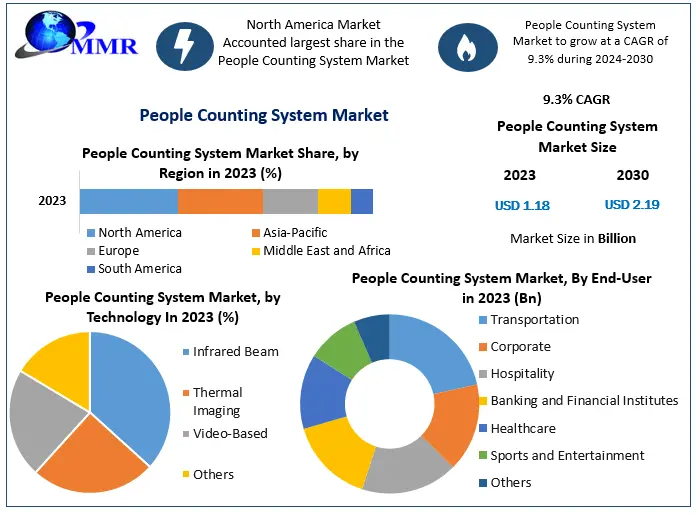
- Retailers, transport operators and smart-building owners are turning footfall into operating data, making people counting systems part of the edge analytics stack. The market was valued at US$ 1.18 Bn in 2023 and is expected to reach nearly US$ 2.19 Bn by 2030, creating demand for sensors, cameras, thermal imaging, embedded software and machine-learning video systems.
- The market is forecast to grow at a 9.3% CAGR from 2024 to 2030, linking demand to retail analytics, staff optimization, visitor monitoring, transportation security and smart commercial buildings.
- Bidirectional systems held more than 65% market share in 2023 and are expected to grow at a 7.3% CAGR, making them the clearest disclosed type leader.
- Video-based systems are expected to grow at the highest CAGR of 8.8%, driven by 3D people counting and integration with point-of-sale data for conversion analysis.
- Asia Pacific held over 30% revenue share in 2023, while North America is expected to lead during the forecast period because of modern retail outlets, malls, stadiums, banks, amusement parks and airports.
Why This Matters Now
People counting has shifted from doorway measurement to commercial intelligence. Retailers now use visitor data to measure campaign performance, optimize staff shifts, improve store layouts and connect footfall with conversion rates.
For electronics and semiconductor suppliers, the opportunity is at the device and sensor level. The public MMR page does not disclose AI chip demand, HPC trends, foundry investments, advanced packaging, chiplets, HBM, memory or logic trends, but it does disclose infrared beams, thermal imaging, WiFi tracking, video counts and machine-learning algorithms.
Market Overview
A people counter is an electronic device that counts people passing through a tunnel, entering a building or passing through an exit. Applications range from simple clickers to smart-flooring systems, infrared beams, thermal imaging, WiFi tracking and video counts using machine-learning algorithms.
The People Counting System Market is segmented by offering into software and hardware; by type into unidirectional and bidirectional systems; by technology into infrared beam, thermal imaging, video-based and others; and by end user into retail, transportation, corporate, hospitality, banking, healthcare, sports and entertainment, and others.
The public page contains a visible header inconsistency: the top panel lists US$ 1.18 Bn as forecast market size, while the overview and scope table state US$ 1.18 Bn in 2023 and US$ 2.19 Bn by 2030. This article uses the overview and scope-table values because they match the supplied market-size statement.
Key Trends Driving Growth
Staff planning is the main operating driver. Retailers use accurate visitor counts to allocate employees, schedule shifts, plan cleaning, manage maintenance and align staffing with visitor density.
Retail analytics is becoming more precise. Shopping malls use people counters to measure visitor flows, identify congregation zones, assess entrance usage and support leasing decisions in high-traffic areas.
Video analytics is changing the technology mix. Video-based 3D counters track customers by minute, hour, day, week, month and year, and can connect with point-of-sale systems to calculate purchase conversion ratios.
4D technology is the key opportunity. MMR states that 2D and 3D systems usually have 85% to 90% accuracy, while 3D systems can maintain 93% accuracy in high-traffic situations; 4D systems add staff exclusion, anonymity, dwell-time measurement, darkness operation, child recognition, gender differentiation and weather-impact assessment in emergencies.
The main restraint is e-commerce. Online retail reduced footfall in retail stores, shopping malls and supermarkets during the pandemic and continues to pressure conventional establishments, reducing demand where physical locations close or shrink.
Get Your Exclusive Market Research Sample Report Today
Segment Insights
- Dominant Segment Bidirectional Systems: Bidirectional systems held more than 65% market share in 2023 and are expected to grow at a 7.3% CAGR. Their value comes from identifying whether a person is entering or exiting an outlet and supporting footfall metrics, visit duration, staff optimization and high-traffic monitoring.
- Fastest-Growing Segment Video-Based Technology: Video-based systems are expected to grow at the highest CAGR of 8.8% during the forecast period, driven by 3D counting technology and retail analytics use cases.
- Offering Scope Software and Hardware: Both software and hardware are covered, but the public page does not disclose offering-level revenue, share or CAGR.
- End-User Scope Retail and Transportation: Retail, supermarkets, shopping malls and transportation are central use cases, but end-user shares are not disclosed.
- Technology Scope Infrared, Thermal, Video and Others: Infrared beam, thermal imaging, video-based and other technologies are included, but only video-based technology has a disclosed CAGR.
Regional Growth Story
Asia Pacific held over 30% market share in 2023. Growth is linked to technological advancement in India, China and Vietnam, along with manufacturers serving transportation, retail and government demand.
Urbanization and smart-building construction are strengthening Asia Pacific demand. Highly populated countries such as China and India are upgrading transportation facilities and deploying people counting systems at metro stations, airports and related transit assets to improve security and passenger management.
North America is expected to lead the market during the forecast period and grow at an 8.1% CAGR. Demand is supported by modern retail outlets, shopping malls, stadiums, banks, amusement parks and 13,513 airports in the United States that require visitor counting and monitoring systems.
The report covers the United States, Canada, Mexico, the UK, France, Germany, Italy, Spain, Sweden, Austria, China, South Korea, Japan, India, Australia, Indonesia, Malaysia, Vietnam, Taiwan, Bangladesh and Pakistan. Country-level revenue, semiconductor incentives, chip manufacturing data, EMS activity and export metrics are not disclosed.
Competitive Landscape
Key players include RetailNext, ShopperTrak, Eurotech, Axiomatic Technology, CountWise, Dilax Intelcom GmbH, IEE S.A., iris-GmbH, FLIR Integrated Imaging Solutions, V-Count, XOVIS AG, Infodev Electronic Designers International, Traf-Sys and Siemens AG. The field combines retail analytics vendors, sensor specialists, imaging suppliers and automation companies.
Competition is shifting toward analytics depth rather than basic counting. Vendors that connect visitor data with conversion rates, staffing decisions, inventory planning and occupancy controls can sell business outcomes instead of hardware units.
For semiconductor and electronics suppliers, the visible technology direction is edge sensing, thermal imaging, infrared detection, camera modules and embedded video analytics. No named fab investment, advanced-packaging breakthrough, chip capacity expansion, HBM roadmap or AI-chip-specific initiative is disclosed on the public page.
Recent Developments
- 4D Counting Opportunity: MMR identifies rapid adoption of 4D technology in video-based people counters as a key opportunity because it improves functionality beyond 2D and 3D systems.
- Video-POS Integration: Video-based systems can connect with POS systems to compare purchasers with total visitors, improving conversion analysis and staffing decisions.
- Asia Pacific Smart Infrastructure: Urbanization and construction of smart residential and commercial buildings are increasing demand for visitor tracking and security solutions.
- No Named Dated Deals Disclosed: The public page does not disclose specific recent acquisitions, partnerships, product launches, fab investments or semiconductor capacity expansions.
Strategic Implications
For retailers, people counting systems convert footfall into measurable operating leverage. Better visitor data can guide staffing, marketing, checkout capacity, store layout and lease-value decisions.
For transport and smart-building operators, the value is crowd visibility. People counting systems can support passenger monitoring, building security, entrance-load analysis and safer movement through high-traffic facilities.
For investors, the market offers exposure to retail analytics, smart buildings, transport modernization, video analytics and edge sensing. The key risk is the structural shift toward e-commerce, which can reduce physical-store demand if retailers close sites or reduce space.
Future Outlook
The People Counting System Market is forecast to grow from US$ 1.18 Bn in 2023 to nearly US$ 2.19 Bn by 2030 at a 9.3% CAGR. Growth will come from bidirectional counting, video analytics, 4D systems, retail optimization, smart buildings, transportation facilities, shopping malls, airports and security-focused occupancy monitoring.
The next phase will test whether suppliers can turn counting devices into edge-intelligence platforms that convert movement into decisions. Future technology leaders will control the sensor-and-analytics layer behind retail, transit and smart-building operations; laggards will remain tied to basic counting hardware in a market moving toward machine-learning occupancy intelligence.
Analyst Perspective
“People counting systems are becoming practical edge-analytics tools as retailers, transport operators and building owners need real-time visibility into footfall, occupancy and customer behavior,” said Rucha Deshpande, Analyst at Maximize Market Research. “The strongest suppliers will combine video analytics, bidirectional accuracy, 4D sensing, POS integration and secure deployment across retail and transport environments.”
About Maximize Market Research
Maximize Market Research Pvt. Ltd. (MMR) is a global market research and consulting company that provides reliable, data-focused, and practical business insights. The firm serves a wide range of industries, including healthcare, pharmaceuticals, technology, automotive, electronics, chemicals, personal care, and consumer goods. Through market forecasts, competitive analysis, strategic consulting, and industry impact assessments, MMR helps organizations understand changing market conditions, identify growth opportunities, and make informed business decisions for long-term success.
Contact Us
2nd Floor, Navale IT Park Phase 3
Pune Banglore Highway, Narhe
Pune, Maharashtra 411041, India
+91 9607365656
sales@maximizemarketresearch.com
