Key Highlights
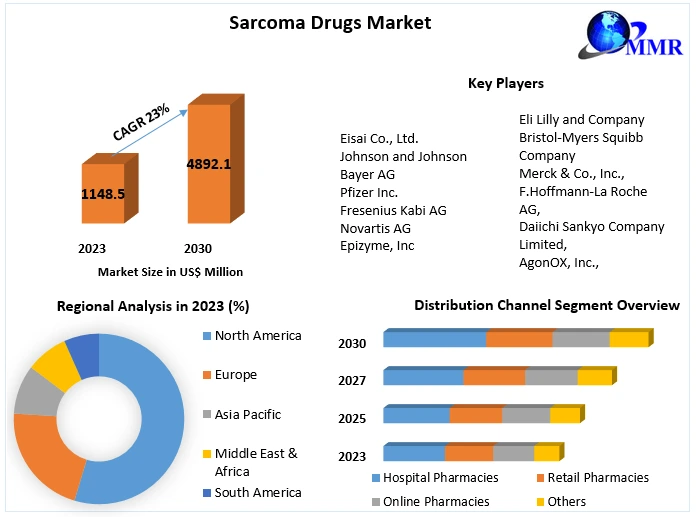
Explosive Valuation Uptick: The global sarcoma drugs market achieved a baseline valuation of USD 1,148.58 Million in 2023 and is projected to skyrocket to USD 4,892.15 Million by 2030, demonstrating an aggressive CAGR of 23%.
Therapy Segment Dominance: Chemotherapy remains the absolute leading treatment mode, capturing a 55% share of the global market due to its foundational role in halting or slowing tumor cell proliferation.
Rapid Distribution Evolution: While hospital pharmacies continue to lead bulk product deliveries, online pharmacies represent the fastest-growing distribution channel, expanding at a 15% CAGR due to patient convenience.
Geographical Market Anchor: North America maintains absolute regional dominance, driven by significant patient volumes, high diagnosis rates, and sophisticated clinical oncology networks.
Patient Access Acceleration: The rise of comprehensive Patient Assistance Programs (PAPs) is significantly driving market volume by enabling uninsured and low-income cancer patients to access advanced therapies.
Why This Matters Now
The global clinical oncology sector is managing a high-stakes transition. Hospital networks, oncology researchers, and private insurers are facing rising cases of rare soft tissue and bone sarcomas, which account for less than 1% of all adult cancers. Historically, standard therapeutic options were limited to aggressive surgical resections and generic radiation schedules, which frequently led to poor patient outcomes, high recurrence rates, and severe side effects.
Transitioning to advanced, targeted combination therapeutics and next-generation immunotherapies addresses these clinical gaps directly. The rapid rate of change in cancer treatment is generating novel pharmaceutical agents designed to work alongside existing chemotherapy setups. These combination pipelines help oncologists bypass traditional tumor resistance, reduce healthy tissue toxicity, and optimize survival curves for patients managing complex, multi-site malignant growths.
Market Overview
The sarcoma drugs market operates as a highly specialized, capital-intensive segment within the global biopharmaceutical and medical oncology sectors. Because managing sarcomas demands early detection, precise tissue differentiation, and continuous therapeutic intervention, specialized drug formulations have become essential for boosting survival outcomes. The market’s aggressive growth trajectory toward USD 4,892.15 Million by 2030 highlights an industry-wide pivot toward innovative drug discoveries, expiration of legacy branded patents, and robust product pipelines.
The parameters of this market are tracked across an extensive historical baseline from 2018 to 2023, providing a validated dataset for the 2024 to 2030 forecast window. Total market distribution is analyzed by treatment configurations—including chemotherapy, targeted therapy, and emerging immunotherapies—and spans major logistics lines including hospital networks, retail pharmacies, and digital health platforms.
Key Trends Driving Growth
The prominent trend accelerating market expansion is the heavy integration of immunotherapy into standard sarcoma care models. Pharmaceutical developers are rushing to approve and deploy new immunotherapeutic treatments that train the patient’s own immune system to isolate and destroy resilient cancer cells. When combined with established chemotherapy lines, these advanced drugs demonstrate superior clinical efficacy, driving higher adoption rates across leading cancer institutes.
Another primary driver is the possessive development of a strong drug pipeline backed by massive pharmaceutical R&D spending. As legacy, first-generation cancer drugs lose their patent protections, multinational drug makers are redirecting capital to fund novel molecule research and combination therapies. This continuous stream of next-generation product launches expands the clinical options available to physicians, supporting market expansion.
Additionally, the widespread introduction of Patient Assistance Programs (PAPs) is expanding the accessible market base. Because advanced oncology treatments carry premium price tags that can rise by double digits annually, cost acts as a major barrier to care. Comprehensive PAPs help bridge this gap, allowing uninsured and underinsured demographics to access high-value therapeutics, directly increasing commercial volume sales.
Segment Insights
Chemotherapy (Dominant Segment): Holds a commanding 55% share of the overall market. It remains the frontline therapeutic choice for stopping and slowing cancer cell duplication, supported by frequent, high-volume administration across global hospital networks.
Online Pharmacies (Fastest-Growing Channel): Expanding at a robust 15% CAGR over the forecast window, driven by the convenience, home delivery comfort, and digital tracking features favored by modern outpatients.
Targeted and Combination Lines: Capturing a growing share of the pipeline as clinical settings combine novel molecular blockades with existing medications to bypass cellular resistance.
Hospital Pharmacies: Retain a massive volume share of total product distribution, as intensive, multi-cycle oncology protocols necessitate direct, specialized supervision within clinical environments.
Regional Growth Story
North America leads the global sarcoma drugs market, supported by strong diagnostic protocols and extensive case tracking across the United States and Canada. According to data from the American Cancer Society, approximately 12,750 new soft tissue sarcomas are diagnosed annually in the United States alone, affecting an estimated 7,240 men and 5,510 women. This substantial patient pool, combined with high healthcare spending and early access to newly approved drug combinations, keeps North America at the forefront of high-value oncology procurement cycles.
Concurrently, European healthcare structures across Germany, the UK, and France maintain steady market demand, driven by unified clinical guidelines and state-backed reimbursement frameworks for orphan oncology drugs. Meanwhile, the Asia-Pacific region represents a vital volume growth zone. Driven by expanding healthcare infrastructure, rising access to modern diagnostic imaging, and expanding local manufacturing agreements, the region is seeing increased procurement of frontline oncology therapeutics.
Competitive Landscape
The global competitive environment in the sarcoma drugs market is defined by intense scientific innovation, strict regulatory approvals, and strategic pipeline management. Leading multinational pharmaceutical corporations leverage vast capital reserves to fund multi-phase clinical trials and secure orphan drug designations, which grant long-term market exclusivity.
To maintain their competitive positioning against rising generic competition following key patent expirations, industry leaders focus heavily on creating proprietary combination regimens. Companies compete by launching molecules with lower toxicity profiles and superior tissue penetration, allowing them to capture leading placements on international hospital formulary lists.
Recent Developments
Frontline Oncology Pipeline Expansions: Industry giants—including Eisai Co., Ltd., Eli Lilly and Company, and Pfizer Inc.—continue to pour capital into multi-site clinical trials to validate next-generation soft tissue sarcoma blockades.
Targeted Molecular Asset Acquisitions: Leading players such as Novartis AG, Bayer AG, and Johnson and Johnson are actively acquiring specialized biotech assets, like Epizyme, Inc., to integrate advanced epigenetic and molecular targeting tools into their core portfolios.
Generic Product Integration: Global generic suppliers, including Fresenius Kabi AG, are expanding the availability of affordable, post-patent chemotherapy injections, widening basic treatment access across emerging economies.
Digital Distribution Cooperations: Major pharmaceutical brands are entering supply agreements with authorized online pharmacy networks to streamline specialty drug delivery systems for home-care oncology patients.
Strategic Implications
For clinical trial directors and biopharma research executives, relying entirely on traditional single-agent chemotherapy lines introduces a clear risk of portfolio obsolescence. As oncology treatment speeds up and shifts toward personalized medicine, companies that fail to develop flexible combination therapies or advanced immunotherapies will lose ground to more innovative pipelines. Investing in multi-mechanism drug assets is essential to secure regulatory approvals and maintain relevance in modern cancer care.
For hospital procurement officers and state oncology buyers, navigating the high cost of specialized cancer therapies requires active collaboration with pharmaceutical assistance programs. Because premium drug pricing can grow by double digits, non-subsidized procurement poses a substantial financial strain on healthcare budgets. Building strategic pathways that utilize PAP allocations and integrating online pharmacy logistics are key steps to optimizing treatment delivery while managing operational health expenditures.
Future Outlook
The trajectory of the global sarcoma drugs market will be shaped by the growth of personalized immunotherapy combinations, the expansion of digital pharmacy logistics, and rising diagnostic rates across developing regional economies. As cancer institutes adapt to strict regulatory guidelines and complex tumor mutations, long-term success will belong to pharmaceutical innovators that successfully transition their pipelines toward targeted, low-toxicity molecular therapies. Future market leaders will be the biopharma groups that seamlessly combine advanced molecule discovery with accessible patient support programs, while traditional drug manufacturers relying solely on generic, single-agent chemotherapies will face steady market share reduction and declining formulary placement.
Analyst Perspective
“The global sarcoma drugs market has entered a phase of rapid molecular innovation,” notes an oncology market specialist at Maximize Market Research. “By shifting focus away from generic tissue-destroying chemotherapies toward targeted immunotherapies and smart combination lines, forward-thinking pharmaceutical developers are giving oncologists the exact precision tools required to modify survival outcomes for rare, complex malignancies.”
About Maximize Market Research
Maximize Market Research Pvt. Ltd. (MMR) is a global market research and consulting company that provides reliable, data-focused, and practical business insights. The firm serves a wide range of industries, including healthcare, pharmaceuticals, technology, automotive, electronics, chemicals, personal care, and consumer goods. Through market forecasts, competitive analysis, strategic consulting, and industry impact assessments, MMR helps organizations understand changing market conditions, identify growth opportunities, and make informed business decisions for long-term success.
2nd Floor, Navale IT Park Phase 3
Pune Banglore Highway, Narhe
Pune, Maharashtra 411041, India
+91 9607365656
sales@maximizemarketresearch.com
