Key Highlights
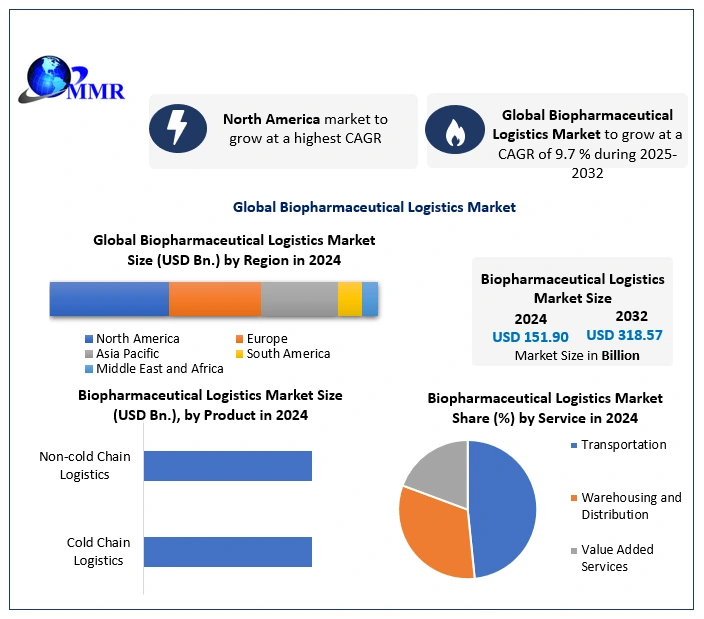
Strong Revenue Trajectory: The global biopharmaceutical logistics market achieved a baseline valuation of USD 151.90 Billion in 2024 and is projected to expand to USD 318.57 Billion by 2032, maintaining a consistent CAGR of 9.7%.
Transportation Mode Dominance: The air shipping segment holds the leading revenue share across cold chain transportation, preferred due to its unparalleled transit speed and high climate control accuracy over long distances.
Logistics Base Division: While non-cold chain logistics maintained a dominant baseline share in 2024 for standard medications, specialized cold chain transport is growing rapidly to accommodate sensitive biological agents.
Geographical Stronghold: North America anchors the global footprint, securing a dominant 37% market share in 2023, heavily driven by dense export-import networks and advanced supply chain tracking setups.
Technological Modernization: The widespread adoption of mobile cloud solutions, data mining algorithms, and real-time monitoring telematics is vastly reducing product spoilage rates globally.
Why This Matters Now
The global pharmaceutical and clinical healthcare supply networks are managing a high-stakes transition. The rapid scientific shift away from standard, chemically synthesized small-molecule pills toward complex, large-molecule biologics, cell therapies, and mRNA vaccines is forcing a complete redesign of legacy transport networks. Unlike traditional drugs, these advanced therapies are highly sensitive to minor environmental shocks, making them vulnerable to rapid degradation if exposed to unauthorized temperature fluctuations, light, or vibrations.
Deploying highly specialized biopharmaceutical logistics protocols addresses these supply vulnerabilities directly. Utilizing sophisticated, temperature-controlled insulated packaging, active cooling containers, and continuous environmental data tracking protects high-value therapeutic payloads at every stage of transit. Implementing these advanced logistics safety buffers is essential for global distributors to meet strict regulatory storage compliance, protect product integrity, and guarantee patient safety upon delivery.
Market Overview
The biopharmaceutical logistics market operates as a vital, highly technical segment within the global life sciences supply chain and specialized transport industries. Because distributing biological medicines requires maintaining precise temperature ranges and satisfying rigorous national distribution compliance laws, this market acts as an essential operational bridge between pharmaceutical manufacturing facilities, clinical research labs, and hospital pharmacies.
The market’s continuous climb toward USD 318.57 Billion by 2032 reflects an industry-wide pivot toward automated tracking systems and outsourced cold chain operations. The commercial framework spans across critical product categories (cold chain vs. non-cold chain transport), transportation methodologies (air shipping, maritime transport, and ground logistics), and core infrastructure applications including high-security warehousing, custom packaging, and long-range product shipping lines.
Key Trends Driving Growth
The most prominent trend accelerating market expansion is the heavy integration of real-time telematics and automated sensor tracking arrays into specialized cold chain networks. Logistics providers are embedding advanced IoT hardware directly into transit containers to monitor cargo conditions continuously. These telematics modules capture real-time temperature, humidity, and location updates, streaming data to mobile cloud platforms to allow operators to intervene before temperature excursions spoil high-value shipments.
Another central driver is the rising trend among global pharmaceutical corporations to outsource their intricate supply chain workflows to specialized third-party logistics (3PL) providers. As shipping compliance laws become more complex and require detailed audits, manufacturers prefer to pass the logistics burden to expert network operators. This strategic outsourcing allows pharmaceutical firms to reduce internal capital expenditures on warehousing infrastructure while leveraging specialized, pre-certified global delivery networks.
Additionally, a strong surge in international import-export volumes for high-value bio-therapeutics and preventative vaccines is expanding the market’s commercial footprint. Rising chronic diseases and a globally aging population are driving up international demand for specialized medical assistance products. This high-volume trade activity requires constant cross-border movements, accelerating investments in specialized cargo hubs and climate-controlled terminal expansions at major global airports.
Segment Insights
Air Shipping (Dominant Transport Mode): Holds a leading position within the cold chain application matrix. Its top placement is sustained by its unmatched speed, which minimizes transit times for sensitive biological items, and its ability to maintain precise climate controls across global trade lines.
Non-Cold Chain Logistics: Retained a substantial structural share in 2024, handling high-volume shipments of conventional, ambient-temperature medical supplies and raw pharmaceutical ingredients that do not require continuous refrigeration.
Cold Chain Services (Fastest Growing): Expanding rapidly due to strict quality mandates for newly approved monoclonal antibodies, cellular treatments, and genetic therapeutics that require storage conditions down to cryogenic ranges.
Warehousing and Storage Infrastructure: Securing major capital upgrades as distribution networks build out specialized regional hubs equipped with automated temperature back-ups and climate-monitored vaults.
Regional Growth Story
North America dominates the global biopharmaceutical logistics landscape, securing a commanding 37% share of the market in 2023. This leading regional position is supported by massive pharmaceutical export-import volumes, high investments in domestic bioprocessing R&D, and extensive cold chain infrastructure networks across the United States and Canada. The presence of top-tier logistics firms and advanced technological integration across major distribution hubs keeps North America at the forefront of supply chain innovation.
In parallel, Europe remains a powerful secondary hub for pharmaceutical distribution, supported by highly integrated ground and air networks across major export economies like Germany, Switzerland, and France. Meanwhile, the Asia-Pacific region represents the fastest-growing geographical market. Driven by expanding aging populations, rising healthcare spending, and expanding regional manufacturing agreements across China, India, and South Korea, APAC is seeing major investments in modern temperature-controlled storage and automated distribution networks.
Competitive Landscape
The global competitive environment in the biopharmaceutical logistics market is highly consolidated and intensely competitive, dominated by multinational freight networks and deeply specialized life sciences transport providers. Success in this high-risk market requires vast capital resources to build out certified climate-controlled facilities, secure international customs clearances, and maintain strict compliance with global Good Distribution Practices (GDP).
To maintain their competitive positioning against local couriers, leading players rely heavily on cross-border corporate acquisitions, service upgrades, and long-term supply agreements with major pharmaceutical groups. Companies compete intensely on the reliability of their tracking software, container insulation technologies, and multi-modal transit networks, allowing them to anchor premium distribution contracts with global health networks and biopharma corporations.
Key Market Players
FedEx Corporation (United States)
United Parcel Service, Inc. (UPS) (United States)
Deutsche Post DHL Group (Germany)
Kuehne + Nagel International AG (Switzerland)
Ceva Logistics LLC (France)
AmerisourceBergen Corporation (Cariat) (United States)
DB Schenker (Germany)
XPO Logistics, Inc. (United States)
C.H. Robinson Worldwide, Inc. (United States)
Strategic Implications
For pharmaceutical manufacturing executives and biopharma supply chain directors, relying entirely on legacy, non-monitored shipping lines introduces an unacceptable risk of product loss. If transit networks lack automated, real-time sensor loops, an unexpected delay or warehouse power failure can cause catastrophic temperature spikes, leading to entire batch rejections and costly legal liability. Transitioning to end-to-end visible cold chain networks and utilizing smart telematics are critical steps to eliminate cargo spoilage and ensure regulatory compliance.
For logistics hub operators and hospital procurement directors, failing to modernize regional cold storage setups to accommodate next-generation ultra-low temperature therapies limits future distribution capabilities. As new cellular and gene therapies expand, standard refrigeration units are becoming insufficient to handle modern medical payloads. Building out specialized, deep-freeze storage zones and optimizing airport cargo facilities are essential to capture high-value biopharma distribution contracts while protecting public health pipelines.
Future Outlook
The trajectory of the global biopharmaceutical logistics market will be shaped by the growth of AI-driven route optimization, the expansion of ultra-low temperature cryogenic shipping networks, and the implementation of unified global data-sharing tracking standards. As advanced medicine moves toward highly personalized, time-critical cell therapies, long-term market success will belong to logistics providers that eliminate temperature variance risks entirely. Future industry leaders will be the freight networks that seamlessly combine real-time cloud tracking software with high-insulation smart containers, while traditional transport lines relying on manual logging and non-monitored transit methods will face steady menu reduction and declining contract wins.
Analyst Perspective
“The biopharmaceutical logistics sector has moved past basic, unmonitored transport boxes into an era of high-precision smart supply lines,” notes a life sciences supply chain expert at Maximize Market Research. “By embedding automated IoT telematics directly into global air and ground networks, forward-thinking logistics partners are giving biopharma manufacturers the exact real-time control required to eliminate product degradation and safeguard vital therapeutic pipelines across international borders.”
About Maximize Market Research
Maximize Market Research Pvt. Ltd. (MMR) is a global market research and consulting company that provides reliable, data-focused, and practical business insights. The firm serves a wide range of industries, including healthcare, pharmaceuticals, technology, automotive, electronics, chemicals, personal care, and consumer goods. Through market forecasts, competitive analysis, strategic consulting, and industry impact assessments, MMR helps organizations understand changing market conditions, identify growth opportunities, and make informed business decisions for long-term success.
2nd Floor, Navale IT Park Phase 3
Pune Banglore Highway, Narhe
Pune, Maharashtra 411041, India
+91 9607365656
