Textile Implants Market Advances as 3D Medical Textiles and Minimally Invasive Surgery Drive Healthcare Innovation
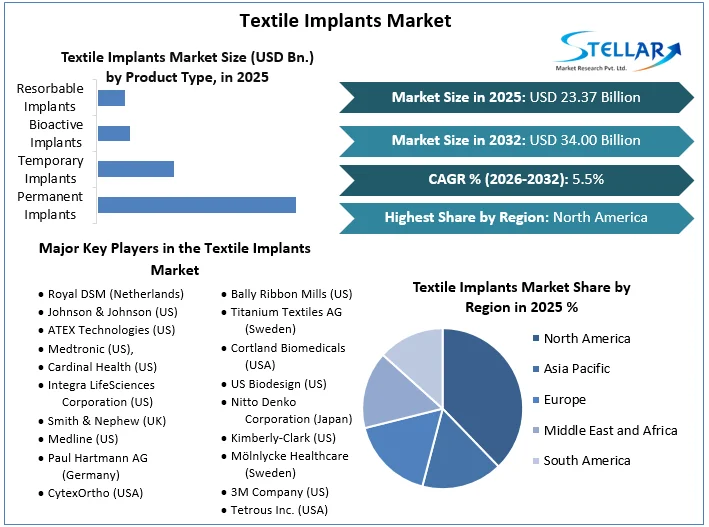
The global Textile Implants Market is experiencing significant growth as advances in biomaterials, regenerative medicine, and minimally invasive surgical procedures reshape modern healthcare. Textile implants are increasingly used in orthopedic reconstruction, cardiovascular surgery, hernia repair, wound management, and soft tissue repair due to their flexibility, biocompatibility, and long-term performance. According to Stellar Market Research, the global Textile Implants Market was valued at USD 22.16 billion in 2024 and is expected to reach USD 34.00 billion by 2032, growing at a CAGR of 5.5% during the forecast period.
Aging Population and Rising Surgical Procedures Fuel Market Growth
The increasing prevalence of age-related disorders is one of the strongest drivers of the Textile Implants Market. As the global elderly population continues to expand, the demand for orthopedic implants, vascular grafts, artificial ligaments, surgical meshes, and wound closure products is increasing across healthcare systems.
Textile implants offer superior mechanical strength, flexibility, and tissue compatibility, making them suitable for a wide range of reconstructive procedures. Hospitals and surgical centers are increasingly adopting advanced implantable textiles to improve patient recovery, reduce complications, and enhance long-term clinical outcomes.
3D Printing and Smart Biomedical Textiles Transform Implant Design
Technological innovation is redefining the future of implantable medical textiles. Three-dimensional printing and additive manufacturing technologies enable manufacturers to produce patient-specific implants with highly customized structures that improve anatomical fit and tissue integration.
At the same time, research into smart biomedical textiles is creating opportunities for implants embedded with nanosensors, conductive fibers, and monitoring capabilities. These next-generation textile implants have the potential to track physiological parameters, support post-operative monitoring, and improve personalized patient care. Research initiatives in Europe and other regions continue to accelerate innovation in this field.
𝐃𝐨𝐰𝐧𝐥𝐨𝐚𝐝 𝐅𝐫𝐞𝐞 𝐏𝐃𝐅 𝐁𝐫𝐨𝐜𝐡𝐮𝐫𝐞: https://www.stellarmr.com/report/req_sample/textile-implants-market/2648
Orthopedic and Cardiovascular Applications Lead Market Demand
Orthopedic surgery remains one of the largest application areas for textile implants due to increasing cases of joint replacement, ligament reconstruction, and sports injuries. Textile-based implants provide high tensile strength while supporting natural tissue healing.
Cardiovascular applications also represent a significant share of the market, with textile implants used in vascular grafts, heart valve repair, and other life-saving procedures. Growing demand for minimally invasive cardiovascular surgeries is expected to further increase adoption during the forecast period.
Other important applications include:
Hernia repair meshes
Surgical sutures
Artificial tendons and ligaments
Soft tissue reinforcement
Wound care products
Dental and reconstructive implants
Material Innovation Improves Clinical Performance
Manufacturers continue investing in advanced fibers and biomaterials to improve implant durability and patient safety.
Key industry trends include:
3D-printed implantable textiles
Smart biomedical textiles with embedded sensors
High-performance synthetic fibers
Bioabsorbable implant materials
Antimicrobial textile coatings
Nanotechnology-enhanced biomaterials
Patient-specific implant manufacturing
Regenerative medicine applications
These innovations improve implant integration, reduce infection risks, and support faster healing while expanding treatment possibilities across multiple medical specialties.
High R&D Investment Remains a Market Challenge
Despite strong growth prospects, the Textile Implants Market faces challenges related to product development costs. Manufacturing implantable medical textiles requires advanced production equipment, rigorous testing, specialized biomaterials, and compliance with stringent regulatory standards.
The use of antimicrobial agents, high-quality synthetic fibers, and sophisticated manufacturing processes increases research and development expenses. These factors can limit market entry for smaller manufacturers while encouraging strategic collaborations among established medical device companies.
North America Leads While Asia-Pacific Emerges as a High-Growth Region
North America remains a major market due to advanced healthcare infrastructure, high surgical volumes, strong reimbursement systems, and continuous investment in medical technology innovation. The presence of leading medical device manufacturers further strengthens regional market leadership.
Asia-Pacific is expected to witness the fastest growth as healthcare infrastructure expands across China, India, Japan, and South Korea. Rising healthcare expenditure, increasing medical tourism, and growing awareness of advanced surgical treatments are creating significant opportunities for textile implant manufacturers.
Competitive Landscape
The Textile Implants Market remains competitive, with companies focusing on biomaterial innovation, strategic acquisitions, clinical research, and product portfolio expansion.
Leading companies operating in the market include:
Johnson & Johnson
W. L. Gore & Associates
Cousin Biotech
Aran Biomedical
Xiros Ltd.
Neoligaments
Serag-Wiessner GmbH
Mathys AG Bettlach
OrthoD Group
Ellis Developments Ltd.
Manufacturers continue investing in bioabsorbable implants, customized textile structures, antimicrobial technologies, and next-generation orthopedic and cardiovascular products to strengthen their competitive positions.
𝐃𝐨𝐰𝐧𝐥𝐨𝐚𝐝 𝐅𝐫𝐞𝐞 𝐏𝐃𝐅 𝐁𝐫𝐨𝐜𝐡𝐮𝐫𝐞: https://www.stellarmr.com/report/req_sample/textile-implants-market/2648
Future Outlook
The future of the Textile Implants Market remains promising as advances in biomaterials, 3D printing, smart textiles, and regenerative medicine continue transforming surgical care. Rising demand for minimally invasive procedures, an aging global population, and increasing investment in personalized healthcare are expected to support sustained market expansion through 2032.
According to Stellar Market Research, continuous innovation in implantable textile technologies, smart biomedical materials, and patient-specific manufacturing will create new opportunities for medical device manufacturers and healthcare providers. As surgical techniques evolve and demand for advanced implant solutions increases, textile implants will remain a vital component of modern medical treatment worldwide.
