Key Highlights
Accelerated Valuation Targets: The global molecular quality controls market is on track to achieve a valuation of USD 313.7 Million by 2030, driven by a steady rise in molecular testing volumes.
Independent Controls Take Charge: Unbiased, third-party independent controls command over 58% of the product market share, preferred by clinical labs to ensure cross-batch validation and cost control.
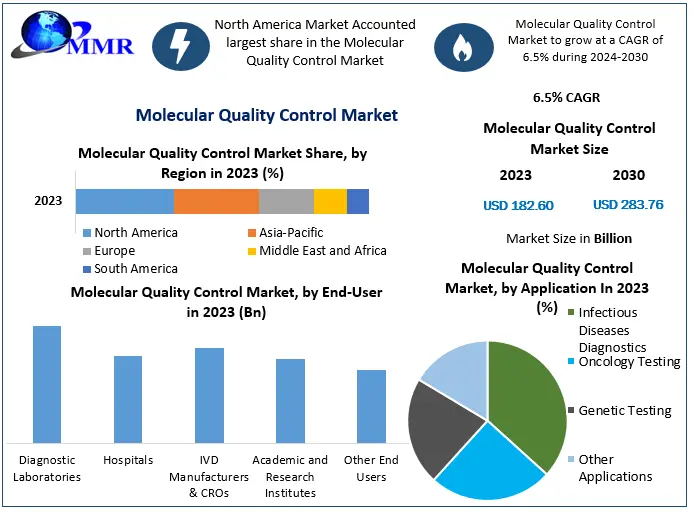
Infectious Disease Dominance: The infectious disease diagnostic applications segment holds the largest share (~44.5%), backed by continuous advancements in multiplex PCR panels.
Sustained Regional Leadership: North America commands the largest global revenue share (~38%), supported by dense networks of accredited diagnostic laboratories and highly developed precision medicine pipelines.
Fast-Track Genomic Scaling: The rapid global expansion of NGS setups is heavily accelerating the integration of multi-analyte controls to safeguard genetic and oncology diagnostics.
Why This Matters Now
Modern healthcare and pathology screening networks are experiencing a massive shift away from traditional culture-based diagnostics toward automated molecular testing. Clinicians heavily rely on highly sensitive Polymerase Chain Reaction (PCR) and Next-Generation Sequencing (NGS) workflows to make definitive decisions regarding oncology therapies, viral loads, and rare inherited conditions. However, because these nucleic acid amplification techniques are exceptionally sensitive, even minor lab contamination, minor thermal variations, or subtle reagent degradation can produce false results, putting patient safety at risk.
Deploying specialized molecular quality controls addresses these baseline assay vulnerabilities directly. By introducing highly stable, quantified positive and negative control matrices into the testing sequence, laboratory teams can continuously monitor assay performance, verify reagent lot stability, and detect errors in real time. Implementing these advanced quality assurance loops is crucial for diagnostic labs to maintain strict regulatory compliance, satisfy international accreditation standards, and guarantee clinical diagnostic accuracy.
Market Overview
The molecular quality controls market functions as an essential quality assurance layer within the global in vitro diagnostics (IVD) and biotechnology sectors. Because verifying complex genetic and viral assays requires high-fidelity matrices that accurately mimic human clinical specimens, this market acts as a critical technical bridge between molecular assay developers, regulatory compliance bodies, and operational clinical labs.
The market’s steady climb toward USD 313.7 Million by 2030 reflects an industry-wide pivot toward independent data validation and standardized laboratory quality control (QC) programs. The market landscape is evaluated across multiple structural paths, including product classification (independent third-party controls vs. instrument-specific proprietary lines), analyte complexity (single-analyte vs. multi-analyte multiplex controls), target application areas (infectious disease diagnostics, oncology tracking, and genetic screening), and core end-user domains like independent diagnostic laboratories, research hubs, and hospital networks.
Key Trends Driving Growth
The most prominent trend accelerating market expansion is the rapid integration of Third-Party Independent Controls into standard lab workflows. Unlike instrument-specific controls provided directly by assay manufacturers, independent controls offer an unbiased validation of the entire testing system. These versatile materials can be used across multiple reagent lots and distinct hardware platforms, allowing high-volume laboratories to achieve uniform quality standards while significantly reducing operational testing overhead.
Another central driver is the global scale-up of Next-Generation Sequencing (NGS) and Digital PCR (dPCR) infrastructure. Clinical oncology programs are increasingly deploying liquid biopsies and targeted gene panels to guide personalized cancer treatments. Because these multi-gene assays generate dense data arrays, labs require advanced multi-analyte controls to validate complex variant calling pipelines, transforming modern genomic surveillance from an academic tool into an everyday diagnostic reality.
Additionally, strict regulatory updates and laboratory accreditation mandates are creating a highly stable baseline of commercial demand. Regulatory bodies globally require clinical facilities to provide verifiable proof of method validation and continuous proficiency testing. To retain their licenses and maintain eligibility for insurance reimbursements, clinical test centers are expanding their routine procurement of verified molecular control samples, establishing a resilient market for leading life sciences vendors.
Segment Insights
Independent Controls (Dominant Product Segment): Capture more than 58% of the global product framework. Their top market position is driven by their cross-platform flexibility, allowing clinical laboratories to run unbiased, multi-instrument performance tracking using a single control matrix.
Single-Analyte Controls (Dominant Analyte Type): Maintain the largest structural revenue share, favored by routine diagnostic laboratories due to their low risk of cross-reactivity, straightforward data analysis, and high cost-effectiveness for singleplex viral or bacterial assays.
Infectious Disease Diagnostics: Stands as the leading application segment, managing high-volume quality assurance pipelines for global healthcare concerns including respiratory infections, sexually transmitted diseases, and viral load monitoring.
Diagnostic Laboratories: Represent the leading end-user tier, utilizing large-scale contract procurement agreements to support high-throughput clinical testing lines and comply with expanding lab accreditation rules.
Regional Growth Story
North America dominates the global molecular quality controls market, securing a commanding 38.2% share of total industry revenue. This leading position is supported by an advanced molecular diagnostics infrastructure, high regional adoption of targeted precision medicine, and strict validation mandates enforced by local regulatory frameworks. The presence of major global control manufacturers throughout the United States and Canada ensures immediate regional access to cutting-edge quality control solutions.
In parallel, the Asia-Pacific region is positioned as the fastest-growing geographical market, projected to expand at an accelerated CAGR of 8.1%. This rapid momentum is propelled by expanding national healthcare networks, rising target disease populations, and extensive genomic surveillance programs across China, Japan, India, and South Korea. Programs like the LC-SCRUM initiative in Japan and the K-MASTER project in South Korea are driving local demand for high-accuracy precision oncology controls, accelerating APAC’s long-term commercial growth.
Competitive Landscape
The global competitive landscape in the molecular quality controls market is highly technical and consolidated, led by established international life sciences conglomerates and specialized molecular control suppliers. Success in this precision-driven sector requires significant investment in advanced biological stabilization methods, extensive catalog access across diverse pathogen strains, and strict alignment with global clinical laboratory validation guidelines.
To maintain their competitive positioning, top-tier vendors focus heavily on launching advanced digital systems and forming strategic clinical platform partnerships. Companies compete intensely on the multi-platform compatibility of their control matrices, the depth of their validation documentation, and the strength of their direct distribution networks to clinical pathology labs, allowing them to secure long-term system integration agreements with major health organizations.
Key Market Players
Bio-Rad Laboratories, Inc. (United States)
Thermo Fisher Scientific, Inc. (United States)
F. Hoffmann-La Roche Ltd (Switzerland)
QIAGEN N.V. (Netherlands)
Abbott Laboratories (United States)
LGC Limited (United Kingdom)
ZeptoMetrix Corporation (United States)
Microbiologics, Inc. (United States)
SeraCare Life Sciences, Inc. (United States)
Strategic Implications
For pathology network directors and clinical laboratory managers, relying entirely on instrument-bundled proprietary controls without independent third-party verification introduces a notable operational blind spot. If an inherent manufacturer kit defect or sub-optimal lot variation occurs, bundled controls may fail to flag the systemic drift, resulting in missed errors, invalid test runs, and potential diagnostic mistakes. Transitioning to independent, third-party quality control loops is a critical step to ensure completely unbiased assay validation, lower operational re-test costs, and protect patient health data.
For molecular assay manufacturers and IVD development teams, treating quality control design as an isolated afterthought rather than an integrated component of development limits long-term market acceptance. As regulatory scrutiny over multiplex panels and companion diagnostics intensifies globally, clinical buyers favor platforms backed by robust, pre-validated control matrices. Collaborating early with independent control specialists to design stable, cross-compatible control materials is key to accelerating regulatory clearance pathways and maximizing product launch success.
Future Outlook
The evolution of the global molecular quality controls market will be shaped by the growth of multiplexed multi-analyte panels, the expanding adoption of automated liquid biopsy validation, and the integration of digital PCR tracking tools into routine oncology testing. As global laboratory networks face complex infectious mutations and strict international data quality audits, long-term market success will belong to manufacturing innovators that eliminate control matrix degradation risks. Future market leaders will be the life sciences corporations that seamlessly blend highly stable, whole-process control materials with real-time cloud data analytics, while legacy vendors relying on unstable, unverified, or highly instrument-restricted control lines will see a steady loss of laboratory market share and declining procurement wins.
Analyst Perspective
“The molecular quality control space has evolved past a basic, checkbox compliance requirement into a sophisticated foundation of modern precision diagnostics,” states a clinical laboratory analytics expert at Maximize Market Research. “By standardizing independent, whole-process third-party controls within high-complexity PCR and NGS workflows, forward-thinking laboratory networks are gaining the exact cross-platform consistency required to eliminate analytical errors and confidently scale personalized patient treatment paths.”
About Maximize Market Research
Maximize Market Research Pvt. Ltd. (MMR) is a global market research and consulting company that provides reliable, data-focused, and practical business insights. The firm serves a wide range of industries, including healthcare, pharmaceuticals, technology, automotive, electronics, chemicals, personal care, and consumer goods. Through market forecasts, competitive analysis, strategic consulting, and industry impact assessments, MMR helps organizations understand changing market conditions, identify growth opportunities, and make informed business decisions for long-term success.
2nd Floor, Navale IT Park Phase 3
Pune Banglore Highway, Narhe
Pune, Maharashtra 411041, India
+91 9607365656
