Residential Gateway Market Grows with Wi-Fi 7, Smart Homes, and Fiber Broadband Expansion
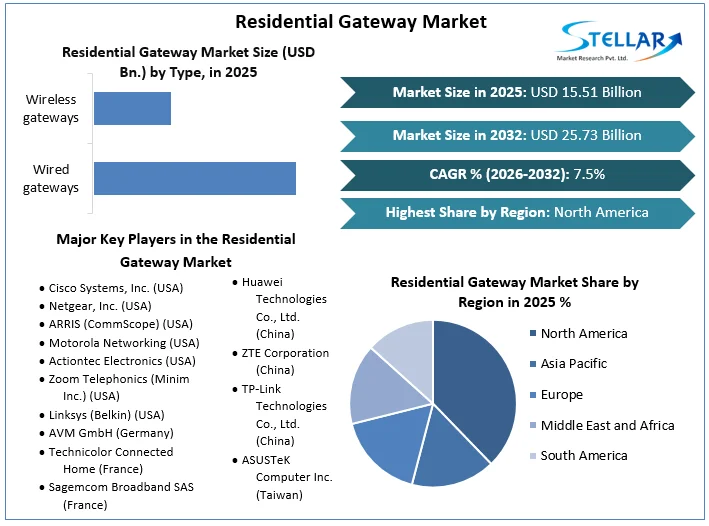
The global Residential Gateway Market is experiencing strong growth as the rapid expansion of smart homes, fiber broadband, and connected devices increases demand for high-performance home networking solutions. Residential gateways have evolved beyond traditional routers, integrating modem, firewall, Wi-Fi, security, and smart home management capabilities into a single platform. According to Stellar Market Research, the global Residential Gateway Market was valued at USD 15.51 billion in 2025 and is projected to reach USD 25.73 billion by 2032, registering a CAGR of 7.5% during the forecast period (2026–2032).
Smart Homes and Connected Devices Fuel Market Expansion
The growing adoption of smart home technologies is transforming residential networking requirements. Modern households now operate dozens of connected devices, including smart TVs, voice assistants, security cameras, gaming consoles, smartphones, laptops, and IoT appliances, all of which require fast, stable, and secure internet connectivity.
Residential gateways provide centralized network management while supporting high-bandwidth applications such as 4K and 8K video streaming, cloud gaming, video conferencing, home automation, and remote work. As the average number of connected devices per household continues to increase, service providers are deploying more advanced gateway solutions capable of managing heavy network traffic efficiently.
𝐃𝐨𝐰𝐧𝐥𝐨𝐚𝐝 𝐅𝐫𝐞𝐞 𝐏𝐃𝐅 𝐁𝐫𝐨𝐜𝐡𝐮𝐫𝐞: https://www.stellarmr.com/report/req_sample/Residential-Gateway-Market/2787
Fiber Broadband and Wi-Fi 7 Accelerate Innovation
The rapid rollout of Fiber-to-the-Home (FTTH) networks and next-generation Wi-Fi technologies is creating significant opportunities for gateway manufacturers. Internet service providers are increasingly replacing legacy equipment with Wi-Fi 6E and Wi-Fi 7 gateways that deliver multi-gigabit speeds, lower latency, and wider wireless coverage.
Modern residential gateways now integrate artificial intelligence to optimize bandwidth allocation, improve network security, and automatically prioritize high-demand applications such as gaming and video streaming.
Key technology trends include:
Wi-Fi 6E and Wi-Fi 7 connectivity
AI-powered mesh networking
Cloud-managed gateway platforms
Matter and Zigbee smart-home integration
Advanced cybersecurity features
Multi-gigabit fiber connectivity
Remote diagnostics and firmware updates
Intelligent Quality of Service (QoS)
These innovations enable telecom operators to improve customer experience while reducing maintenance and support costs.
Wireless Gateways Continue to Dominate
Based on type, wireless gateways accounted for more than 72% of global market revenue in 2025, driven by growing consumer preference for cable-free home networking and seamless smart-home connectivity. Wireless mesh systems have become particularly popular for providing reliable coverage across larger homes and supporting multiple connected devices simultaneously.
By connectivity, fiber gateways held the largest market share at approximately 46%, reflecting the rapid expansion of FTTH infrastructure worldwide. Increasing demand for gigabit broadband services continues to encourage deployment of advanced residential gateway equipment capable of supporting ultra-high-speed internet access.
Cloud-Based Network Management Creates New Opportunities
Cloud-managed residential gateways are becoming increasingly important for internet service providers (ISPs). These platforms allow operators to remotely configure devices, perform diagnostics, deploy firmware updates, and strengthen cybersecurity without requiring on-site technical support.
Artificial intelligence also enables predictive network optimization by identifying congestion, automatically selecting optimal wireless channels, and improving overall network performance. These capabilities enhance customer satisfaction while lowering operational costs for broadband providers.
North America Leads While Asia-Pacific Emerges as the Fastest-Growing Region
North America remained the leading regional market in 2025, supported by extensive fiber broadband deployment, widespread smart-home adoption, and high consumer spending on connected home technologies. Households across the United States and Canada increasingly require advanced gateways capable of supporting numerous simultaneously connected devices and bandwidth-intensive applications.
Asia-Pacific is projected to register the fastest growth throughout the forecast period. Countries including China, India, Japan, and South Korea are expanding broadband infrastructure through government-backed initiatives and increasing investments in digital connectivity. Rapid urbanization, growing middle-class populations, and rising adoption of IoT devices are accelerating residential gateway deployment across the region.
Industry Trends Focus on Security and Interoperability
Cybersecurity has become a major competitive differentiator in the residential gateway industry. Manufacturers are integrating advanced firewall protection, intrusion detection, parental controls, encrypted communications, and AI-based threat detection into gateway platforms.
Compatibility with emerging smart-home standards such as Matter and Zigbee is also becoming increasingly important, enabling homeowners to connect a wider range of devices through a unified networking ecosystem.
Competitive Landscape
The Residential Gateway Market is highly competitive, with leading companies investing in AI networking, fiber broadband technologies, cloud management, and smart-home integration.
Major companies operating in the market include:
Cisco Systems
TP-Link Technologies
Huawei Technologies
Netgear
Technicolor Connected Home
Nokia Corporation
ZTE Corporation
ASUS
D-Link Corporation
Sagemcom Broadband
These companies continue expanding their product portfolios with Wi-Fi 7 gateways, AI-driven mesh networking systems, cloud-managed security platforms, and high-speed fiber connectivity solutions. Strategic collaborations with telecom operators remain a key growth strategy as broadband providers upgrade customer-premises equipment to support next-generation digital services.
𝐃𝐨𝐰𝐧𝐥𝐨𝐚𝐝 𝐅𝐫𝐞𝐞 𝐏𝐃𝐅 𝐁𝐫𝐨𝐜𝐡𝐮𝐫𝐞: https://www.stellarmr.com/report/req_sample/Residential-Gateway-Market/2787
Future Outlook
The future of the Residential Gateway Market remains highly promising as global demand for high-speed internet, smart homes, and connected lifestyles continues to grow. Ongoing investments in fiber broadband, Wi-Fi 7, artificial intelligence, and cloud-based network management are expected to reshape residential connectivity over the coming years.
According to Stellar Market Research, increasing deployment of intelligent gateways capable of supporting smart-home ecosystems, advanced cybersecurity, and multi-gigabit broadband will drive sustained market growth through 2032. Companies that prioritize AI-powered networking, seamless interoperability, and secure cloud management will be well positioned to capitalize on the evolving digital home landscape.
