Resuscitation Devices Market Advances with AI Defibrillators and Expanding Emergency Care Infrastructure
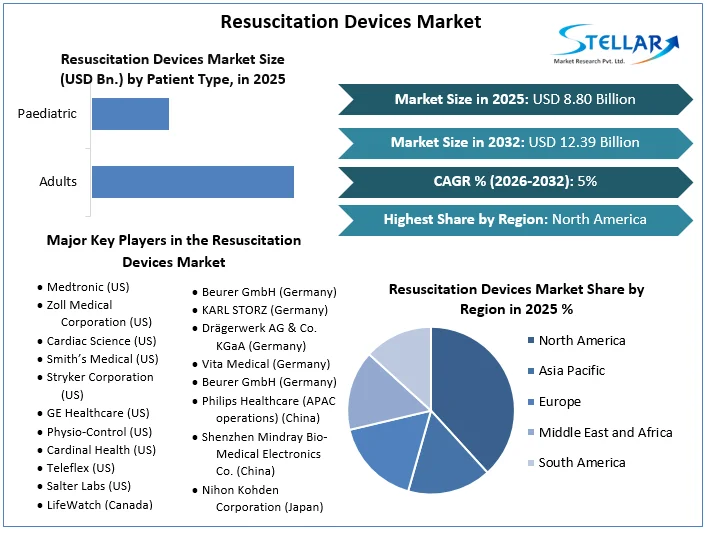
The global Resuscitation Devices Market is experiencing steady growth as healthcare systems worldwide strengthen emergency response capabilities and invest in advanced life-saving technologies. Rising incidences of cardiac arrest, respiratory disorders, trauma cases, and preterm births are increasing the demand for innovative resuscitation equipment across hospitals, ambulatory care centers, and pre-hospital emergency services. According to Stellar Market Research, the global Resuscitation Devices Market was valued at USD 8.80 billion in 2025 and is projected to reach USD 12.39 billion by 2032, growing at a CAGR of 5% during the forecast period (2026–2032).
Rising Cardiac Emergencies Drive Market Growth
The increasing prevalence of cardiovascular diseases remains one of the primary drivers of the Resuscitation Devices Market. Every minute during a cardiac arrest significantly impacts survival rates, encouraging healthcare providers, governments, and public institutions to deploy automated external defibrillators (AEDs), mechanical CPR systems, airway management devices, and advanced ventilators.
Healthcare organizations are also expanding emergency preparedness by installing public-access defibrillators in airports, schools, shopping centers, sports venues, and transportation hubs. Growing awareness of cardiopulmonary resuscitation (CPR) and improved emergency medical services are further supporting market expansion.
𝐃𝐨𝐰𝐧𝐥𝐨𝐚𝐝 𝐅𝐫𝐞𝐞 𝐏𝐃𝐅 𝐁𝐫𝐨𝐜𝐡𝐮𝐫𝐞: https://www.stellarmr.com/report/req_sample/Resuscitation-Devices-Market/2798
AI-Powered Emergency Devices Transform Patient Care
Technological innovation is reshaping modern resuscitation equipment. Manufacturers are integrating artificial intelligence, remote monitoring, real-time compression feedback, and connected healthcare capabilities into next-generation devices.
Key technology trends include:
AI-powered rhythm analysis
Smart automated external defibrillators (AEDs)
Connected emergency monitoring systems
Mechanical CPR devices
Portable ventilators
Remote telemetry and cloud connectivity
Compact airway management systems
Digital emergency response integration
These technologies improve clinical decision-making, reduce response times, and help healthcare professionals deliver more effective emergency treatment in hospitals and pre-hospital settings.
Hospitals Continue to Lead Product Adoption
Hospitals remain the largest end-user segment due to high patient volumes and the need for advanced emergency care equipment. Intensive care units (ICUs), emergency departments, operating rooms, and trauma centers rely heavily on resuscitation devices to manage critical medical situations.
Airway management devices and external defibrillators continue to represent key product categories because they are essential components of emergency response protocols. Increasing investments in critical care infrastructure and emergency preparedness programs are expected to sustain long-term demand across healthcare facilities.
Public Access Defibrillation Expands Market Opportunities
Governments and healthcare organizations are increasingly implementing public-access defibrillation programs to improve survival outcomes during out-of-hospital cardiac arrest.
Growing investments in emergency medical infrastructure have encouraged wider deployment of AEDs across public locations, while CPR awareness campaigns continue improving community readiness. Combined with advances in portable and user-friendly devices, these initiatives are creating new opportunities for manufacturers worldwide.
North America Maintains Market Leadership
North America accounted for the largest share of the global Resuscitation Devices Market in 2025, supported by advanced healthcare infrastructure, high prevalence of cardiovascular disease, favorable reimbursement systems, and continuous investment in emergency medical technologies. Strong adoption of innovative defibrillators, ventilators, and airway management systems continues to reinforce regional leadership.
Asia-Pacific is expected to register significant growth throughout the forecast period as healthcare infrastructure expands across China, India, Japan, and Southeast Asia. Rising healthcare expenditure, improving emergency response systems, and increasing awareness of life-saving technologies are accelerating regional demand.
Innovation and Regulatory Compliance Shape Competition
Medical device manufacturers continue focusing on improving product performance while complying with stringent global regulatory standards. Advanced software integration, miniaturization, battery efficiency, and wireless connectivity have become important competitive differentiators.
Recent product launches demonstrate the industry’s commitment to innovation. AI-assisted defibrillators, connected CPR devices, and intelligent airway management systems are helping healthcare providers deliver faster and more accurate emergency care.
𝐃𝐨𝐰𝐧𝐥𝐨𝐚𝐝 𝐅𝐫𝐞𝐞 𝐏𝐃𝐅 𝐁𝐫𝐨𝐜𝐡𝐮𝐫𝐞: https://www.stellarmr.com/report/req_sample/Resuscitation-Devices-Market/2798
Competitive Landscape
The Resuscitation Devices Market remains highly competitive, with leading medical technology companies investing in product innovation, acquisitions, and global expansion.
Major companies operating in the market include:
Medtronic plc
ZOLL Medical Corporation
Stryker Corporation
Philips Healthcare
Cardinal Health
Dräger
Ambu A/S
Mindray Medical
Teleflex Incorporated
Nihon Kohden Corporation
Companies are strengthening their market positions through AI-enabled emergency care devices, remote patient monitoring capabilities, strategic acquisitions, and expanded product portfolios. For example, Stryker strengthened its emergency care portfolio through the acquisition of Inari Medical in 2025, while Medtronic introduced next-generation implantable defibrillator technologies featuring enhanced remote monitoring capabilities.
Future Outlook
The future of the Resuscitation Devices Market remains highly promising as healthcare systems continue prioritizing emergency preparedness and advanced critical care. Rising cardiovascular disease prevalence, expanding public-access defibrillation programs, technological innovation, and increasing healthcare investments are expected to drive sustained market growth through 2032.
According to Stellar Market Research, continued advancements in AI-powered emergency devices, connected healthcare ecosystems, and portable life-support technologies will create significant opportunities for manufacturers. Companies that focus on intelligent automation, clinical reliability, regulatory compliance, and user-friendly emergency solutions will be well positioned to lead the next generation of life-saving medical technologies.
