Utility Markers Market to Reach USD 789.37 Million by 2032 as Smart Infrastructure Projects Accelerate Worldwide
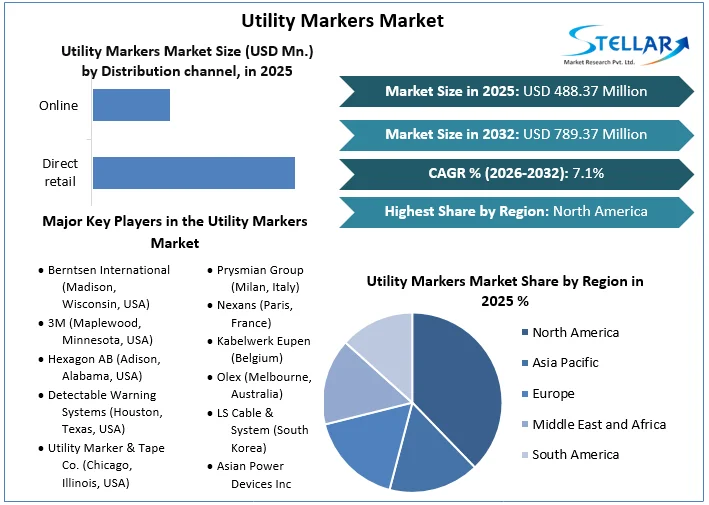
The global Utility Markers Market is witnessing steady growth as governments and utility providers invest in modernizing underground infrastructure and improving excavation safety. Utility markers play a vital role in identifying buried pipelines, power cables, fiber-optic networks, water lines, and other critical underground assets, helping reduce accidental damage during construction and maintenance activities. According to the latest industry analysis, the global utility markers market was valued at USD 488.37 million in 2025 and is projected to reach USD 789.37 million by 2032, registering a CAGR of 7.1% during the forecast period.
Infrastructure Development Drives Market Growth
Rapid urbanization, expanding transportation networks, renewable energy projects, and smart city initiatives are significantly increasing the demand for reliable underground utility identification systems. Governments across the globe are investing in new power grids, water distribution systems, telecommunication infrastructure, and gas pipelines, creating strong demand for utility markers that improve operational safety and regulatory compliance.
Strict excavation safety regulations are also encouraging contractors and utility operators to adopt advanced marking solutions that minimize service interruptions and protect public infrastructure.
𝐃𝐨𝐰𝐧𝐥𝐨𝐚𝐝 𝐅𝐫𝐞𝐞 𝐏𝐃𝐅 𝐁𝐫𝐨𝐜𝐡𝐮𝐫𝐞: https://www.stellarmr.com/report/req_sample/utility-markers-market/2850
Smart Technologies Revolutionize Utility Marking
Technological innovation is transforming traditional utility markers into intelligent infrastructure management tools. Modern solutions now incorporate RFID, GPS, GIS, Bluetooth connectivity, and QR codes, enabling accurate underground asset mapping and real-time data access.
Programmable utility markers integrated with Internet of Things (IoT) platforms are becoming increasingly popular for smart city projects. Artificial intelligence is also being used to analyze historical utility maps and soil data, helping improve underground asset detection and reduce excavation risks.
Renewable Energy Projects Create New Opportunities
The rapid expansion of renewable energy infrastructure is opening new growth opportunities for utility marker manufacturers. Solar farms, wind power installations, hydrogen pipelines, geothermal facilities, and offshore transmission networks all require accurate underground utility identification.
As countries continue investing in sustainable energy infrastructure, the demand for durable, weather-resistant, and high-visibility utility markers is expected to rise steadily throughout the forecast period.
Market Segmentation Highlights
By Function
The passive utility markers segment dominated the market in 2025 due to its affordability, durability, and widespread use in traditional underground utility detection. However, programmable markers are gaining traction as digital infrastructure projects increasingly require smart monitoring capabilities.
By Marker Type
Tape markers accounted for the largest market share owing to their easy installation, color-coded warning systems, and broad use across construction and utility projects. Ball markers also remain widely used because they can be easily detected underground using specialized locating equipment.
By Distribution Channel
Direct retail continues to dominate the market, particularly for large infrastructure projects requiring bulk purchases. Meanwhile, online sales are expanding rapidly as digital procurement platforms simplify purchasing for contractors and utility companies.
By End-User Industry
The oil and gas sector remains the largest end-user due to extensive underground pipeline networks and strict safety regulations. Significant demand also comes from electricity and power, telecommunications, water and wastewater management, and transportation infrastructure.
Regional Outlook
North America leads the global utility markers market due to stringent excavation safety regulations, aging infrastructure replacement programs, and significant investments in utility maintenance. The region continues to adopt advanced technologies such as RFID-enabled and GIS-integrated utility markers.
Emerging economies in Asia-Pacific are expected to experience robust growth, driven by rapid industrialization, urban expansion, infrastructure modernization, and increasing government investment in public utilities. Public-private partnerships and foreign investments are further supporting regional market expansion.
Challenges Facing the Industry
Despite favorable market conditions, several challenges remain:
High costs associated with utility easements and rights-of-way.
Complex regulatory requirements across different regions.
Rising raw material and manufacturing costs.
Limited awareness of advanced utility marking technologies in developing markets.
Integration challenges when upgrading legacy infrastructure systems.
Competitive Landscape
The market features strong competition among global manufacturers focusing on product innovation, durability, and digital integration. Companies are investing in RFID-enabled markers, IoT connectivity, sustainable materials, and AI-powered asset management solutions to strengthen their competitive positions.
Strategic mergers, acquisitions, and partnerships with construction firms, utility providers, and smart city developers are also shaping the competitive landscape. The growing demand for biodegradable materials and environmentally friendly products is encouraging manufacturers to develop sustainable utility marking solutions.
𝐃𝐨𝐰𝐧𝐥𝐨𝐚𝐝 𝐅𝐫𝐞𝐞 𝐏𝐃𝐅 𝐁𝐫𝐨𝐜𝐡𝐮𝐫𝐞: https://www.stellarmr.com/report/req_sample/utility-markers-market/2850
Future Outlook
The future of the Utility Markers Market remains promising as global infrastructure investments continue to grow and underground utility networks become increasingly complex. Advances in smart technologies, artificial intelligence, and digital mapping are expected to improve the efficiency, accuracy, and reliability of utility marking systems.
Manufacturers that prioritize innovation, sustainability, and integration with modern asset management platforms will be well positioned to capitalize on the expanding opportunities created by smart cities, renewable energy projects, and next-generation utility infrastructure.
