Peripheral Vascular Devices and Accessories Market to Reach USD 21.64 Billion by 2032 as Minimally Invasive Vascular Treatments Gain Momentum
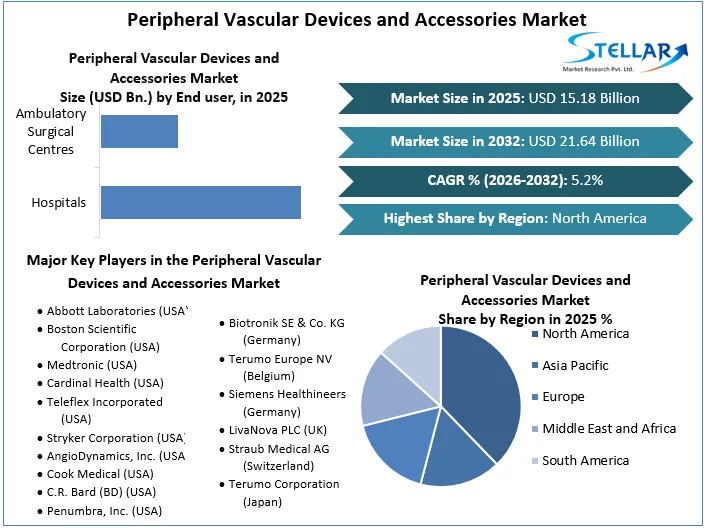
The global Peripheral Vascular Devices and Accessories Market is experiencing steady growth as the prevalence of peripheral arterial disease (PAD), aneurysms, and other vascular disorders continues to rise worldwide. Increasing adoption of minimally invasive endovascular procedures, combined with technological advancements in vascular intervention devices, is driving demand across hospitals and ambulatory surgical centers. According to the latest industry analysis, the market was valued at USD 15.18 billion in 2025 and is projected to reach USD 21.64 billion by 2032, growing at a CAGR of 5.2% during the forecast period.
Rising Burden of Peripheral Arterial Disease Fuels Market Growth
The growing incidence of peripheral arterial disease, diabetes, obesity, hypertension, and an aging population is significantly increasing the need for advanced vascular treatment solutions. Peripheral vascular devices help restore blood flow, reduce complications, and improve patient outcomes through minimally invasive procedures.
Healthcare providers are increasingly preferring catheter-based interventions over traditional open surgeries due to shorter hospital stays, faster recovery, lower complication rates, and improved procedural success. These factors continue to strengthen demand for peripheral vascular devices globally.
𝐃𝐨𝐰𝐧𝐥𝐨𝐚𝐝 𝐅𝐫𝐞𝐞 𝐏𝐃𝐅 𝐁𝐫𝐨𝐜𝐡𝐮𝐫𝐞: https://www.stellarmr.com/report/req_sample/peripheral-vascular-devices-and-accessories-market/2858
Technological Innovations Transform Vascular Care
Continuous innovation is reshaping the peripheral vascular device industry. Manufacturers are introducing drug-coated balloons, drug-eluting stents, bioresorbable scaffolds, atherectomy systems, advanced imaging technologies, and AI-assisted navigation systems to improve procedural precision.
Modern vascular devices offer greater flexibility, enhanced deliverability, superior durability, and improved long-term clinical outcomes. Integration of intravascular ultrasound (IVUS), digital imaging, and robotic-assisted interventions is further advancing minimally invasive vascular treatment.
Growing Preference for Minimally Invasive Procedures
Patients and healthcare providers increasingly favor minimally invasive vascular interventions because they reduce surgical trauma, shorten recovery periods, minimize blood loss, and lower healthcare costs.
The expansion of outpatient vascular procedures has also contributed to higher adoption of peripheral vascular devices in ambulatory surgical centers, creating additional growth opportunities for manufacturers worldwide.
Market Segmentation Highlights
By Product
Peripheral stents accounted for the largest market share due to their proven effectiveness in treating peripheral arterial disease and maintaining long-term vessel patency. PTA balloons, catheters, endovascular aneurysm repair (EVAR) stent grafts, and other accessories continue to witness increasing demand as vascular intervention procedures become more common.
By Application
Peripheral arterial disease (PAD) remains the dominant application segment owing to its rising global prevalence. Devices used in aneurysm repair and venous disease management are also experiencing significant growth as awareness and early diagnosis improve.
By End User
Hospitals represent the largest end-user segment because they perform the highest volume of complex vascular procedures and maintain advanced interventional facilities. Ambulatory surgical centers are expected to register strong growth due to increasing outpatient treatment adoption and healthcare cost optimization.
Regional Outlook
North America dominates the global Peripheral Vascular Devices and Accessories Market, supported by advanced healthcare infrastructure, high adoption of minimally invasive procedures, favorable reimbursement policies, and the presence of leading medical device manufacturers.
The Asia-Pacific region is projected to witness the fastest growth during the forecast period. Rising healthcare expenditure, expanding hospital infrastructure, increasing awareness of vascular diseases, and a growing elderly population in countries such as China, India, and Japan are accelerating regional market expansion.
Challenges Facing the Industry
Despite strong growth potential, the market faces several challenges:
High costs associated with advanced vascular devices.
Stringent regulatory approval processes for medical devices.
Limited access to specialized vascular care in developing regions.
Product recalls and reimbursement uncertainties.
Shortage of skilled interventional specialists in some healthcare systems.
Competitive Landscape
The market is moderately consolidated, with leading companies investing heavily in research, product innovation, and strategic acquisitions. Major industry participants include Abbott Laboratories, Boston Scientific Corporation, Medtronic, Becton, Dickinson and Company (BD), Cook Medical, Teleflex Incorporated, Terumo Corporation, Philips, Siemens Healthineers, and AngioDynamics. These companies continue to develop next-generation vascular technologies to improve treatment outcomes and expand their global market presence.
𝐃𝐨𝐰𝐧𝐥𝐨𝐚𝐝 𝐅𝐫𝐞𝐞 𝐏𝐃𝐅 𝐁𝐫𝐨𝐜𝐡𝐮𝐫𝐞: https://www.stellarmr.com/report/req_sample/peripheral-vascular-devices-and-accessories-market/2858
Future Outlook
The future of the Peripheral Vascular Devices and Accessories Market remains promising as cardiovascular disease prevalence continues to increase and healthcare providers prioritize minimally invasive treatment options. Advances in stent technology, drug-coated devices, vascular imaging, and robotic-assisted interventions are expected to enhance procedural success and patient outcomes.
With growing investments in healthcare infrastructure, expanding patient access to advanced vascular care, and ongoing technological innovation, the market is well positioned for sustained growth through 2032.
