Light Beer Market to Reach USD 503.81 Million by 2032 as Health-Conscious Consumers Drive Premium Beer Demand
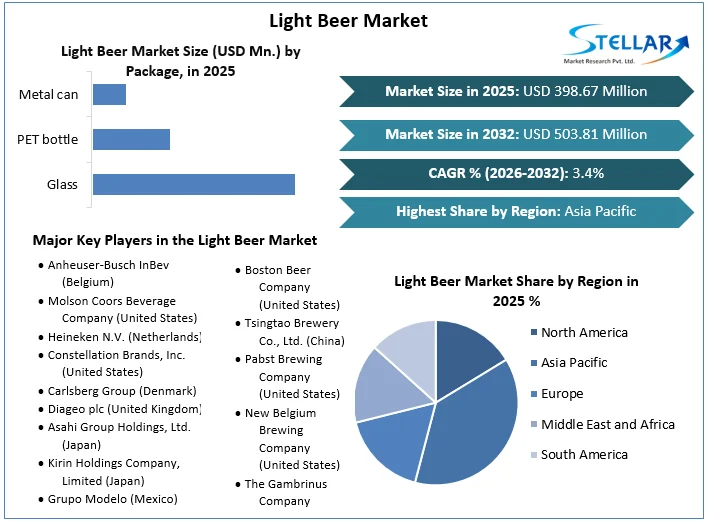
The global Light Beer Market is experiencing steady growth as consumers increasingly seek beverages with lower calories and reduced alcohol content without compromising taste. Evolving lifestyle preferences, growing health awareness, and the expansion of craft brewing are reshaping the beer industry, making light beer one of the fastest-growing categories in alcoholic beverages. According to the latest industry analysis, the global Light Beer Market was valued at USD 398.67 million in 2025 and is projected to reach USD 503.81 million by 2032, registering a CAGR of 3.4% during the forecast period.
Health and Wellness Trends Fuel Market Growth
Consumers are becoming increasingly mindful of calorie intake and alcohol consumption, leading to higher demand for light beer products. Light beer offers fewer calories and lower alcohol content than traditional beer while maintaining a refreshing taste, making it particularly attractive to fitness-conscious individuals and younger consumers.
The growing popularity of moderation and “better-for-you” alcoholic beverages is encouraging breweries to expand their portfolios with innovative light beer offerings. Low-carb, gluten-reduced, and organic variants are also gaining traction as consumer preferences continue to evolve.
𝐃𝐨𝐰𝐧𝐥𝐨𝐚𝐝 𝐅𝐫𝐞𝐞 𝐏𝐃𝐅 𝐁𝐫𝐨𝐜𝐡𝐮𝐫𝐞: https://www.stellarmr.com/report/req_sample/Light-Beer-Market/1807
Craft Brewing Revolution Expands Product Choices
The rapid growth of craft breweries has transformed the global light beer market. Small and independent breweries are introducing premium light beers with unique ingredients, distinctive flavors, and local brewing techniques, attracting consumers looking for alternatives to traditional mass-produced products.
With more than 19,000 breweries operating worldwide and craft breweries accounting for a significant majority, innovation continues to drive competition across the industry. Breweries are experimenting with fruit infusions, botanical ingredients, and sustainable brewing methods to differentiate their products in an increasingly competitive market.
Premiumization Strengthens Consumer Demand
Premium beer consumption continues to rise across developed and emerging markets. Consumers are willing to spend more on high-quality beverages that combine superior taste, premium ingredients, and healthier nutritional profiles.
Manufacturers are responding by launching premium light lagers, low-calorie IPAs, and specialty brews that appeal to consumers seeking both quality and wellness. Attractive packaging and limited-edition releases are further supporting market growth across retail and hospitality channels.
E-Commerce and Modern Retail Drive Sales
Digital commerce has become an important distribution channel for alcoholic beverages in markets where regulations permit online sales. Consumers benefit from greater product variety, subscription services, promotional pricing, and convenient home delivery.
Meanwhile, supermarkets, specialty liquor stores, restaurants, bars, and convenience stores continue to play an essential role in expanding product availability and improving brand visibility. Omnichannel retail strategies are helping breweries reach broader customer segments.
Market Segmentation Highlights
By Production
The craft brewery segment is expected to witness significant growth due to rising consumer interest in premium, locally produced, and innovative beer varieties. Macro breweries continue to dominate overall production because of their extensive distribution networks and established brand recognition.
By Packaging
Metal cans and glass bottles remain the most widely used packaging formats. Aluminum cans are becoming increasingly popular because they are lightweight, recyclable, and convenient for outdoor activities, while glass bottles continue to appeal to consumers seeking a premium drinking experience.
By Distribution Channel
Hypermarkets and supermarkets account for a major share of global sales due to their broad product selection and competitive pricing. On-trade channels—including bars, pubs, restaurants, and hotels—remain important for premium light beer consumption and brand exposure.
Regional Outlook
North America remains one of the largest markets for light beer, supported by strong consumer awareness, established brewing companies, and widespread demand for lower-calorie alcoholic beverages. The United States continues to lead consumption with well-known brands and a thriving craft beer ecosystem.
Europe also maintains a significant market share due to its long brewing tradition and premium beer culture. Meanwhile, Asia-Pacific is expected to experience robust growth as rising disposable incomes, urbanization, and changing consumer lifestyles increase demand for premium and light alcoholic beverages.
Challenges Facing the Industry
Despite favorable market conditions, the industry faces several challenges:
Intense competition from traditional and craft beer brands.
Strict government regulations governing alcohol marketing and sales.
Rising raw material and packaging costs.
Increasing consumer preference for alcohol-free beverages in some markets.
High taxation on alcoholic drinks in several countries.
Competitive Landscape
Leading brewers continue to invest in product innovation, premium branding, and sustainable brewing practices to strengthen their market positions. Major companies include Anheuser-Busch InBev, Molson Coors Beverage Company, Heineken N.V., Carlsberg Group, Asahi Group Holdings, Kirin Holdings, Constellation Brands, and Boston Beer Company. Strategic product launches, acquisitions, and investments in craft beer brands remain central to competitive strategies.
𝐃𝐨𝐰𝐧𝐥𝐨𝐚𝐝 𝐅𝐫𝐞𝐞 𝐏𝐃𝐅 𝐁𝐫𝐨𝐜𝐡𝐮𝐫𝐞: https://www.stellarmr.com/report/req_sample/Light-Beer-Market/1807
Future Outlook
The future of the Light Beer Market remains promising as health-conscious lifestyles, premiumization, and craft brewing continue to reshape consumer preferences. Innovation in brewing techniques, sustainable packaging, and flavor development is expected to create new growth opportunities for manufacturers worldwide.
As consumers increasingly seek balanced lifestyles without giving up social drinking experiences, light beer is expected to remain an attractive choice, supporting steady market expansion through 2032.
