Stainless Steel Fermenter Market to Reach USD 5.23 Billion by 2032 as Biotechnology and Food Processing Industries Expand
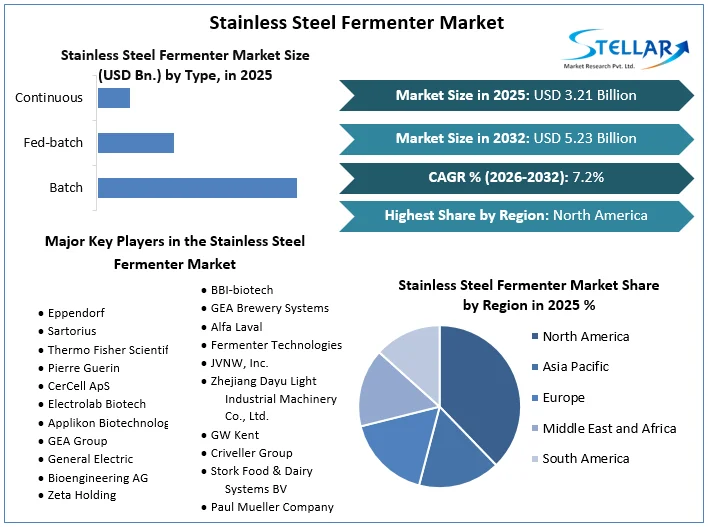
The global Stainless Steel Fermenter Market is witnessing strong growth as industries increasingly adopt advanced fermentation technologies for food production, biotechnology, pharmaceuticals, and healthcare applications. Stainless steel fermenters have become essential equipment due to their durability, corrosion resistance, hygiene benefits, and ability to support precise fermentation processes. According to the latest market analysis, the global Stainless Steel Fermenter Market was valued at USD 3.00 billion in 2024 and is projected to reach nearly USD 5.23 billion by 2032, growing at a CAGR of 7.2% during 2025–2032.
Increasing Demand for Fermented Products Drives Market Growth
The growing popularity of fermented foods and beverages is one of the major factors supporting the expansion of stainless steel fermenters. Products such as yogurt, cheese, kombucha, beer, wine, probiotics, and other fermented foods require controlled fermentation environments to maintain quality, consistency, and safety.
Food and beverage manufacturers are investing in modern fermentation equipment to increase production efficiency while meeting rising consumer demand for healthier and functional food products. Stainless steel fermenters provide excellent temperature control, contamination prevention, and easy cleaning capabilities, making them a preferred choice across the industry.
𝐃𝐨𝐰𝐧𝐥𝐨𝐚𝐝 𝐅𝐫𝐞𝐞 𝐏𝐃𝐅 𝐁𝐫𝐨𝐜𝐡𝐮𝐫𝐞: https://www.stellarmr.com/report/req_sample/Stainless-Steel-Fermenter-Market/1831
Biotechnology and Pharmaceutical Applications Accelerate Adoption
The biotechnology and pharmaceutical sectors represent significant growth opportunities for stainless steel fermenter manufacturers. Increasing production of vaccines, monoclonal antibodies, enzymes, antibiotics, and other biopharmaceutical products requires highly efficient fermentation systems.
Advanced fermenters equipped with automated controls, monitoring systems, and precision temperature regulation enable manufacturers to improve production yields and maintain strict quality standards. The rising focus on personalized medicine and biologics development is further increasing demand for reliable fermentation infrastructure.
Automation and Smart Fermentation Technologies Transform the Industry
Technological innovation is reshaping the stainless steel fermenter market. Modern systems are increasingly integrated with automation technologies, sensors, digital monitoring platforms, and advanced control systems to improve operational efficiency.
Smart fermenters allow manufacturers to monitor important parameters such as temperature, pressure, pH levels, oxygen concentration, and nutrient supply in real time. These capabilities help reduce production errors, optimize fermentation cycles, and improve overall productivity.
The integration of Industry 4.0 technologies and data-driven process management is expected to create new opportunities for manufacturers developing next-generation fermentation equipment.
Sustainability Trends Support Stainless Steel Fermenter Demand
Sustainability has become an important factor influencing industrial equipment decisions. Stainless steel fermenters offer long operational life, recyclability, and resistance to corrosion, making them suitable for environmentally responsible manufacturing operations.
Industries are increasingly adopting efficient fermentation processes for alternative proteins, biofuels, enzymes, and sustainable chemicals. This shift toward bio-based production methods is expected to generate additional demand for advanced fermentation systems.
Market Segmentation Highlights
By Type
The Fed-batch fermenter segment holds a significant position in the global market due to its widespread application in biotechnology, pharmaceutical manufacturing, and industrial fermentation processes.
Fed-batch systems allow controlled nutrient addition during fermentation, helping improve productivity and achieve higher yields compared with traditional batch processes. The increasing demand for biopharmaceutical production continues to support the adoption of fed-batch technology.
By Application
The major application segments include:
Food
Beverages
Healthcare & Cosmetics
The food and beverage sector remains a key contributor due to increasing consumption of fermented products. Healthcare and biotechnology applications are also expanding rapidly because of rising investments in biologics and pharmaceutical research.
By Process Type
Batch, fed-batch, and continuous fermentation systems are widely used depending on production requirements. Continuous fermentation is gaining attention because of its ability to support high-volume production with improved efficiency.
Regional Outlook
North America currently leads the global Stainless Steel Fermenter Market due to strong biotechnology research, advanced pharmaceutical manufacturing capabilities, and a well-established craft beverage industry. The region’s focus on automation and advanced fermentation technologies continues to support market growth.
Europe represents another important market, supported by strict quality regulations, strong food and beverage industries, and increasing adoption of sustainable production technologies.
Asia-Pacific is expected to experience significant growth during the forecast period due to rapid industrialization, expanding pharmaceutical production, rising demand for fermented foods, and increasing investments in biotechnology infrastructure. Countries such as China and India are becoming important manufacturing hubs for fermentation-based industries.
𝐃𝐨𝐰𝐧𝐥𝐨𝐚𝐝 𝐅𝐫𝐞𝐞 𝐏𝐃𝐅 𝐁𝐫𝐨𝐜𝐡𝐮𝐫𝐞: https://www.stellarmr.com/report/req_sample/Stainless-Steel-Fermenter-Market/1831
Challenges Facing the Industry
Despite strong growth opportunities, the market faces several challenges:
High initial investment costs for advanced fermenter systems
Complex maintenance requirements
Need for skilled technical professionals
Strict regulatory compliance requirements
Fluctuating stainless steel raw material prices
Manufacturers are addressing these challenges by developing cost-effective systems, modular fermenters, and automated solutions that reduce operational complexity.
Competitive Landscape
The stainless steel fermenter market is competitive, with companies focusing on innovation, customization, automation, and strategic partnerships. Industry players are expanding their product portfolios to serve diverse applications across pharmaceuticals, biotechnology, food processing, and beverage manufacturing.
Recent strategic developments include acquisitions and collaborations aimed at strengthening fermentation technology capabilities and expanding market reach. For example, SPX FLOW acquired GEA Brewery Systems in 2023 to enhance its position in brewing and fermentation equipment, while Alfa Laval collaborated with Fermenter Technologies to strengthen craft brewing solutions.
Future Outlook
The future of the Stainless Steel Fermenter Market looks promising as industries continue shifting toward efficient, sustainable, and technology-driven fermentation processes. Growing demand for biopharmaceuticals, functional foods, alternative proteins, and bio-based products will continue to create opportunities for market expansion.
With advancements in automation, digital monitoring, and precision fermentation technologies, stainless steel fermenters are expected to remain a critical component of modern industrial production systems through 2032.
