Key Highlights
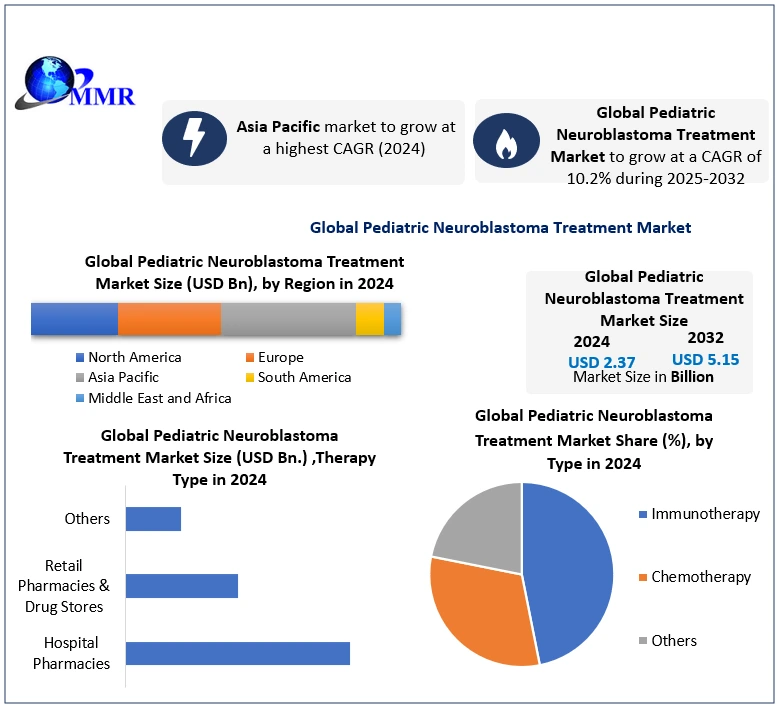
Market Valuation: The pediatric neuroblastoma treatment market reached USD 2.37 billion in 2024 and is projected to expand to USD 5.15 billion by 2032.
Growth Velocity: Commercial acceleration maintains a steady compounding annual growth rate (CAGR) of 10.2% from 2025 to 2032.
Therapy Performance: Immunotherapy commands the highest revenue allocation among therapy types due to elevated clinical adoption and premium pricing tiers.
Supply Channel Value: Hospital pharmacies capture the largest market share, controlling therapeutic administration for complex high-dose regimens.
Regional Dynamics: North America retains massive capital dominance, while Asia Pacific serves as the fastest-growing geographical segment over the forecast period.
Why This Matters Now
The financial and clinical landscape for childhood cancer therapeutics is experiencing a deep realignment driven by targeted precision medicine. Hospital groups, oncology investors, and global pharmaceutical entities face a sharp escalation in pediatric neuroblastoma treatment costs alongside an expanding global patient pool. Emerging gene mutations and persistent late-stage diagnoses compress the development timeline for next-generation metastatic neuroblastoma drugs.
What changed? The medical framework has transitioned away from broad, high-toxicity systemic interventions toward targeted biologics that improve infant survival rates. Why now? Regulatory acceleration pathways and an influx of clinical research and development funding are squeezing asset commercialization timelines from a decade down to multiple concurrent trials. This rapid shift rewards biopharma pioneers securing early approvals while putting cost pressures on regional public insurance systems trying to fund these innovative protocols.
Market Overview
The Global pediatric neuroblastoma treatment market reached a clear valuation of USD 2.37 billion in 2024. Rising detection rates combined with expanding technical infrastructure push global market revenues toward USD 5.15 billion by 2032. This performance yields a steady 10.2% CAGR throughout the 2025 to 2032 forecast window. However, high therapeutic costs create significant adoption barriers across volatile, emerging medical economies.
Neuroblastoma develops within early nerve cells of infants and children under the age of 10, often generating tumors along the spine, neck, chest, or abdomen. The disease imposes an acute burden on specialized pediatric healthcare networks, requiring long-term, multi-modal hospital treatment. Symptoms range from distinct physical presentations like bulging eyes and abdominal masses to systemic imbalances including anemia, bone pain, and high blood pressure.
Key Trends Driving Growth
Escalating disease prevalence acts as the primary volume catalyst for specialized therapeutic pipelines. In the United States alone, diagnostic tracking confirms between 650 and 800 new clinical cases each year. This persistent disease base creates a reliable commercial demand for novel orphan drug classes and targeted advanced therapies.
Rising corporate and public healthcare expenditure allows advanced children’s hospitals to integrate premium-tier therapies into standard treatment protocols. Concurrently, technical improvements across diagnostic fields—specifically advanced imaging tools like MIBG scans and PET/MRI setups—uncover early-stage tumors faster. Early identification broadens the window for continuous, highly profitable therapeutic interventions.
A heavy emphasis on clinical trial fundraising also shapes the biopharmaceutical pipeline. Corporate leaders are shifting capital into combinations of chemotherapy and immunotherapy to overcome metastatic resistance. Regulatory approval pathways for orphan indications have shortened, allowing small and large biotech firms to commercialize highly specialized molecules rapidly.
Segment Insights
Dominant Therapy Type: Immunotherapy holds the largest revenue share in the market, benefiting from strong medical adoption and higher commercial pricing compared to traditional options.
Therapy Runners-Up: Chemotherapy and other therapeutic options continue to support multi-agent protocols, maintaining consistent supply volumes across all pediatric hospital networks.
Dominant Distribution Channel: Hospital Pharmacies capture the largest market share, serving as the essential hub for handling and dispensing complex injectable oncology assets.
Alternative Distribution Channels: Retail Pharmacies & Drug Stores along with other specialty channels manage maintenance medications, though their overall revenue share remains secondary to inpatient facilities.
Regional Growth Story
North America maintains structural dominance within the global pediatric neuroblastoma treatment market. This leadership stems from early technology integration, established healthcare networks, and favorable institutional insurance coverage. The region’s commercial strength is further driven by reliable diagnostic reporting, as American Cancer Society data tracks approximately 800 new cases annually.
Europe retains a substantial portion of the global marketplace, supported by dedicated public clinical trials and structured regional healthcare funding. Advanced clinical settings in Germany, the UK, and France actively incorporate premium therapeutic options into their standard pediatric oncology protocols. These well-developed compensation frameworks help insulate manufacturers from localized economic shifts.
Asia Pacific stands out as the fastest-growing regional segment through 2032. Rapidly improving healthcare facilities in China and India are broadening access to advanced care for large patient populations. Increasing research capabilities, technological adoption, and local clinical production across South Korea and Japan are accelerating the region’s overall market growth.
Competitive Landscape
The competitive space centers on specialized biopharmaceutical companies advancing targeted biologic pipelines. Established enterprises leverage their extensive manufacturing networks, while agile biotechnology firms focus on developing niche orphan molecules. Strategic positioning depends heavily on securing exclusive intellectual property rights and rolling out premium therapies across major hospital networks.
Market leaders concentrate their capital on R&D and aggressive fundraising to push early-stage candidates into Phase II and Phase III trials. Strategic alliances between infrastructure providers like Baxter or Sartorius and innovative drug developers like Y-mAbs or APEIRON shorten manufacturing setup times. Meanwhile, generic suppliers like Sun Pharma and Teva stabilize the market by providing affordable baseline chemotherapies.
Recent Developments
Pipeline Fundraising: Key industry players are expanding their R&D budgets to speed up clinical validation for high-risk neuroblastoma therapies.
Targeted Monoclonal Approvals: Recent product authorizations are shifting clinical focus away from general chemotherapies toward targeted immunotherapies.
Diagnostic Upgrades: Modern imaging protocols, including PET/MRI and advanced biopsies, are increasingly paired with therapies to track real-time patient outcomes.
Infrastructure Investment: Major hospital pharmacies are upgrading their cold-chain capabilities to support next-generation biologics and targeted injectables.
Strategic Implication
The shifting product distribution split reinforces the importance of hospital pharmacy networks. Because these complex oncology therapies require specialized handling and precise administration, drug developers must build direct relationships with major pediatric medical centers. Companies that optimize these institutional supply chains can establish strong market positions and create barriers for new competitors.
At the same time, high therapy costs are pushing payers to re-evaluate pricing models. While advanced healthcare systems in North America and Europe can absorb premium-priced immunotherapies, emerging markets require more flexible cost structures. Pharmaceutical manufacturers must balance their R&D investments against the real-world limitations of global healthcare budgets to achieve sustainable, widespread adoption.
Future Outlook
The global pediatric neuroblastoma treatment market is headed toward a highly technical future, with total revenues on track to reach USD 5.15 billion by 2032. The market’s long-term direction will depend on closing the gap between advanced diagnostic discoveries and scalable therapeutic production. Companies that navigate changing international regulatory landscapes and secure favorable insurance coverage will shape the next generation of pediatric oncology care.
Future market leaders will be defined by their ability to successfully commercialize targeted, low-toxicity therapies that replace outdated systemic treatments, while firms that rely solely on legacy chemotherapy portfolios risk falling behind.
Analyst Perspective
“The rapid shift toward targeted immunotherapy is completely reshaping the commercial landscape of pediatric oncology,” stated Komal Patil, Analyst at Maximize Market Research. “As clinical diagnostics catch infant nerve cell cancers earlier, the drug companies that can deliver high-efficacy molecules while navigating intense global cost pressures will capture the bulk of this expanding USD 5.15 billion market.”
About Maximize Market Research
Maximize Market Research Pvt. Ltd. (MMR) is a global market research and consulting firm known for delivering accurate, actionable, and data-driven insights. Our expertise spans diverse industries — including medical devices, pharmaceuticals, technology, automotive, electronics, chemicals, personal care, and consumer goods. We provide services such as market-validated forecasts, competitive intelligence, strategic consulting, and industry impact analysis, helping businesses navigate market complexities and achieve sustainable growth.
2nd Floor, Navale IT Park Phase 3
Pune Banglore Highway, Narhe
Pune, Maharashtra 411041, India
+91 9607365656
sales@maximizemarketresearch.com
