Key Highlights
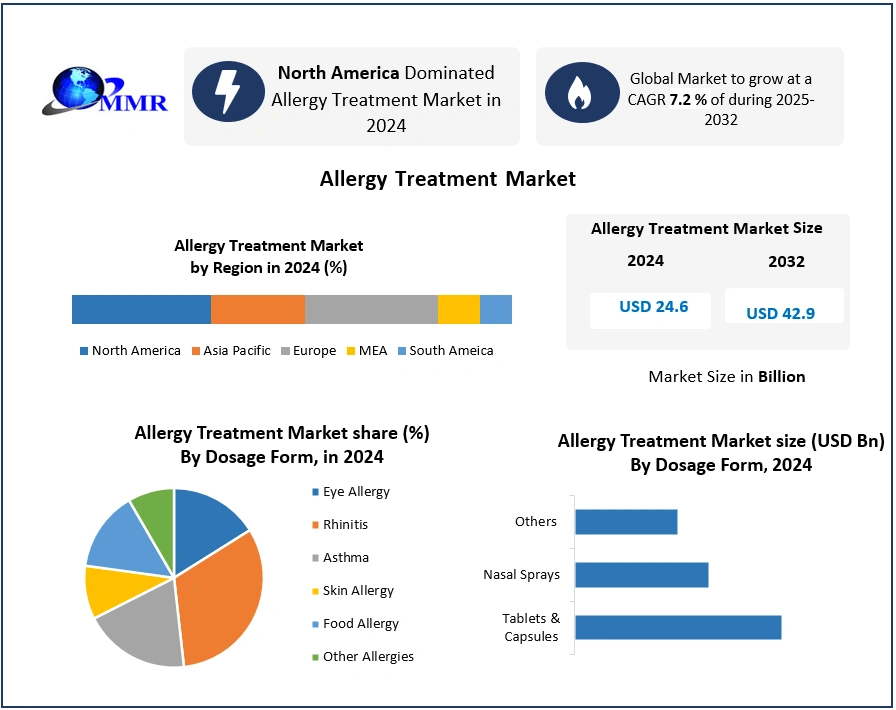
Market Growth & Valuation: The global allergy treatment market size reached USD 24.6 billion in 2024 and is projected to scale to USD 42.9 billion by 2032, advancing at a Compound Annual Growth Rate (CAGR) of 7.2%.
Segment Dominance: The allergic rhinitis segment captured the highest revenue share in 2024, driven by urban sensitization rates that exceed 50% in major metropolitan centers.
Distribution Performance: Hospital pharmacies remain the dominant end-user channel, leveraging direct clinical access, bulk institutional procurement channels, and specialty delivery infrastructure for high-value biologics.
Regional Leadership: North America commands the global market with a regional valuation exceeding USD 10.88 billion in the United States alone, anchored by rapid commercial rollouts of targeted immunotherapies.
Accelerating Modalities: Sublingual immunotherapy (SLIT) tablets and targeted monoclonal antibodies are capturing significant market share from conventional therapeutic options due to improved adherence profiles.
Why This Matters Now
Escalating urbanization and severe environmental degradation are transforming mild allergic responses into complex, chronic respiratory conditions, forcing healthcare networks to restructure their clinical strategies. For pharmaceutical developers and institutional investors, this shifts the market from a historical reliance on over-the-counter (OTC) management toward a high-value sector driven by precision diagnostics and targeted immunotherapies.
As climate change expands seasonal pollen windows and deepens urban atmospheric pollution, patient volumes are scaling rapidly. Healthcare providers must adopt advanced diagnostic tools and personalized biological treatments to optimize long-term clinical outcomes and mitigate the macroeconomic impact of lost workplace productivity.
Market Overview
The global Allergy treatment market spans a diverse continuum of interventions, including core pharmacological agents like second-generation antihistamines and intranasal corticosteroids, alongside advanced therapeutics like targeted biologics and custom immunotherapies. Beyond therapeutics, the sector integrates multi-allergen diagnostic assays and clinical devices utilized across hospital networks, specialized immunology clinics, and home care settings.
The industry is navigating an inflection point where conventional symptom suppression is giving way to disease-modifying interventions. Rising diagnostic rates, paired with expanded access to healthcare infrastructure in emerging economies, provide a resilient foundation for long-term commercial growth.
Key Trends Driving Growth
The primary driver of market expansion is the rising global incidence of allergic rhinitis and asthma, directly exacerbated by modern urban environmental conditions. Industrial pollution across major global megacities has driven allergen sensitization rates above 50%, forcing millions of individuals to seek long-term therapeutic intervention.
Concurrently, climate change is prolonging natural pollen seasons and changing regional allergen distribution patterns, causing more frequent, acute disease exacerbations. This persistent environmental stimulus is shifting patient behaviors away from intermittent, reactive self-medication toward proactive, clinically supervised management plans.
Digital health integration has further accelerated this transition. The adoption of tele-immunotherapy platforms grew from 17% prior to recent global health events to 89% during subsequent clinical adjustments, establishing remote treatment as a permanent, viable delivery channel.
Furthermore, the introduction of artificial intelligence (AI) into allergen and pollen forecasting allows clinical teams to execute real-time dosage adjustments, lowering systemic safety risks and increasing overall patient compliance.
Segment Insights
Rhinitis (Dominant Segment): Allergic rhinitis maintained a commanding lead within the market in 2024. Widespread urban exposure to airborne particulates, dust mites, and pet dander sustains a massive, continuous patient base requiring consistent therapeutic regimens.
Food and Skin Allergies (Fastest-Growing Segment): Driven by shifting global dietary habits, changing lifestyles, and rising pediatric vulnerability, this segment is expanding rapidly. The introduction of standardized, oral desensitization therapies has created a commercial market where historical options were limited to absolute avoidance.
Hospital Pharmacies (Dominant End-User Segment): Hospital pharmacies led distribution in 2024. These specialized facilities are essential for initiating complex, moderate-to-severe allergy treatments, providing the controlled environments needed to safely administer high-risk immunotherapies and advanced biological infusions.
Regional Growth Story
North America continues to lead the global landscape, a position anchored by advanced clinical infrastructure, a dense network of certified immunologists, and supportive insurance reimbursement models. The United States market alone surpasses USD 10.88 billion in value, functioning as a primary global hub for novel therapeutic launches.
Favorable commercial conditions across the region enable rapid clinical adoption of high-cost innovations, such as targeted food allergy immunotherapies and multiplex allergen assays, ensuring stable market performance.
In Europe, nations like Germany and the United Kingdom are focusing their healthcare expenditures on structured value-based care models, increasing the clinical adoption of standardized sublingual immunotherapies.
Meanwhile, the Asia-Pacific region is the fastest-growing geographical market. Rapid industrialization, expanding commercial middle classes, and severe air quality challenges across major economies like China and India are driving high volumes of new patient diagnoses, prompting extensive public and private investments in local healthcare systems.
Competitive Landscape
The global marketplace is highly fragmented, characterized by intense competition between multi-national pharmaceutical conglomerates and highly specialized biotechnology companies. Leading entities including Sanofi, GSK, Novartis, Johnson & Johnson, Pfizer, and AstraZeneca dominate high-volume sectors like small-molecule antihistamines and established respiratory biologics.
Concurrently, specialized industry players like ALK-Abelló, Stallergenes Greer, and Allergy Therapeutics focus their research and development on sublingual tablets and complex, long-term desensitization protocols.
This dynamic forces major manufacturers to invest heavily in next-generation molecules to prevent patent erosion from generic alternatives. To remain competitive, established firms are increasingly forming strategic development partnerships with smaller biotech innovators, seeking to secure early-stage intellectual property in monoclonal antibodies and advanced molecular diagnostics.
Recent Developments
Food Allergy Biologics Expansion: The United States Food and Drug Administration (FDA) approved omalizumab (Xolair) for the management of multiple food allergies, establishing a new therapeutic standard for reducing severe allergic reactions following accidental exposure.
Targeted Immunotherapy Launch: The commercial introduction of Palforzia as the first approved oral immunotherapy for peanut allergies has reshaped clinical protocols, enabling structured, pediatric desensitization within controlled medical networks.
Multiplex Diagnostic Assays: Beckman Coulter introduced advanced multiplex allergy assays, significantly improving the speed and diagnostic accuracy of multi-allergen profiles from minimal serum samples.
Strategic Mucosal Partnerships: Specialized biotech firms have expanded collaborative investments into oral mucosal immunotherapies, accelerating clinical trials for heat-stable, non-injectable treatment formulations.
Strategic Implications
The commercial arrival of disease-modifying biologics and structured immunotherapies requires a fundamental re-evaluation of institutional market access and pricing strategies. Payers and health insurance systems are re-structuring their pharmacy benefit architectures, balancing the substantial upfront costs of biological drugs against long-term reductions in emergency room admissions and acute clinical complications.
For pharmaceutical commercialization teams, securing a preferred position on institutional formularies requires presenting clear, data-driven evidence of long-term economic utility alongside traditional clinical efficacy metrics.
Additionally, the steady transition of standard antihistamines into mature over-the-counter markets is compressing profit margins on conventional small-molecule therapies. Major industry players must re-allocate capital toward specialized biologics and precision diagnostics to maintain long-term corporate growth.
Hospital networks must also adapt by upgrading their outpatient clinical infrastructure, ensuring they can safely support the specialized monitoring workflows required for advanced cellular and immunotherapeutic protocols.
Future Outlook
Looking toward 2032, the global allergy treatment market will increasingly reward enterprises that pivot from broad, symptom-masking therapies toward targeted, curative solutions. The market will favor organizations that successfully integrate precision diagnostics with patient-centric digital adherence tools, allowing clinicians to precisely tailor long-term treatment pathways to individual genetic and environmental patient profiles.
Ultimately, long-term market leadership will belong to organizations that can successfully translate advanced biological insights into affordable, scalable, and personalized therapies, while slow-moving entities reliant on traditional, non-specific small molecules face increasing margin compression.
Analyst Perspective
“The global shift from basic symptom management to targeted, disease-modifying therapies is redrawing the competitive boundaries of the allergy sector,” stated Komal Patil, Analyst at Maximize Market Research.
About Maximize Market Research
Maximize Market Research Pvt. Ltd. (MMR) is a global market research and consulting firm known for delivering accurate, actionable, and data-driven insights. Our expertise spans diverse industries — including medical devices, pharmaceuticals, technology, automotive, electronics, chemicals, personal care, and consumer goods. We provide services such as market-validated forecasts, competitive intelligence, strategic consulting, and industry impact analysis, helping businesses navigate market complexities and achieve sustainable growth.
2nd Floor, Navale IT Park Phase 3
Pune Banglore Highway, Narhe
Pune, Maharashtra 411041, India
+91 9607365656
sales@maximizemarketresearch.com
