Key Highlights
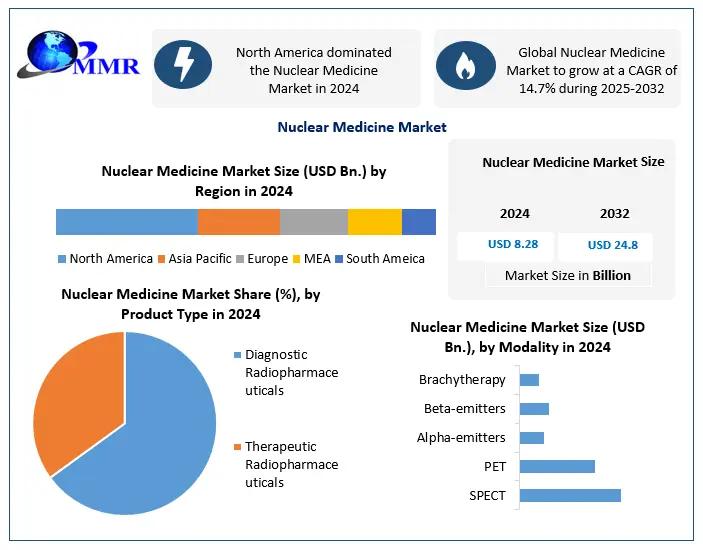
Market Valuation: The global nuclear medicine market reached USD 8.28 billion in 2024 and is projected to hit USD 24.8 billion by 2032, expanding at an accelerating CAGR of 14.7%.
Procedural Volume: Over 40 million nuclear medicine procedures are executed globally each year, with radioisotope demand experiencing a consistent 5% annual expansion.
Therapeutic Innovation: The U.S. FDA breakthrough designation of diffusing alpha-emitters radiation therapy (DaRT) for recurrent glioblastoma multiforme signals a major paradigm shift toward alpha-emitter commercialization.
Infrastructure Maturation: Emerging economies are scaling up specialized clinical infrastructure rapidly, highlighted by India establishing over 300 nuclear medicine centers of excellence and 250 PET hubs across 60 cities.
Strategic Consolidation: Market leaders are actively deploying cross-border M&A strategies, exemplified by Mediso Medical Imaging Systems acquiring UK-based supplier Bartec Technologies to solidify its regional support and installation footprint.
Why This Matters Now
Healthcare networks, life sciences investors, and pharmaceutical developers face an immediate operational crossroads as chronic disease management shifts toward molecular precision. The escalating global burden of cancer and cardiovascular diseases demands diagnostic pathways that identify metabolic anomalies before physical anatomical changes register on standard structural scans. For providers, scaling nuclear medicine capability is no longer a long-term capital option but a near-term requirement to capture value-based reimbursement and improve long-term patient outcomes.
Market Overview
The global Nuclear medicine market is undergoing an aggressive capital expansion, moving from an niche clinical specialty into a cornerstone of advanced molecular diagnostics and targeted therapeutics. Globally, the sector achieved a market valuation of USD 8.28 billion in 2024. Sustained by high clinical utility and expanding reimbursement frameworks, total revenue is forecasted to hit USD 24.8 billion by 2032, advancing at a compound annual growth rate (CAGR) of 14.7%.
This financial trajectory is fundamentally anchored by the escalating volume of medical procedures. Data indicates that approximately 40 million nuclear medicine interventions are administered annually worldwide. In the United States alone, the Center for Medicare & Medicaid Services (CMS) oversees a USD 1.7 billion nuclear medicine ecosystem, approving and reimbursing 12 million of the 20 million procedures performed nationally every year.
Key Trends Driving Growth
The primary catalyst reshaping the industry is the massive global disease burden in oncology and cardiology. According to World Health Organization (WHO) data, cancer claimed 10 million lives in 2020, with annual new instances projected to reach 19.3 million. Concurrently, cardiovascular diseases (CVD) caused 17.9 million deaths in 2019, accounting for 32% of all global fatalities, a figure expected to rise to 23.3 million by 2030. Because early metabolic detection dictates survival rates, clinical reliance on short-lived radioactive isotopes has intensified.
Technological convergence is also altering competitive dynamics through the deployment of hybrid imaging systems, such as SPECT/CT and PET/CT. These modalities merge cellular physiology with structural anatomy, giving physicians an analytical advantage over standalone systems. However, low-cost alternatives present a clear market constraint. In cost-sensitive developing economies, standard MRI and CT scans are frequently favored due to lower upfront capital costs and broader baseline insurance coverage, which can slow nuclear medicine adoption rates in those specific regions.
Segment Insights
Diagnostic Products (Dominant Segment): Driven by high-volume clinical applications, this segment captured the majority of market share. This dominance is sustained by widespread physician reliance on Positron Emission Tomography (PET) and Single-Photon Emission Computed Tomography (SPECT) to diagnose complex oncological and cardiac conditions via metabolic tracking.
Therapeutic Radiopharmaceuticals (Fastest-Growing Segment): Fueled by an incredibly deep product pipeline and rapid regulatory breakthroughs, this segment is expanding fastest. Growth is propelled by targeted alpha and beta emitters that treat advanced malignancies when conventional lines of therapy fail.
Regional Growth Story
North America maintains structural dominance over the global industry, securing a 45.2% market share. The region benefits from a dense concentration of specialized imaging infrastructure, high procedural volumes, and aggressive research funding. To capitalize on this localized demand, major European suppliers are expanding their manufacturing footprint in the region. For instance, Germany-based Eckert & Ziegler announced plans to establish a advanced cGMP radiopharmaceutical contract manufacturing facility in Boston to secure local supply lines for critical radionuclides.
Concurrently, the Asia-Pacific region is transforming into a high-yield investment destination. India has established itself as an regional hub, operating more than 300 nuclear medicine centers of excellence and 250 dedicated PET centers across 60 major cities. This rapid infrastructure buildout, paired with expanding healthcare spending by the Government of India, provides a highly lucrative point of entry for international biotechnology and medical device firms looking to establish long-term regional market share.
Competitive Landscape
The competitive environment is dictated by consolidation, cross-border asset acquisition, and multi-sector alliances designed to expand supply chain resilience. Global radioactive isotope distribution is highly dependent on continuous logistical support, forcing hardware manufacturers to acquire localized service networks.
A notable example of this trend is Budapest-headquartered Mediso Medical Imaging Systems acquiring UK-based specialized supplier Bartec Technologies. This acquisition directly integrates Bartec’s installation, maintenance, and technical support teams into Mediso’s wider corporate structure, securing direct market access to the United Kingdom’s clinical networks.
Furthermore, international regulatory bodies are actively collaborating with sovereign organizations to expand clinical reach and mobilize financial resources. This is evident in the formal execution of practical arrangements between global atomic agencies and the Sovereign Military Order of Malta, an initiative specifically targeted at expanding nuclear medicine outreach and resource mobilization across underserved healthcare jurisdictions.
Recent Developments
FDA Breakthrough Status: In October 2021, the U.S. FDA granted breakthrough designation to diffusing alpha-emitters radiation therapy (DaRT) for the localized treatment of recurrent glioblastoma multiforme, validating alpha therapies as viable monotherapies for highly resistant tumors.
Clinical Trial Progression: In January 2022, ITM Isotope Technologies Munich SE initiated its international COMPOSE Phase 3 clinical trial for 177Lu-edotreotide, evaluating its therapeutic efficacy in patients diagnosed with advanced neuroendocrine tumors.
Pipeline Diversification: Commercial pipelines are shifting heavily toward next-generation alpha-emitting radioisotopes, with major R&D investments flowing into the clinical validation of Terbium (Tb-149), Bismuth (Bi-212), and Actinium (Ac-225).
Strategic Implications
The shifting dynamics of the nuclear medicine market signal an immediate need for hospital networks to update their existing capital allocation models. Entities relying solely on standalone diagnostic equipment risk losing patient volume to regional centers that feature hybrid SPECT/CT and PET systems. For pharmaceutical and biotech firms, the clear clinical success of targeted alpha and beta therapies means that future oncology drug development must prioritize theranostic applications—where diagnostic imaging tracers and therapeutic radioisotopes are paired to track and treat disease simultaneously.
Future Outlook Looking ahead, the market will experience a sharp division based on supply chain integration and pipeline execution. As therapeutic radioisotopes move rapidly through late-stage clinical trials toward full commercialization, the ultimate market winners will be those organizations that build resilient, localized cGMP manufacturing networks and secure stable isotope supply chains, while slower-moving laggards will find themselves cut out by rising transport costs and critical material shortages.
Analyst Perspective
“The massive influx of clinical capital into hybrid molecular imaging and targeted alpha therapies is completely transforming chronic disease management. Organizations that proactively integrate theranostic pipelines into their existing oncology and cardiology networks will secure an insurmountable market advantage as precision medicine becomes the global baseline for care.” — Komal Patil, Healthcare & Life Sciences Research Analyst, Maximize Market Research
About Maximize Market Research
Maximize Market Research Pvt. Ltd. (MMR) is a global market research and consulting firm known for delivering accurate, actionable, and data-driven insights. Our expertise spans diverse industries — including medical devices, pharmaceuticals, technology, automotive, electronics, chemicals, personal care, and consumer goods. We provide services such as market-validated forecasts, competitive intelligence, strategic consulting, and industry impact analysis, helping businesses navigate market complexities and achieve sustainable growth.
2nd Floor, Navale IT Park Phase 3
Pune Banglore Highway, Narhe
Pune, Maharashtra 411041, India
+91 9607365656
sales@maximizemarketresearch.com
