Key Highlights
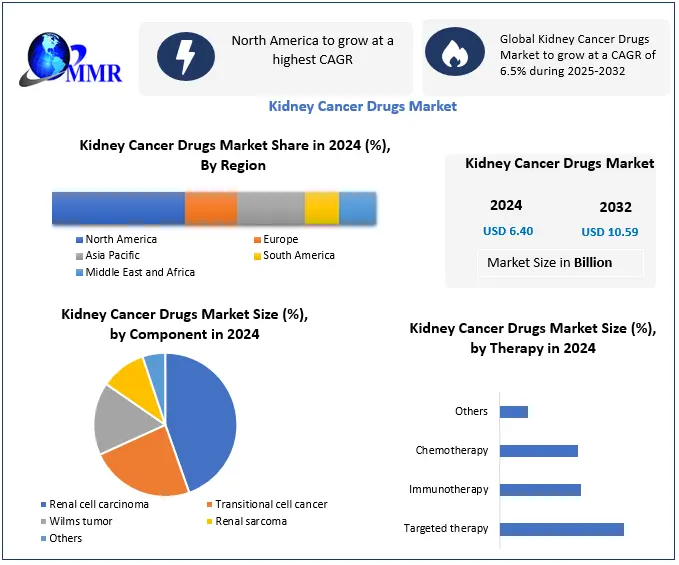
Market Valuation: The global sector achieved a valuation of USD 6.40 billion in 2024 and is on track to reach USD 10.59 billion by 2032.
Sustained Momentum: Commercial expansion is moving at a 6.5% compound annual growth rate (CAGR) throughout the 2025–2032 forecast horizon.
Therapeutic Shift: Precision targeted therapy holds market dominance, aggressively displacing traditional, non-selective chemical therapies.
Core Indication: Renal cell carcinoma accounts for 85% to 90% of total clinical diagnoses, cementing its status as the primary revenue generator.
Geographic Anchor: North America controls the largest share, with the United States commanding over 75.0% of the regional ecosystem.
Regulatory Acceleration: The United States FDA implemented a series of expedited approvals for complex combo regimens containing anti-PD-1 backbone agents.
Why This Matters Now
Delays in advancing oncological pipelines expose pharmaceutical developers to immediate market share erosion as frontline treatment protocols shift toward multi-drug regimens. Healthcare providers and institutional payers face an escalating financial and operational burden driven by a projected 15% surge in renal cancer incidence over the next two decades.
This macro-level demographic pressure demands a complete reassessment of clinical portfolios, procurement strategies, and reimbursement frameworks. Entities that fail to rapidly incorporate molecular targeted agents and sequential combination immunotherapies risk obsolescence as traditional mono-chemotherapies lose clinical relevance.
Market Overview
The global kidney cancer drugs market stood at USD 6.40 billion in 2024 and is projected to scale to USD 10.59 billion by 2032, expanding at a stable CAGR of 6.5%. This long-term revenue trajectory is fundamentally anchored to the rising prevalence of renal malignancies globally, particularly among patient segments aged 60 and older.
The underlying disease burden is worsening due to shifting systemic risk profiles, such as increasing global tobacco consumption and poor metabolic health patterns that promote the proliferation of malignant renal cells. For example, statistical tracking from the American Cancer Society identified approximately 79,000 new cases of kidney cancer within a single year, highlighting the expanding pool of patients requiring specialized pharmacotherapy.
Key Trends Driving Growth
Therapeutic strategies are undergoing a fundamental transformation characterized by the rapid adoption of combination therapy designed to prevent the emergence of drug-resistant cancer cell lines. By combining complementary mechanisms of action, clinical investigators are achieving significantly higher rates of tumor shrinkage and prolonged progression-free survival.
This clinical reality has prompted regulatory authorities to accelerate validation pathways for complex therapeutic combinations. A key example is the strategic expansion of Merck & Co., Inc.’s Keytruda (pembrolizumab), which secured FDA approval as an adjuvant treatment for renal cell carcinoma patients facing an intermediate-high or high risk of recurrence following a nephrectomy.
Concurrently, public sector funding allocations are expanding clinical surveillance and modernizing public health infrastructure. In the United States, legislative backing via the House Committee on Appropriations directed USD 8.5 million to the Centers for Disease Control and Prevention to enhance chronic kidney disease awareness and early diagnostic routing.
An additional USD 1 million injection into the national living donor assistance center further demonstrates how public spending is strengthening the broader renal care continuum. These state-backed funding mechanisms directly de-risk corporate investments in targeted oncological drug development.
Segment Insights
Type: Renal Cell Carcinoma (Dominant Segment) — This classification maintains definitive market dominance because it accounts for 85% to 90% of all adult kidney cancer diagnoses globally. Revenue dominance is sustained by continuous advancements in high-resolution medical imaging that capture asymptomatic tumors earlier, alongside heavy R&D allocations targeting adult-onset renal cell lines.
Therapy: Targeted Therapy (Dominant & Fastest-Growing Segment) — This therapeutic class leads both current revenue generation and forward-looking growth rates due to its capacity to target specific oncogenic pathways while preserving healthy tissue architecture. Wide clinical deployment of tyrosine kinase inhibitors and vascular endothelial growth factor (VEGF) inhibitors has positioned this segment at the top of frontline clinical protocols, outpacing traditional chemotherapy.
Regional Growth Story
North America commands the largest share of the global market, underpinned by dense healthcare spending, a high baseline prevalence of renal malignancies, and rapid clinical adoption of advanced therapeutics. Within this region, the United States operates as the dominant engine, controlling more than 75.0% of the North American market share. This high concentration of value is driven by the structural presence of pioneering multinational biotech manufacturers and a highly sophisticated healthcare delivery network that rapidly commercializes newly approved molecular entities.
In contrast, the Asia-Pacific region is positioned to achieve the highest localized acceleration rate over the forecast period, led by Japan. The Japanese market landscape is characterized by a rapidly aging demographic profile that is biologically susceptible to late-onset renal malignancies. This structural demand factor is attracting a high volume of local product rollouts and regulatory approvals, prompting global pharmaceutical operations to expand their commercial presence across major Asian healthcare distribution channels.
Competitive Landscape
The corporate ecosystem is defined by intense capital competition among established multinational pharmaceutical giants including Pfizer Inc., Bristol-Myers Squibb Company, and F. Hoffmann-La Roche Ltd. These entities are actively defending their market positions by upgrading single-agent brands into broader combination clinical programs to lengthen patent utility and capture frontline clinical market share.
Concurrently, high-capacity generic manufacturers across the Asia-Pacific region, such as Sun Pharmaceutical Industries Ltd, Aurobindo Pharma, and Dr. Reddy’s Laboratories Ltd, are positioning themselves to capitalize on upcoming patent expirations by scaling up small-molecule production capabilities.
Recent Developments
January 2023: The United States FDA granted expedited approval to the combination of pembrolizumab (Keytruda) and axitinib (Inlyta) for advanced renal cell carcinoma patients who previously experienced disease progression on a standard frontline VEGF-targeted regimen.
February 2023: Regulators fast-tracked the combination of nivolumab (Opdivo) and cabozantinib (Cabometyx), expanding choice in the second-line advanced renal cell carcinoma therapeutic class.
March 2023: The FDA accelerated the approval of pembrolizumab when paired with lenvatinib (Lenvima), providing a high-efficacy choice to address advanced renal cell carcinoma therapeutic resistance.
April 2023: Regulatory clearance was quickly extended to the combination of avelumab (Bavencio) and axitinib, providing an alternative options mix for advanced renal cell carcinoma patient cohorts showing disease progression.
Strategic Implications
The wave of sequential, expedited FDA approvals for combo regimens signals a definitive shift away from traditional monotherapy protocols in advanced oncology. For pharmaceutical pipelines, this means single-agent therapies are becoming commercially unviable in the frontline setting unless they can serve as an effective backbone for combination regimens.
Biotech firms must reallocate capital toward multi-target clinical trials or establish co-development partnerships to maintain competitive positioning. Consequently, product positioning will increasingly depend on showing superior safety profiles and lower toxicity when used in combination.
For institutional payers and hospital systems, this therapeutic shift introduces significant budget forecasting complexities. Multi-drug regimens dramatically increase the per-patient cost of oncological care, which will place added pressure on value-based reimbursement frameworks.
Hospital pharmacies must adjust formulary management and specialized compounding workflows to handle complex intravenous and oral drug pairs. Providers able to implement precise diagnostic screening to match patients with the most effective combination therapies will be best positioned to optimize clinical outcomes and manage rising treatment costs.
Future Outlook
Long-term market expansion will be shaped by the convergence of early diagnostic tools and next-generation precision targeted therapies that delay or prevent disease recurrence in early-stage patients. Organizations that master multi-mechanism combination clinical trials and secure favorable placement on institutional formularies will capture dominant market share, while developers reliant on older, single-agent portfolios will see their market relevance diminish.
Analyst Perspective
“The rapid shift toward multi-drug combination regimens is completely rewriting the commercial playbook for renal oncology. Success in this highly competitive space is no longer just about discovering isolated active molecules, but about strategically pairing immunotherapies with targeted inhibitors to overcome tumor resistance mechanisms and deliver measurable improvements in long-term survival.” — Komal Patil, Healthcare Research Analyst
About Maximize Market Research
Maximize Market Research Pvt. Ltd. (MMR) is a global market research and consulting firm known for delivering accurate, actionable, and data-driven insights. Our expertise spans diverse industries — including medical devices, pharmaceuticals, technology, automotive, electronics, chemicals, personal care, and consumer goods. We provide services such as market-validated forecasts, competitive intelligence, strategic consulting, and industry impact analysis, helping businesses navigate market complexities and achieve sustainable growth.
2nd Floor, Navale IT Park Phase 3
Pune Banglore Highway, Narhe
Pune, Maharashtra 411041, India
+91 9607365656
sales@maximizemarketresearch.com
