The Austria Bike Sharing Market is experiencing steady growth as the country embraces sustainable urban mobility, eco-friendly transportation solutions, and smart city development. With increasing concerns over traffic congestion, carbon emissions, and urban air quality, bike sharing systems are becoming an integral part of Austria’s transportation ecosystem.
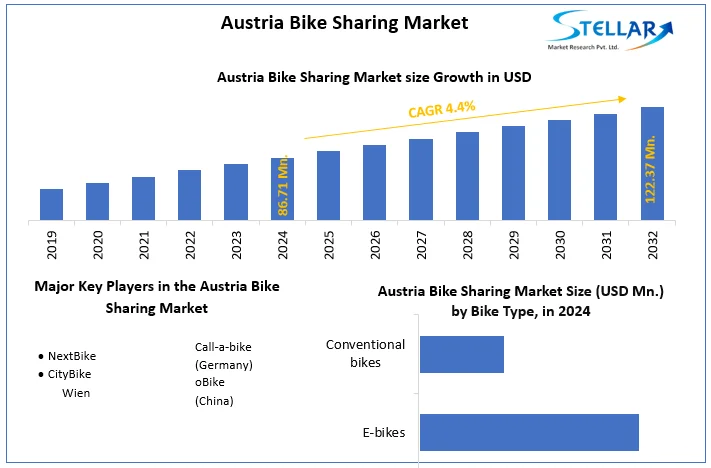
Austria Bike Sharing Market size was valued at US$ 86.71 Million in 2024 and the total Austria Bike Sharing Market revenue is expected to grow at 4.4% through 2025 to 2032, reaching nearly US$ 122.37 Million.
Cities such as Vienna, Salzburg, and Graz are leading the adoption of bike sharing programs, supported by strong government initiatives and a growing culture of cycling.
A Market Driven by Sustainability and Urban Mobility
A defining trend in the Austria bike sharing market is the growing emphasis on sustainable and low-carbon transportation. As part of broader climate goals, Austria is promoting cycling as an efficient and environmentally friendly alternative to traditional modes of transport.
Bike sharing systems provide convenient, affordable, and flexible mobility options for residents and tourists alike. These systems are particularly popular in urban areas, where short-distance travel is common.
Integration with public transportation networks is further enhancing accessibility and encouraging multimodal transportation.
Key Market Insights
- Austria is a growing bike sharing market in Europe.
- Docked and dockless bike sharing systems are widely used.
- Electric bikes (e-bikes) are gaining popularity.
- Urban areas are key adoption centers.
- Tourism significantly contributes to demand.
- Government policies support sustainable mobility.
- Smart city initiatives are driving innovation.
𝐃𝐨𝐰𝐧𝐥𝐨𝐚𝐝 𝐅𝐫𝐞𝐞 𝐏𝐃𝐅 𝐁𝐫𝐨𝐜𝐡𝐮𝐫𝐞: https://www.stellarmr.com/report/req_sample/Austria-Bike-Sharing-Market/212
Market Drivers Accelerating Growth
1. Government Support for Green Mobility
Policies promoting sustainable transportation are driving adoption.
2. Increasing Urbanization and Traffic Congestion
Bike sharing offers a convenient solution for short-distance travel.
3. Growth in Tourism
Tourists prefer bike sharing for exploring cities in an eco-friendly way.
Market Challenges and Restraints
1. Seasonal Demand Fluctuations
Usage can decline during colder months.
2. Infrastructure Limitations
Limited cycling lanes in some areas may restrict growth.
Technology and Innovation Trends
Technological advancements are transforming the Austria bike sharing market. The adoption of IoT-enabled bikes, GPS tracking, and mobile applications is enhancing user experience and operational efficiency.
Mobile apps allow users to locate, unlock, and pay for bikes seamlessly. Data analytics is being used to optimize fleet management, improve service availability, and enhance operational performance.
Electric bikes are becoming increasingly popular, providing a convenient option for longer distances and hilly terrains.
Integration with smart city infrastructure is also enabling better traffic management and urban planning.
𝐃𝐨𝐰𝐧𝐥𝐨𝐚𝐝 𝐅𝐫𝐞𝐞 𝐏𝐃𝐅 𝐁𝐫𝐨𝐜𝐡𝐮𝐫𝐞: https://www.stellarmr.com/report/req_sample/Austria-Bike-Sharing-Market/212
Regional Insights: Vienna Leads, Other Cities Expand
Vienna dominates the Austria bike sharing market, supported by a well-developed cycling infrastructure, strong public transport integration, and high population density.
Salzburg and Graz are also key markets, driven by tourism and urban mobility initiatives.
Smaller cities are gradually adopting bike sharing systems as part of their sustainable development strategies.
Recent Industry Developments
- nextbike (2025): Expanded bike sharing services in Austrian cities.
- Lime (2024): Increased deployment of e-bikes in urban areas.
- Tier Mobility (2025): Invested in sustainable urban mobility solutions.
- City of Vienna (2024): Promoted cycling infrastructure and smart mobility initiatives.
- European Cyclists’ Federation (2025): Supported cycling policies and advocacy efforts.
Competitive Landscape
The Austria bike sharing market is moderately competitive, with both local and international players operating in the space. Companies are focusing on technology integration, service expansion, and sustainability to strengthen their market position.
Partnerships with municipalities and public transport operators are key strategies for market growth.
Analyst Perspective
A senior market analyst notes:
“The Austria bike sharing market is growing steadily as cities prioritize sustainable mobility and smart urban solutions. E-bike adoption and digital integration will play a key role in future growth.”
Future Outlook
The Austria Bike Sharing Market is expected to witness steady growth in the coming years, supported by increasing urbanization, rising environmental awareness, and supportive government policies.
The expansion of e-bike fleets, integration with public transportation, and advancements in smart mobility technologies will continue to drive market development.
As Austria continues to promote sustainable and efficient transportation systems, bike sharing will play a crucial role in shaping the future of urban mobility.
Overall, the market presents significant opportunities for mobility providers, technology companies, and investors looking to capitalize on the shift toward greener transportation solutions.
