Key Highlights
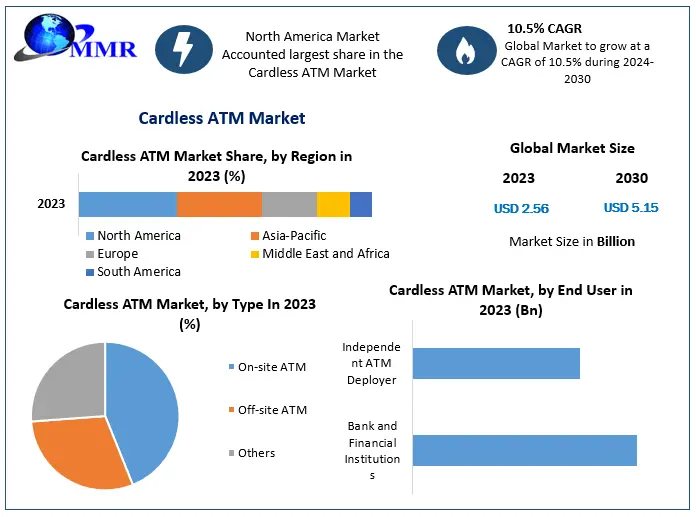
- Global Cardless ATM Market reached USD 2.56 Billion in 2023 and is projected to reach USD 5.15 Billion by 2030, growing at 10.5% CAGR. Every percentage point of expansion reflects accelerating investment in digital banking infrastructure and customer authentication technologies.
- North America remains the leading regional market, highlighting continued investment in financial technology modernization.
- Off-site ATMs represent the dominant market segment, extending digital banking beyond traditional branch networks.
- NFC, QR codes, and biometric verification are transforming ATM authentication and improving transaction convenience.
- Banks and financial institutions continue to drive deployment as digital customer engagement becomes a competitive priority.
Why This Matters Now
Banks are redesigning customer journeys around smartphones instead of plastic cards. Digital identity, secure authentication, and mobile banking have shifted from innovation projects to core operating priorities.
For technology leaders, the opportunity extends beyond ATM hardware. Cardless transactions strengthen digital ecosystems, reduce dependence on physical cards, improve customer experience, and create new opportunities to integrate mobile applications with banking infrastructure.
Market Overview
The Cardless ATM Market has entered a new phase where physical cash access increasingly depends on digital authentication rather than traditional debit cards. According to Maximize Market Research, the market reached USD 2.56 Billion in 2023 and is expected to reach USD 5.15 Billion by 2030, expanding at a 10.5% CAGR. The market’s growth signals sustained investment in modern banking infrastructure and secure customer authentication rather than simple ATM replacement.
Cardless ATM technology allows customers to withdraw cash using smartphones through Near Field Communication (NFC), QR codes, or biometric verification. These capabilities align with broader digital transformation initiatives across financial services, where mobile-first banking experiences increasingly define customer expectations.
The shift also reflects growing enterprise demand for secure authentication frameworks capable of reducing fraud risks while simplifying customer access to financial services.
Key Trends Driving Growth
Financial institutions continue to prioritize digital transformation initiatives that integrate mobile banking with physical banking infrastructure. Cardless ATM deployments bridge digital applications with traditional cash services, allowing customers to access funds without carrying payment cards.
Cybersecurity remains another major catalyst. Biometric authentication and secure digital verification strengthen identity protection while reducing exposure to card-related fraud. Security investments increasingly complement broader enterprise cybersecurity strategies focused on identity management and trusted authentication.
Cloud-enabled banking platforms also simplify integration between mobile applications and ATM networks. As financial institutions modernize core banking systems, cardless transactions become easier to deploy across distributed ATM ecosystems.
Automation is changing ATM operations as well. Digital authentication minimizes manual verification while improving operational efficiency across large banking networks. Banks benefit through lower operational complexity and improved customer satisfaction.
Competitive pressure is equally important. Mobile-first financial institutions continue to raise customer expectations, encouraging traditional banks to modernize self-service channels and strengthen omnichannel banking experiences.
Segment Insights
- Dominant Segment: Off-site ATMs accounted for the largest share of the global Cardless ATM Market in 2023, demonstrating strong demand for convenient cash access outside traditional bank branches.
- Fastest-Growing Segment: The report identifies technology adoption across NFC, QR Code, and Biometric Verification but does not specify the fastest-growing segment. No unsupported ranking is provided.
- Technology Landscape: NFC, QR code authentication, and biometric verification collectively define the industry’s transition toward secure digital authentication.
- Leading End User: Banks and financial institutions remain the primary adopters as customer experience and digital banking become strategic priorities.
Regional Growth Story
North America leads the global Cardless ATM Market, supported by advanced digital banking ecosystems, widespread mobile banking adoption, and continuous financial technology investment. The region demonstrates how mature banking markets continue modernizing customer authentication while maintaining extensive ATM infrastructure.
Asia-Pacific represents an important strategic opportunity because large banking populations continue expanding digital banking services across markets including China and India. Smartphone adoption, financial inclusion initiatives, and rapid digital payment ecosystems create favorable conditions for future cardless ATM deployment where supported by banking infrastructure.
European financial institutions continue investing in secure authentication technologies as customer expectations evolve toward frictionless banking experiences. Markets including Germany and the United Kingdom remain focused on balancing digital convenience with regulatory compliance and cybersecurity resilience.
Competitive Landscape
Competition increasingly centers on platform capability rather than ATM hardware alone. Financial institutions, ATM manufacturers, and banking technology providers are expanding partnerships that connect mobile applications with secure authentication platforms.
Companies including Banco Santander, Barclays, Citigroup, Commonwealth Bank of Australia, Diebold Nixdorf, NCR, Fujitsu, GRG Banking, HDFC Bank, HSBC, ICICI Bank, JPMorgan Chase, Kotak Mahindra Bank, State Bank of India, Wells Fargo, and others illustrate how the competitive landscape combines banking institutions with financial technology providers.
The strategic implication extends beyond product launches. Banks capable of integrating secure authentication, digital identity, and seamless customer experiences will strengthen customer retention while reducing operational dependence on physical payment cards. ATM manufacturers are similarly evolving into technology platform providers rather than equipment vendors, positioning software integration and digital services as long-term competitive advantages.
Recent Developments
- Adoption of NFC-enabled authentication continues expanding across cardless ATM deployments.
- Financial institutions are increasing deployment of QR-code-based cash withdrawal capabilities.
- Biometric verification technologies are strengthening secure customer authentication.
- Banks continue investing in digital banking modernization through cardless cash access integration.
Strategic Implications
Technology executives increasingly evaluate ATM infrastructure as part of broader digital transformation rather than standalone banking hardware. Cardless authentication enables closer integration between mobile banking applications, customer identity platforms, cybersecurity frameworks, and enterprise banking systems.
For investors, sustained market expansion indicates continuing demand for authentication technologies, banking software integration, and financial infrastructure modernization. Cloud providers, fintech companies, cybersecurity vendors, and ATM technology suppliers all benefit as financial institutions pursue more connected banking ecosystems.
The broader implication is clear: future banking competitiveness depends less on branch density and increasingly on secure digital experiences that seamlessly connect physical and digital customer interactions.
Future Outlook
Cardless ATM adoption will increasingly align with enterprise digital transformation, mobile-first banking strategies, secure authentication technologies, and intelligent financial infrastructure. As banks continue modernizing customer engagement, ATM networks will become integrated digital service platforms instead of isolated cash machines.
The next competitive divide will not be determined by who owns the largest ATM network, but by who delivers the most secure, intelligent, AI-ready, and seamlessly connected banking experience across every customer touchpoint.
Analyst Perspective
“The evolution of cardless ATM technology demonstrates how financial institutions are aligning secure authentication with digital banking transformation. Mobile-first customer experiences, supported by NFC, QR code, and biometric verification, are reshaping how banks modernize cash access while strengthening operational efficiency and customer convenience.” — Yash Ghosalkar
About Maximize Market Research
Maximize Market Research Pvt. Ltd. (MMR) is a global market research and consulting company that provides reliable, data-focused, and practical business insights. The firm serves a wide range of industries, including healthcare, pharmaceuticals, technology, automotive, electronics, chemicals, personal care, and consumer goods. Through market forecasts, competitive analysis, strategic consulting, and industry impact assessments, MMR helps organizations understand changing market conditions, identify growth opportunities, and make informed business decisions for long-term success.
2nd Floor, Navale IT Park Phase 3
Pune Banglore Highway, Narhe
Pune, Maharashtra 411041, India
+91 9607365656
sales@maximizemarketresearch.com
