Key Highlights
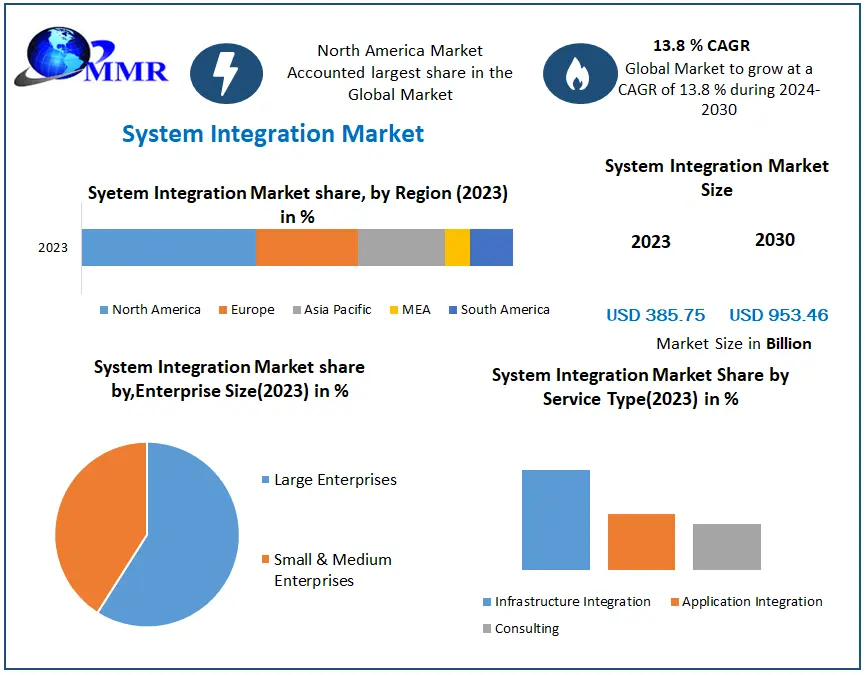
Global market valuation scaling from US$ 385.75 Billion in 2023 to US$ 953.46 Billion by 2030.
Market growth profile secured at a compound annual growth rate of 13.8% through 2030.
Infrastructure integration services dominated the industrial segment landscape over separate consulting architectures.
The banking, financial services, and insurance (BFSI) sector led global end-user infrastructure acquisition.
North America controlled over 35% of total market revenue utilization.
Strategic partnerships, such as the multi-year collaboration between Infosys and LKQ Europe, accelerate enterprise modernization.
Why This Matters Now
Enterprise computing environments are colliding with a wave of architectural complexity that makes disconnected operational platforms unsustainable. Corporate technology buyers, chief information officers, and database architects can no longer tolerate isolated, single-vendor applications that segment data away from underlying transaction systems. The urgent commercial demand to link hybrid cloud setups, expansive IoT sensor groups, and legacy core engines into a unified database is driving immediate capital expenditure reallocations.
2nd Floor, Navale IT Park Phase 3
Pune Banglore Highway, Narhe
Pune, Maharashtra 411041, India
+91 9607365656
sales@maximizemarketresearch.com
What changed is that businesses are shifting from simple software adoption to deep, end-to-end infrastructure optimization to eliminate multi-layer processing friction. This fundamental structural modification forces service providers to completely re-engineer operational strategies or risk immediate customer churn. Why now? Because the explosive accumulation of real-time transactional data means slow, legacy systems cause critical processing delays, rendering companies uncompetitive against automated peers.
Market Overview
The global System Integration Market achieved an institutional valuation of US$ 385.75 Billion in 2023 and is on a definitive structural trajectory to reach US$ 953.46 Billion by 2030. This expansion demonstrates a highly reliable CAGR of 13.8% across the seven-year forecast period. This capital expenditure is distributed across core vertical ecosystems, including the IT and telecommunications sector, defense and security branches, BFSI operations, oil and gas networks, healthcare frameworks, transportation systems, and retail industries.
The underlying market structure balances physical hardware configurations and networking protocols with complex application software integrations. As global corporations execute wide-scale digital transformation initiatives, these multi-layer integration frameworks function as the essential engine needed to consolidate physical servers with virtual data tools.
Key Trends Driving Growth
The continuous expansion of hybrid cloud deployment models operates as the primary architectural catalyst within corporate technology departments. Modern organizations are executing extensive cloud migration initiatives, shifting data assets off localized storage to capitalize on scalable, cost-effective processing engines. This technological shift creates immediate opportunities for system integrators, who are needed to bridge cloud software with on-premises storage and maintain continuous data flow.
Concurrently, the rapid deployment of Internet of Things (IoT) devices across industrial automation sectors is changing data collection strategies. IoT sensors and communication gateways generate massive streams of real-time data that must connect with back-end enterprise resource planning systems. System integrators provide the structural connectors to link these endpoint monitors with corporate analytics suites, enabling predictive maintenance models and improved asset monitoring.
Furthermore, corporate technology buyers are demanding advanced business intelligence systems to parse these massive datasets. System integration platforms enable the aggregation and processing of diverse transactional feeds, providing management teams with a unified view of operational performance. This capability helps executive decision-makers minimize project delays, resolve cost overruns, and mitigate the technical debt tied to obsolete, monolithic software structures.
Segment Insights
Dominant Segment (Service Type): The Infrastructure Integration segment dominated the global market in 2023 and is projected to maintain the largest market share through 2030. This prominent position reflects massive capital investments in linking hardware, software, networking, and data center components to build resilient, scalable IT environments.
Dominant Segment (End User): The BFSI segment emerged as the leading end-user marketplace in 2023. Financial institutions are prioritizing the integration of core banking systems with third-party customer channels to enable real-time payment processing and secure digital financial transactions.
Fastest-Growing Segment: Software and application integration frameworks, focusing on linking ERP, CRM, and supply chain management applications, represent the fastest-accelerating category as businesses automate internal workflows.
Regional Growth Story
North America held a dominant global position in the system integration market, capturing over 35% of total market revenue. This leading regional share is driven by the extensive use of IoT networks within industrial automation and the aggressive adoption of public cloud platforms by major US corporations. The financial sector across the United States has integrated advanced digital services at scale, with major institutions like Bank of America reporting that 70% of their clients actively utilize digital channels for routine financial needs, increasing the demand for unified backend systems.
In comparison, the Europe and Asia-Pacific regional markets are expanding through distinct corporate strategies and regulatory frameworks. The European market is growing via large-scale corporate partnerships and service provider collaborations. For instance, in December 2023, Infosys established a five-year cooperation agreement with LKQ Europe to standardize business processes and optimize end-to-end delivery systems across their automotive components network.
Meanwhile, market development within France is accelerated by direct public intervention, highlighted by the French government proposing specific digitalization mandates in September 2023 to modernize localized business infrastructures.
Competitive Landscape
The global system integration arena is highly fragmented, featuring intense platform competition alongside low entry barriers for specialized local integrators. Despite the regular influx of niche software engineers, major multinational corporations managed to secure stable control over core market segments. The tier-one provider ecosystem is dominated by leading multinational entities, including IBM Corporation, Accenture Plc, Deloitte Touche Tohmatsu, Capgemini SE, and Infosys Limited, alongside prominent market competitors like Cisco Systems Inc., Hewlett-Packard Company, and Huawei Technologies.
To defend their market position against small software disruptors, these primary system integrators are focusing on deep enterprise application ecosystems. The corporate strategy has shifted from basic software support toward executing long-term infrastructure contracts that bundle hardware integration with managed cybersecurity compliance.
These comprehensive agreements allow major service providers to lock in multi-year recurring revenue streams. At the same time, they give corporate clients predictable IT costs and a structured path toward complete network virtualization.
Recent Developments
Tier-one integration providers are launching pre-built application connectors to accelerate the integration of cloud-native tools with legacy corporate ERP systems.
European automotive logistics groups are entering multi-year managed services agreements with global integrators to automate supply chain tracking.
Financial technology vendors are introducing automated compliance modules that embed regional data laws, like GDPR, directly into core banking architectures.
System integrators are expanding specialized edge computing practices to process industrial IoT datasets closer to the physical sensor source.
Strategic Implications
The clustering of market value around comprehensive infrastructure integration providers marks a clear shift toward complete platform reliance. Large financial institutions and telecommunications operators can no longer afford the custom code maintenance costs associated with connecting isolated software products from different vendors. This trend awards significant pricing power to large integrators that offer standardized, full-stack architectures matching strict global standards like Basel III or PCI-DSS.
Technology buyers who continue to build custom integrations risk locking themselves into rigid architectures and slow operational speeds. For corporate investment groups, long-term market success depends entirely on using pre-configured, multi-tenant integration platforms that deploy smoothly across diverse cloud networks.
Future Outlook
The next phase of system integration development will be defined by how efficiently architecture models handle automated, real-time data orchestration. As data networks expand via 5G infrastructure and edge nodes, traditional batch-processing data migration models will become a significant bottleneck. Winning organizations will be those that transition their core data architectures into continuous processing engines capable of automated scaling and instant resource provisioning across hybrid environments.
The future marketplace will see a permanent separation between highly integrated digital leaders operating open API ecosystems and legacy operational laggards restricted by isolated software pools.
Analyst Perspective
“Navigating modern corporate digital transformation without a standardized infrastructure integration strategy is an immediate path to operational obsolescence,” states Yash Ghosalkar, Lead Analyst at Maximize Market Research. “As strict global regulatory frameworks like GDPR and Basel III demand absolute data transparency, deploying unified system architectures is the only sustainable way for CIOs to protect operating margins while guaranteeing transactional security.”
About Maximize Market Research
Maximize Market Research Pvt. Ltd. (MMR) is a global market research and consulting company that provides reliable, data-focused, and practical business insights. The firm serves a wide range of industries, including healthcare, pharmaceuticals, technology, automotive, electronics, chemicals, personal care, and consumer goods. Through market forecasts, competitive analysis, strategic consulting, and industry impact assessments, MMR helps organizations understand changing market conditions, identify growth opportunities, and make informed business decisions for long-term success.
