Key Highlights
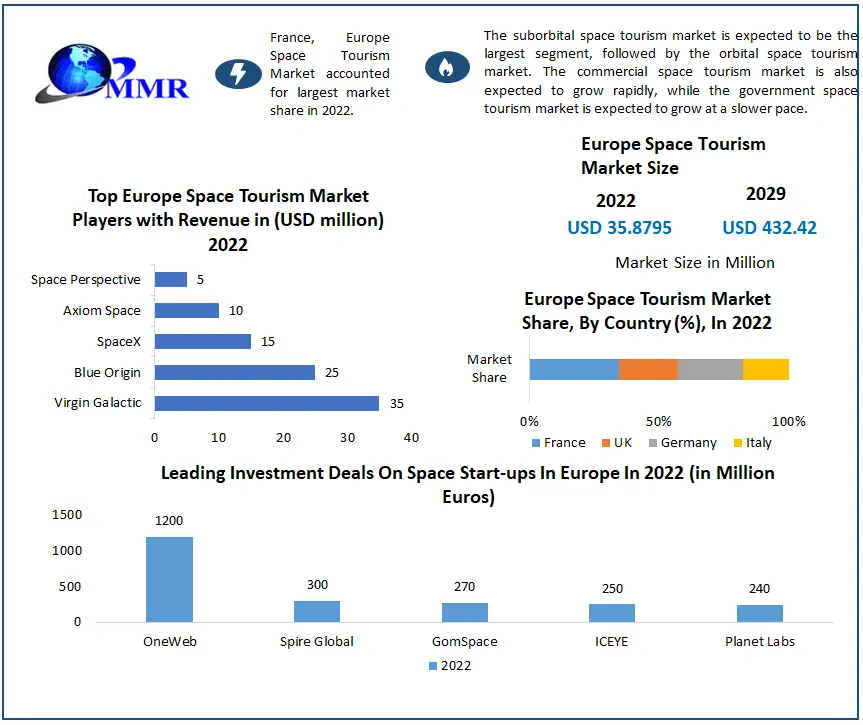
- Europe Space Tourism Market was valued at USD 35.8795 million in 2022.
- Market revenue is forecast to reach USD 432.42 million by 2029.
- The market is expected to expand at a 36.50% CAGR during 2023–2029.
- Sub-orbital tourism accounted for the largest market share in 2022.
- France is projected to lead regional market growth.
- Commercial investment is reshaping Europe’s private space ecosystem.
Why This Matters Now
Europe’s commercial space industry is entering a defining decade. Governments are no longer the sole drivers of human spaceflight as private aerospace companies move toward commercial passenger services, reusable launch technologies, and new revenue models.
The Europe Space Tourism Market, valued at USD 35.8795 million in 2022, is projected to reach USD 432.42 million by 2029, growing at 36.50% CAGR. That growth signals more than rising ticket sales. It points to expanding aerospace manufacturing, launch infrastructure, technology commercialization, and private capital flowing into Europe’s broader space economy.
Market Overview
The Europe Space Tourism Market is shifting from concept to commercialization. New launch systems, growing private-sector participation, and stronger collaboration between governments and aerospace companies are changing how Europe competes in the global commercial space race.
The European Space Agency continues to play a central role in supporting research, satellite programs, and human spaceflight capabilities. At the same time, private companies are pursuing sub-orbital tourism platforms that could lower barriers to commercial access over time. According to the MMR report, failure to adapt to new technological developments could reduce Europe’s competitiveness, weaken traditional aerospace companies, and allow non-European suppliers to capture larger portions of the value chain. Those risks make innovation an economic necessity rather than an option.
Although artificial intelligence, cloud migration, cybersecurity, 5G deployment, enterprise software modernization, edge computing, and data-center investments dominate many technology sectors, the supplied report does not provide market-specific evidence on these themes for Europe’s space tourism industry. Therefore, they are not assessed here.
Key Trends Driving Growth
Commercial spaceflight is becoming the industry’s primary catalyst. Companies developing reusable sub-orbital vehicles are reducing technical barriers while creating new business opportunities for tourism, astronaut training, research missions, and technology demonstrations.
Another important trend is Europe’s growing focus on maintaining industrial independence. The report highlights concerns that delayed technology adoption could increase dependence on major non-European providers. As private launch companies mature, Europe has an opportunity to strengthen domestic aerospace manufacturing, engineering expertise, and commercial launch capabilities.
Sub-orbital missions are also attracting significant attention because they require less complex mission architecture than orbital flights while still delivering a commercial spaceflight experience. That creates a more practical pathway for early market expansion.
Segment Insights
- Dominant Segment: Sub-Orbital tourism held the largest market share in 2022, supported by multiple European sub-orbital vehicle development programs and operational initiatives.
- Fastest-Growing Segment: The supplied report identifies Sub-Orbital as the leading segment but does not specify the fastest-growing segment separately.
- End User: Government, Commercial, and Other segments are included in the market scope. The report does not identify the dominant or fastest-growing end-user category.
Regional Growth Story
France is expected to lead the Europe Space Tourism Market during the forecast period. That leadership reflects the country’s established aerospace capabilities and participation in European space initiatives.
The report also evaluates the United Kingdom, Germany, Spain, Italy, Sweden, Austria, and the Rest of Europe. Each market contributes differently through aerospace manufacturing, engineering capabilities, launch technologies, and research infrastructure. Rather than relying on one national champion, Europe’s competitive position depends on coordinated regional innovation, industrial partnerships, and technology commercialization.
For investors, this broad geographic footprint reduces dependence on a single market while creating opportunities across multiple aerospace clusters.
Competitive Landscape
Competition extends beyond passenger launches. Companies are building capabilities that could define Europe’s long-term position in commercial space.
Virgin Galactic’s presence demonstrates increasing commercial interest in European customers. Airbus and EADS Astrium represent established aerospace engineering expertise that could accelerate commercialization through advanced manufacturing and systems integration. Orion Span and ZERO-2Infinity illustrate how specialized innovators are expanding the industry’s technology portfolio.
The competitive signal is clear. Market leadership will increasingly depend on reusable launch technologies, engineering efficiency, strategic partnerships, and scalable commercial business models rather than traditional government-funded space programs alone. Companies that successfully integrate aerospace innovation with commercial operations may gain stronger pricing power and broader ecosystem influence as the market matures.
Recent Developments
- European companies continue developing sub-orbital launch vehicles for commercial applications.
- Private-sector participation is expanding Europe’s commercial space ecosystem.
- The European Space Agency continues supporting human spaceflight and broader space activities across Europe.
- Industry attention remains focused on preserving European competitiveness against growing international competition.
Strategic Implications
Executives should view space tourism as part of a wider commercial space economy rather than a niche travel business. Launch systems, advanced materials, propulsion technologies, engineering services, simulation platforms, astronaut training, and aerospace manufacturing all stand to benefit from market expansion.
For policymakers, maintaining Europe’s technology leadership requires continued investment in innovation and commercial space infrastructure. For investors, the market’s projected expansion indicates opportunities extending well beyond passenger flights into the broader aerospace value chain.
The report also highlights the strategic importance of preventing supply-chain concentration among a limited number of non-European providers. Strengthening domestic capabilities could improve resilience while expanding Europe’s role in global commercial space activities.
Future Outlook
Europe’s space tourism industry is transitioning from experimental missions toward commercial execution. Market growth will increasingly depend on successful deployment of reusable launch technologies, stronger collaboration between public institutions and private companies, and sustained investment in aerospace innovation.
The organizations that build scalable commercial launch ecosystems and technology partnerships today will define Europe’s next generation of space leadership, while slower innovators risk losing strategic relevance in the rapidly evolving global space economy.
Analyst Perspective
“Europe’s expanding sub-orbital ecosystem and growing commercial participation position the region to strengthen its role in the global space economy. Continued technological advancement and coordinated industry development will be essential to sustaining long-term competitiveness.” — Yash Ghosalkar, Analyst
About Maximize Market Research
Maximize Market Research Pvt. Ltd. (MMR) is a global market research and consulting company that provides reliable, data-focused, and practical business insights. The firm serves a wide range of industries, including healthcare, pharmaceuticals, technology, automotive, electronics, chemicals, personal care, and consumer goods. Through market forecasts, competitive analysis, strategic consulting, and industry impact assessments, MMR helps organizations understand changing market conditions, identify growth opportunities, and make informed business decisions for long-term success.
2nd Floor, Navale IT Park Phase 3
Pune Banglore Highway, Narhe
Pune, Maharashtra 411041, India
+91 9607365656
sales@maximizemarketresearch.com
