Key Highlights
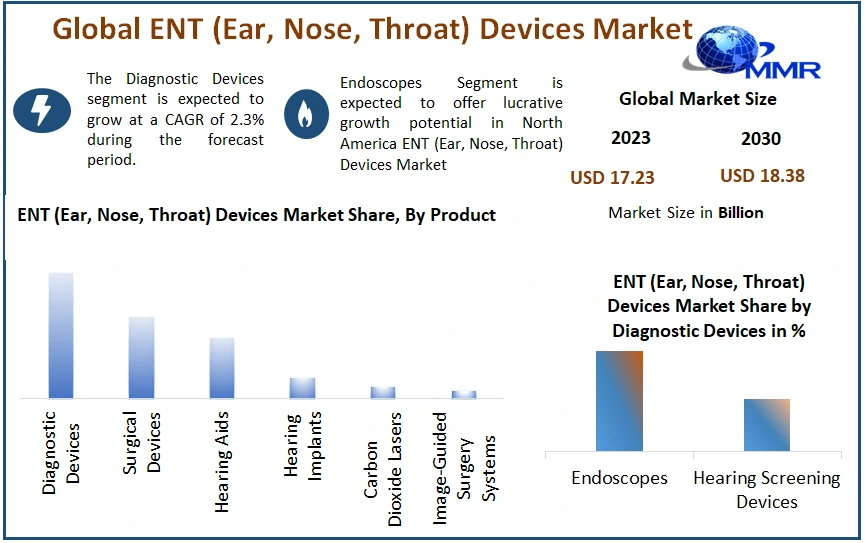
Market Valuation: The global ENT devices market reached USD 17.23 billion in 2023 and is projected to grow to USD 18.38 billion by 2030.
Compound Growth: The industry is advancing at a steady CAGR of 6.7% throughout the forecast period.
Clinical Driver: Increasing prevalence of chronic sinusitis, hearing loss, and vocal cord disorders in aging populations is accelerating demand for specialized instruments.
Technological Shift: Minimally invasive surgical tools and high-definition endoscopic systems are replacing traditional methods, reducing recovery times and improving precision.
Infection Control: A notable rise in the preference for disposable, single-use endoscopes and biopsy forceps is minimizing cross-contamination risks in clinical settings.
Why This Matters Now
Healthcare providers are facing a surge in ENT-related disorders, placing immediate pressure on hospital infrastructure to adopt more efficient, precise, and infection-resistant technologies. For medical device manufacturers and investors, the shift toward outpatient, minimally invasive procedures represents a definitive transition in the standard of care. Companies failing to integrate AI-driven surgical navigation or high-definition imaging into their product pipelines risk obsolescence as payers increasingly prioritize patient outcomes and shorter hospital stays.
Market Overview
The global ENT devices market Size is currently in a phase of structural optimization. With a valuation of USD 17.23 billion in 2023, the sector is balancing rapid technological innovation with the challenges of high capital costs and stringent regulatory requirements. Growth is no longer driven by incremental improvements alone; it is fueled by the systemic integration of digital health, machine learning, and portable diagnostics that enable care outside traditional hospital settings.
The market encompasses everything from diagnostic tools like audiometers and otoscopes to therapeutic devices such as cochlear implants and navigation systems. As healthcare systems move toward value-based care, the ENT segment is forced to demonstrate not just efficacy, but also cost-efficiency through reduced operative times and improved safety profiles.
Key Trends Driving Growth
Digital and wireless integration is transforming how hearing aids and diagnostic tools operate, offering patients personalized, data-driven management of their conditions. High-definition endoscopy has become the gold standard, providing surgeons with anatomical clarity that was previously unachievable. This trend toward high-precision imaging is complemented by the development of AI-powered surgical navigation.
Another significant trend is the rise of portable, handheld diagnostic devices. These tools allow practitioners to conduct assessments in ambulatory care settings, bypassing the need for heavy, centralized equipment. Furthermore, the industry is seeing increased investment in 3D-printed custom implants, which allow for patient-specific solutions that significantly improve the success rates of complex nasal and laryngeal surgeries.
𝐃𝐨𝐰𝐧𝐥𝐨𝐚𝐝 𝐏𝐃𝐅 𝐁𝐫𝐨𝐜𝐡𝐮𝐫𝐞 @
Segment Insights
Dominant Segment: Diagnostic and therapeutic surgical instruments (including endoscopes and powered surgical tools) currently command a significant share, supported by the high volume of routine procedures like septoplasty and tonsillectomy.
Fastest-Growing Segment: Minimally invasive surgical devices, particularly those integrated with navigation software and robotic-assisted platforms, are experiencing the most rapid adoption due to their ability to shorten recovery times.
Emerging Segment: Single-use, disposable ENT devices (endoscopes and biopsy forceps) are rapidly gaining traction as healthcare facilities prioritize rigorous infection control protocols.
Regional Growth Story
North America maintains a commanding position in the global market, underpinned by mature healthcare infrastructure, high healthcare spending, and early adoption of robotic-assisted surgical platforms. Regulatory pathways in the US are rigorous, yet they provide the necessary framework for global manufacturers to establish clinical credibility.
Conversely, the Asia-Pacific and Latin American markets represent the highest potential for volume growth. Expanding healthcare budgets, rising disposable income, and increasing awareness of ENT-related health issues are driving hospitals to modernize their equipment. Manufacturers that localize their manufacturing and distribution networks in these regions are capturing the growing demand for affordable, high-quality diagnostic tools.
Competitive Landscape
The market is characterized by a mix of established medical device conglomerates and agile, innovation-focused startups. Large players compete by acquiring niche technologies that provide proprietary surgical navigation or advanced imaging capabilities. Recent competitive maneuvers show that successful firms are no longer selling isolated hardware; they are providing comprehensive surgical ecosystems—linking preoperative planning software, navigation, and intraoperative instruments into a single, seamless platform.
Reimbursement policies remain a primary strategic hurdle. Companies that can provide robust clinical data demonstrating long-term cost savings through reduced surgical complications are securing favorable positions on hospital formularies and insurance coverage lists.
Recent Developments
AI Integration (September 2021): Acclarent (a Johnson & Johnson company) launched AI-powered software (TruSeg and TruPath) for the TruDi Navigation System, streamlining preoperative planning and real-time guidance for endoscopic sinus surgery.
Vocal Health Innovation: Researchers at Northwestern University developed a wearable sensor that monitors vocal usage through chest-worn vibration tracking, providing haptic alerts to prevent vocal injury in teachers, singers, and high-frequency speakers.
Strategic Collaboration: Increased partnerships between ENT specialists and device manufacturers are driving the development of 3D-printed nasal and laryngeal implants tailored to individual patient anatomy, addressing gaps in generic device performance.
Strategic Implications
The shift toward minimally invasive and outpatient care mandates a rethink of product design and marketing strategies. Manufacturers must prioritize portability, ease of use, and integration with existing electronic health record (EHR) systems. For healthcare systems, the move toward disposable instruments offers a clear path to reduced sterilization costs and lower liability regarding infection transmission. Success in the next five years will be contingent on the ability to translate advanced data—from wearables or surgical imaging—into actionable clinical decisions.
Future Outlook
The future of the ENT devices market will be defined by the convergence of AI-guided surgery, remote patient monitoring via wearable sensors, and a transition to high-precision, single-use instrumentation. As diagnostic accuracy improves and surgical interventions become less invasive, the distinction between hospital-based and ambulatory care will continue to blur. Healthcare providers who pivot toward these digitized, patient-centric workflows will lead, while those tethered to traditional, high-cost, and high-maintenance legacy hardware will struggle to remain competitive in an increasingly cost-conscious landscape.
Analyst Perspective
“The ENT devices sector is moving from a hardware-centric model to a data-driven service model. We are seeing a shift where technology is not just fixing a physical ailment—like sinusitis or hearing loss—but is actively monitoring the patient’s condition to prevent recurring complications. Companies that successfully integrate AI diagnostics with minimally invasive surgical ecosystems will capture the next wave of institutional investment and patient trust.” — Komal Patil, Research Analyst at Maximize Market Research
About Maximize Market Research
Maximize Market Research Pvt. Ltd. (MMR) is a global market research and consulting company that provides reliable, data-focused, and practical business insights. The firm serves a wide range of industries, including healthcare, pharmaceuticals, technology, automotive, electronics, chemicals, personal care, and consumer goods. Through market forecasts, competitive analysis, strategic consulting, and industry impact assessments, MMR helps organizations understand changing market conditions, identify growth opportunities, and make informed business decisions for long-term success.
2nd Floor, Navale IT Park Phase 3
Pune Banglore Highway, Narhe
Pune, Maharashtra 411041, India
+91 9607365656
sales@maximizemarketresearch.com
