Key Highlights
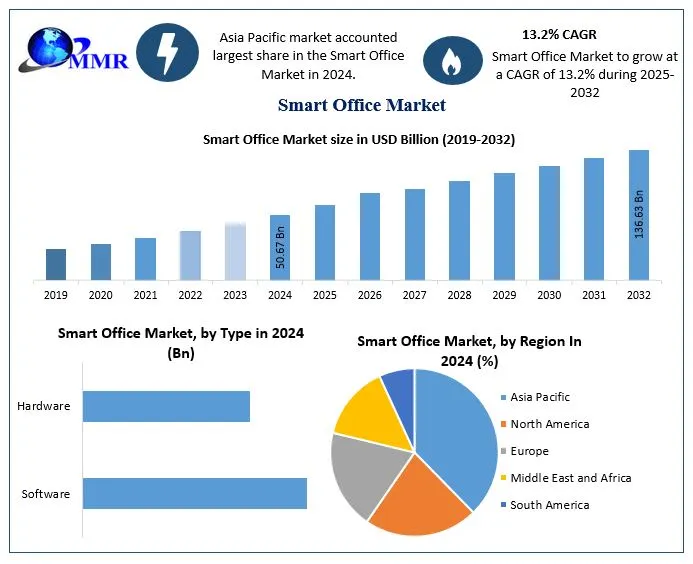
Global market scale expanding from USD 50.67 Billion in 2024 to USD 136.63 Billion by 2032.
Structural expansion maintained at a 13.2% compound annual growth rate across the forecast timeline.
Integrated software infrastructure secured the leading product segment share.
Computerized energy management systems emerged as the leading functional category.
Asia Pacific captured the maximum global market share while securing the fastest-accelerating CAGR at 13.3%.
Real-time broadcast analytics integration and structural upgrading complexities represent key friction points.
Why This Matters Now
Commercial real estate is shifting away from static structural designs toward dynamic, data-driven operating networks, forcing corporate technology leaders to completely re-evaluate their workspace investments. Traditional office space allocations can no longer survive the financial realities of unpredictable, modern hybrid occupancy schedules. The urgent operational necessity to decrease carbon footprints, track space utilization metrics, and cut unnecessary overhead costs is pushing capital directly into software-defined infrastructure.
What changed is that businesses are transitioning from siloed facility management tools to fully connected, sensor-embedded office networks. Enterprise technology buyers are under immediate pressure to unify localized environmental controls, meeting room scheduling systems, and smart security authentication platforms into a single, cohesive dashboard. Why now? Because corporate real estate represents a major overhead expense, and companies cannot afford to waste capital heating, cooling, and maintaining unutilized facilities. Cloud providers, enterprise leaders, and digital transformation executives benefit directly by deploying real-time automation to lower energy expenses and improve employee output.
Market Overview
The global Smart Office Market achieved an institutional valuation of USD 50.67 Billion in 2024 and is on a definitive trajectory to reach USD 136.63 Billion by 2032. This expansion marks a reliable 13.2% CAGR as corporations upgrade physical offices with intelligent networking. These systems balance distinct technologies, including smart lighting controls, specialized security setups, computerized energy management platforms, and automated HVAC operations.
However, migrating to an automated building framework introduces significant technical friction. Upgrading and replacing complex legacy infrastructure remains a primary obstacle for corporate real estate teams. Furthermore, integrating real-time broadcast analytics can strain existing enterprise networks, forcing technology buyers to thoroughly evaluate total lifecycle costs before approving wide-scale device deployments.
Key Trends Driving Growth
The ongoing rollout of deep Internet of Things (IoT) ecosystems acts as the primary architectural catalyst within corporate environments. Modern enterprises are embedding network-connected sensors and actuators directly into everyday facility equipment, allowing disparate hardware endpoints to communicate seamlessly. This continuous data flow lets organizations optimize space management, automate maintenance schedules, and improve structural utilization.
Concurrently, corporate focus on environmental footprint reduction is accelerating the adoption of specialized software controls. Computerized energy management platforms are being deployed to monitor and coordinate complex operational systems, including lighting, HVAC systems, plumbing networks, and localized watershed management. This automation allows corporate tenants to match energy consumption directly with actual daily building occupancy, cutting operational waste.
Additionally, smart building technologies are increasingly integrating with broader smart city initiatives. By linking office power grids, waste management systems, and transport connections with municipal data networks, corporations are improving overall operational agility. This data-driven strategy helps executive teams retain talent, streamline daily employee communication, and optimize asset utilization across the enterprise.
Segment Insights
Dominant Segment (Type): The Software segment held the largest global market share in 2024. Software platforms act as the central intelligence hub of the smart office, linking field sensors with executive dashboards to provide actionable insights into facility performance.
Dominant Segment (Product Type): Computerized energy management platforms led the product market category. These platforms track and optimize electrical and mechanical subsystems, helping corporations meet sustainability goals and lower utility expenses.
Fastest-Growing Segment: Real-time analytics and space management applications represent the fastest-accelerating category as businesses adapt physical footprints to accommodate flexible, hybrid work models.
Regional Growth Story
The Asia Pacific region captured the largest share of the global smart office market in 2024, while also locking in the highest forecast growth rate with a projected 13.3% CAGR. This dominant position is driven by rapid economic expansion and heavy infrastructure spending across developing markets, particularly India and China. These nations are experiencing massive commercial real estate development, allowing developers to build advanced IoT concepts directly into new facilities from the ground up.
In comparison, the North American market, encompassing the United States, Canada, and Mexico, relies primarily on retrofitting established corporate spaces. North American technology buyers focus heavily on embedding smart security authentication and cloud-based analytics into existing corporate layouts to reduce energy consumption. This focus on efficiency aligns with regional environmental standards and corporate cost-containment initiatives.
Competitive Landscape
The global smart office competitive arena features intense platform competition as traditional hardware manufacturers transform into software-centric ecosystem providers. The marketplace is shaped by industry heavyweights, including Schneider Electric SA, Johnson Controls International PLC, Honeywell International Inc., ABB Ltd., and Cisco Systems, Inc., alongside specialized players like United Technologies Corporation, Lutron Electronics Co. Inc., and Enlighted, Inc. This concentration signals a structural shift away from isolated hardware sales toward open, API-driven software platforms.
For technology leadership, this evolution means pricing power belongs to platforms that can successfully bridge information technology (IT) with operational facility hardware (OT). Cisco and Honeywell are integrating network virtualization and advanced cybersecurity layers directly into automated building management systems. This strategy forces consolidation across the sector, as smaller, single-tier sensor developers struggle to match the end-to-end security and hybrid cloud capabilities of these large platform providers.
Recent Developments
Tier-one building automation providers are launching pre-built API integrations to connect building occupancy sensors directly with enterprise resource planning (ERP) platforms.
Global technology vendors are deploying advanced edge computing nodes within smart offices to process localized environmental data without adding latency to core corporate networks.
Enterprise software developers are expanding cloud-hosted space-management suites to help corporate real estate teams reconfigure desk layouts dynamically based on historical badge data.
Security hardware manufacturers are introducing biometrically integrated authentication controls that connect with automated HVAC and lighting configurations to personalize workspaces instantly upon worker entry.
Strategic Implications
Deploying smart office technology requires a significant shift in corporate capital allocation. Chief Information Officers and facility managers must stop managing offices as simple real estate assets and start treating them as integrated data environments. Gathering real-time building data requires immediate investments in local network modernization, structured cabling, and edge gateway infrastructure to protect internal information traffic.
Furthermore, connecting mechanical systems to the corporate network introduces new security risks. Air-gapped facilities are no longer practical when using IoT-based energy optimization. Enterprises must implement zero-trust security architectures across all connected field devices to protect corporate networks from external threats. Ultimately, the integration of smart authentication, HVAC controls, and space analytics into a single software dashboard will determine an organization’s agility and long-term cost efficiency.
Future Outlook
As the global market scales toward its USD 136.63 Billion milestone, the historic boundary separating facility management from corporate computing networks will permanently disappear. Future digital leaders will run highly responsive, energy-optimized workplaces controlled by automated edge networks and unified software platforms, while market laggards will face rising operational costs tied to disconnected, inefficient facilities.
Analyst Perspective
“Modernizing the corporate workspace is no longer an optional employee benefit; it is an immediate financial necessity,” states Yash Ghosalkar, Analyst at Maximize Market Research. “As commercial energy costs rise and compliance standards mandate strict carbon accountability, deploying unified software platforms to orchestrate office infrastructure is the only reliable way for CIOs to optimize real estate expenditures while protecting profit margins.”
About Maximize Market Research
Maximize Market Research Pvt. Ltd. (MMR) is a global market research and consulting company that provides reliable, data-focused, and practical business insights. The firm serves a wide range of industries, including healthcare, pharmaceuticals, technology, automotive, electronics, chemicals, personal care, and consumer goods. Through market forecasts, competitive analysis, strategic consulting, and industry impact assessments, MMR helps organizations understand changing market conditions, identify growth opportunities, and make informed business decisions for long-term success.
2nd Floor, Navale IT Park Phase 3
Pune Banglore Highway, Narhe
Pune, Maharashtra 411041, India
+91 9607365656
sales@maximizemarketresearch.com
