Key Highlights
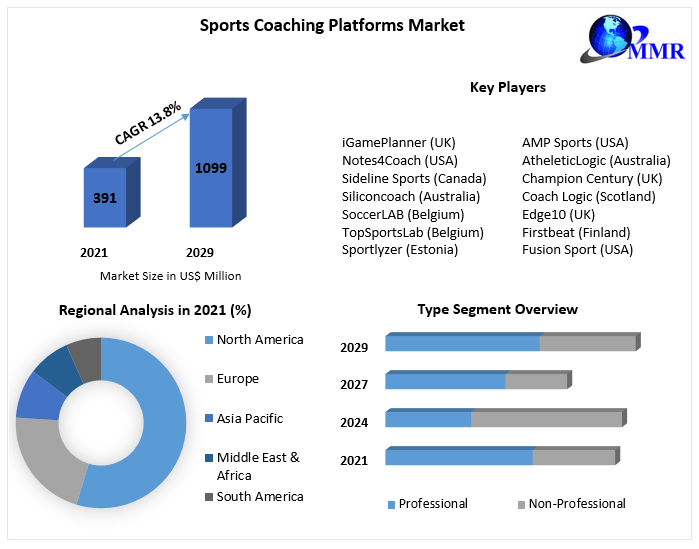
- Sports Coaching Platforms Market was valued at US$ 391.03 Mn. in 2021.
- Market revenue is projected to reach US$ 1,099.88 Mn. by 2029 at a 13.8% CAGR.
- Cloud-based coaching solutions remain a primary technology catalyst.
- AI-powered performance analytics are reshaping coaching decisions.
- North America holds the largest market share, while Asia-Pacific is the fastest-growing regional market.
- Subscription pricing remains the dominant business model.
- Non-professional users represent the largest type segment, while professional platforms are expanding fastest.
Why This Matters Now
Sports organizations are rapidly digitizing athlete development as coaching increasingly moves beyond physical practice sessions into always-connected digital ecosystems. Artificial intelligence, cloud computing, wearable technologies, and online performance analytics are changing how coaches evaluate talent, personalize training, and improve competitive outcomes.
For technology vendors, software developers, investors, sports organizations, and enterprise buyers, this transition represents far more than software adoption. It signals the emergence of scalable sports intelligence platforms where data, automation, and cloud infrastructure become competitive assets rather than operational tools.
Market Overview
The Sports Coaching Platforms Market reached US$ 391.03 Mn. in 2021 and is forecast to grow to US$ 1,099.88 Mn. by 2029, expanding at a CAGR of 13.8%. That trajectory signals accelerating investment in digital coaching infrastructure as organizations seek measurable performance improvements through technology.
Several structural shifts explain the momentum. Growing internet penetration has expanded access to online coaching across both developed and emerging markets. Cloud-based software has lowered deployment costs while enabling coaches, athletes, and organizations to collaborate remotely. AI-enabled performance analytics are making training decisions increasingly data-driven rather than intuition-based.
The pandemic further validated remote coaching models by demonstrating that athlete development could continue through digital platforms even when physical facilities were unavailable. While in-person training has resumed, digital coaching has become a permanent component of modern sports development strategies rather than a temporary substitute.
Key Trends Driving Growth
Artificial intelligence is becoming central to sports coaching software. Performance analytics platforms increasingly analyze large volumes of athlete data, enabling coaches to identify strengths, weaknesses, workload patterns, and tactical opportunities with greater precision. Solutions such as cloud-based cognitive analytics illustrate how AI is moving from experimentation into practical coaching workflows.
Cloud migration remains another defining technology trend. Organizations continue replacing traditional software deployments with cloud-native coaching platforms that simplify updates, improve accessibility, and reduce infrastructure costs. Cloud delivery also enables collaboration across coaching staff, athletes, medical teams, and management regardless of location.
Subscription-based software models continue expanding because they lower adoption barriers while providing recurring platform enhancements. Software vendors benefit from predictable revenue streams, while customers gain continuous access to new analytics capabilities without major upfront investment.
Automation is also changing coaching operations. Digital scheduling, athlete management, video analysis, training documentation, and performance reporting reduce administrative work, allowing coaches to focus on strategic athlete development.
Segment Insights
- Dominant Segment: Non-Professional platforms lead the market because digital coaching has become increasingly accessible for beginners and amateur athletes seeking affordable training solutions.
- Fastest-Growing Segment: Professional coaching platforms are projected to grow at the fastest pace as elite organizations invest more heavily in advanced analytics and digital performance management.
- Dominant Pricing Model: Subscription-based platforms account for the largest market share due to lower deployment costs and greater affordability.
- Fastest-Growing Pricing Model: One-time license solutions are expected to record the fastest growth as vendors diversify pricing strategies.
- Leading Application: Baseball represents the largest application segment and is expected to maintain the highest growth rate, supported by continued investment in coaching technologies.
Regional Growth Story
North America continues to hold the largest market share, supported by advanced digital infrastructure, mature sports technology adoption, established professional leagues, and significant software investment. Organizations across the United States increasingly integrate analytics, cloud software, and digital athlete management into competitive operations.
Asia-Pacific represents the fastest-growing regional market. Rapid internet adoption, expanding youth participation in organized sports, and increasing acceptance of advanced digital technologies are creating substantial opportunities across China, India, Japan, South Korea, and other regional markets. The combination of digital transformation and growing sports participation positions the region for sustained expansion.
Europe continues investing in sports modernization through technology-enabled coaching, while digital sports ecosystems gradually expand across additional emerging economies as awareness of platform capabilities increases.
Competitive Landscape
Competition is shifting from simple coaching applications toward comprehensive digital performance ecosystems.
Technology companies developing cloud-native coaching platforms are strengthening their competitive positions by embedding AI, analytics, and collaborative workflows directly into athlete management systems. This signals an industry transition where software differentiation increasingly depends on actionable intelligence rather than feature volume.
The growing presence of enterprise technology vendors demonstrates that sports coaching is becoming part of the broader digital transformation economy. Cloud infrastructure providers gain opportunities to expand enterprise workloads, while AI vendors strengthen platform ecosystems by integrating predictive analytics into sports performance management.
Market fragmentation remains a defining characteristic. Mature markets feature numerous established providers, making partnerships, platform integration, and ecosystem development increasingly important for competitive differentiation. Emerging markets, meanwhile, offer opportunities for new entrants as awareness and digital adoption continue improving.
Recent Developments
- Cloud-based sports coaching platforms continue expanding enterprise adoption.
- AI-powered athlete performance analytics are becoming mainstream coaching tools.
- Subscription software remains the preferred commercialization strategy.
- Internet expansion continues increasing online coaching participation.
- Sports organizations are investing in digital athlete management capabilities.
- Platform vendors continue integrating performance analytics into coaching workflows.
Strategic Implications
Technology providers should prioritize AI-enabled analytics, cloud scalability, and integrated athlete management rather than standalone coaching applications. Enterprise customers increasingly expect unified platforms capable of connecting coaching, performance analysis, communication, and operational management.
Sports organizations gain competitive advantages by converting athlete data into actionable coaching intelligence. Investors, meanwhile, are likely to focus on software providers capable of building recurring SaaS revenue models while expanding platform ecosystems through partnerships and intelligent automation.
The greatest long-term opportunity lies at the intersection of artificial intelligence, cloud computing, wearable technologies, and real-time performance analytics, where coaching evolves from periodic evaluation into continuous decision intelligence.
Future Outlook
The next phase of the Sports Coaching Platforms Market will be defined less by digitization itself and more by intelligent automation, AI-assisted coaching decisions, and cloud-native sports ecosystems. Organizations that transform coaching into a data-driven competitive capability will shape the future of athlete development, while those relying on traditional training models risk falling behind in an increasingly intelligence-powered sports economy.
Analyst Perspective
“The Sports Coaching Platforms Market is entering a phase where cloud computing, artificial intelligence, and digital performance management are becoming strategic capabilities rather than optional technologies. Organizations investing early in intelligent coaching ecosystems will be better positioned to improve athlete performance, operational efficiency, and long-term competitiveness.” — Yash Ghosalkar
About Maximize Market Research
Maximize Market Research Pvt. Ltd. (MMR) is a global market research and consulting company that provides reliable, data-focused, and practical business insights. The firm serves a wide range of industries, including healthcare, pharmaceuticals, technology, automotive, electronics, chemicals, personal care, and consumer goods. Through market forecasts, competitive analysis, strategic consulting, and industry impact assessments, MMR helps organizations understand changing market conditions, identify growth opportunities, and make informed business decisions for long-term success.
2nd Floor, Navale IT Park Phase 3
Pune Banglore Highway, Narhe
Pune, Maharashtra 411041, India
+91 9607365656
sales@maximizemarketresearch.com
