Key Highlights
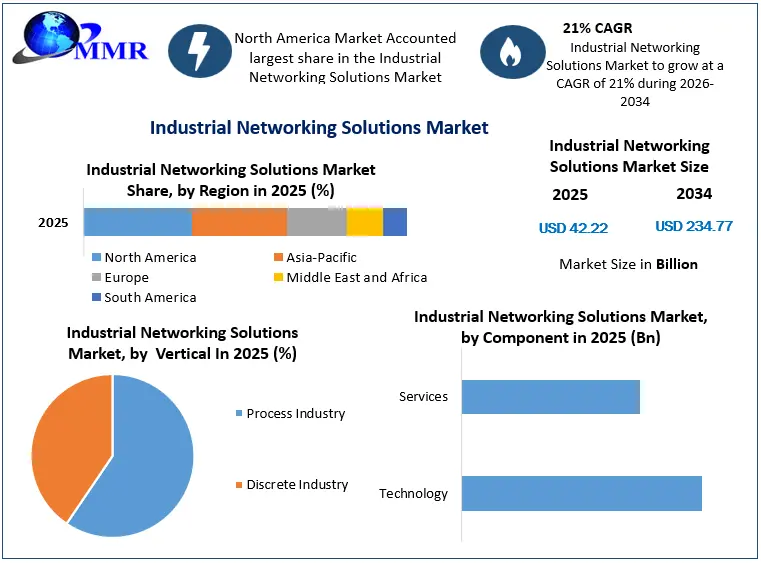
- Industrial Networking Solutions Market is projected to reach US$ 234.77 billion by 2034, growing at a 21% CAGR during the forecast period.
- AI-enabled predictive maintenance is becoming a strategic investment priority.
- Cloud deployment is accelerating industrial digital transformation.
- Wireless networking adoption continues expanding across smart manufacturing.
- North America remains the leading regional market through early Industry 4.0 implementation.
- Enterprise cybersecurity has become a core purchasing criterion for industrial networking investments.
- Industrial networking is evolving from operational infrastructure into a strategic digital platform.
Why This Matters Now
Industrial networks are no longer supporting factory automation alone. They are becoming the operational foundation for AI, cloud computing, real-time analytics, and autonomous production environments. Technology leaders are redesigning production architectures because disconnected operations can no longer support modern manufacturing requirements.
The Industrial Networking Solutions Market is expected to reach US$ 234.77 billion by 2034, expanding at a 21% CAGR during the forecast period. That pace of growth signals far more than infrastructure spending. It reflects enterprise priorities shifting toward resilient digital operations, predictive intelligence, and continuous industrial connectivity.
Market Overview
The Industrial Networking Solutions Market are moving beyond isolated automation systems toward fully connected production environments. Industrial networking enables machines, sensors, controllers, cloud platforms, and enterprise software to exchange operational data in real time. The business objective is no longer simply connectivity. It is continuous operational intelligence.
Manufacturers are integrating industrial Ethernet, wireless networking, SD-WAN technologies, and cloud-based management platforms to reduce downtime and improve production efficiency. Predictive maintenance has emerged as one of the strongest business drivers because connected equipment allows maintenance teams to identify failures before production interruptions occur. At the same time, digital transformation initiatives continue increasing demand for secure, scalable industrial communication networks.
Key Trends Driving Growth
Artificial intelligence is reshaping industrial networking from passive infrastructure into an intelligent operational platform. AI algorithms increasingly analyze equipment performance, detect anomalies, optimize traffic, and support predictive maintenance without manual intervention.
Cloud migration is also changing network architecture. Enterprises are extending operational technology environments into hybrid cloud platforms to centralize monitoring, simplify software management, and improve operational visibility across geographically distributed facilities.
Wireless networking continues replacing traditional wired deployments in applications requiring mobility, flexibility, and faster deployment. Industrial environments increasingly use wireless connectivity for mobile equipment, autonomous systems, and connected production assets because reducing cabling lowers installation complexity while improving operational flexibility.
Cybersecurity has become equally important. As factories become more connected, industrial organizations face increasing exposure to ransomware, unauthorized access, and operational disruption. Network security therefore moves from an IT responsibility to a production continuity requirement.
Automation initiatives further accelerate investment. Manufacturers adopting Industry 4.0 strategies require networking platforms capable of supporting robotics, machine vision, industrial AI, and edge computing simultaneously.
Segment Insights
- Dominant Segment: Wireless Networking Technology benefits from increasing deployment across industrial environments requiring mobility, flexible installation, and reduced cabling complexity.
- Fastest-Growing Segment: Cloud Deployment continues expanding as enterprises modernize industrial operations through centralized management and scalable digital infrastructure.
- Process industries continue investing in industrial networking to improve operational visibility and predictive maintenance.
- Large enterprises remain major adopters because digital transformation programs require integrated networking across multiple facilities.
- Services are becoming increasingly valuable as organizations seek network design, deployment, security, and lifecycle management expertise.
Regional Growth Story
North America maintains market leadership because manufacturers adopted Industry 4.0 technologies earlier than many global regions. Strong investments in industrial IoT, SD-WAN, wireless networking, and smart manufacturing continue reinforcing regional competitiveness. Mature digital infrastructure also enables faster deployment of advanced industrial networking platforms.
Asia-Pacific is becoming a major investment destination as China, India, Japan, and South Korea expand manufacturing automation and digital infrastructure. Growing factory modernization programs are increasing demand for intelligent networking solutions capable of supporting AI-enabled production environments.
Germany continues advancing industrial connectivity through its manufacturing leadership and Industry 4.0 initiatives. The United Kingdom increasingly focuses on industrial digital transformation and cybersecurity modernization across critical infrastructure.
These regional developments demonstrate that industrial networking has become central to national competitiveness, manufacturing productivity, and digital resilience rather than merely supporting operational communications.
Competitive Landscape
Competition increasingly centers on platform ecosystems instead of standalone networking hardware. Technology vendors are combining industrial connectivity with cloud management, cybersecurity, analytics, AI capabilities, and lifecycle services to build long-term customer relationships.
Strategic investments in wireless networking, industrial Ethernet, SD-WAN, and intelligent network management indicate that vendors are competing to become digital transformation partners rather than equipment suppliers. Platform integration strengthens customer retention because enterprises prefer unified operational environments over fragmented networking solutions.
Cybersecurity capabilities have also become a major differentiator. Vendors that integrate secure networking, continuous monitoring, and AI-assisted threat detection position themselves more effectively as manufacturers prioritize operational resilience.
The competitive environment also signals ongoing market consolidation. Partnerships between networking vendors, automation providers, cloud platforms, and software companies are expanding integrated industrial ecosystems that simplify enterprise adoption while strengthening long-term recurring revenue opportunities.
Recent Developments
- AI-driven predictive maintenance capabilities continue expanding across industrial networking deployments.
- Cloud-managed industrial networking platforms are gaining enterprise adoption.
- Wireless industrial networking continues replacing conventional wired infrastructure in mobile production environments.
- SD-WAN deployment is increasing across distributed industrial operations.
- Industrial cybersecurity investments continue accelerating alongside digital transformation initiatives.
- Manufacturers are modernizing networking infrastructure to support Industry 4.0 automation strategies.
Strategic Implications
Industrial networking has become a board-level investment decision because operational performance increasingly depends on connected digital infrastructure. CIOs are aligning IT and operational technology strategies to create unified data environments. CTOs are investing in scalable architectures capable of supporting AI, automation, cloud computing, and industrial analytics simultaneously.
Technology providers benefit from expanding demand for integrated networking platforms, managed services, cybersecurity, and cloud-native industrial applications. Investors increasingly view industrial networking as foundational infrastructure supporting the broader digital manufacturing ecosystem rather than an isolated networking market.
Telecom operators also gain opportunities as private wireless networks, industrial 5G deployments, and edge connectivity become integral components of modern manufacturing environments.
Future Outlook
Industrial networking is entering a new phase where connectivity alone will no longer create competitive advantage. Intelligent networks capable of supporting AI, cloud-native operations, predictive maintenance, automation, and cyber resilience will define the next generation of industrial leadership. Organizations that modernize their networking platforms early will build adaptive digital factories, while those delaying modernization risk becoming increasingly disconnected from the future of intelligent manufacturing.
Analyst Perspective
“Industrial networking is evolving into the digital operating system for modern industry. Organizations investing in intelligent connectivity today are creating the foundation for AI-driven automation, resilient operations, and long-term competitive differentiation.” — Yash Ghosalkar
About Maximize Market Research
Maximize Market Research Pvt. Ltd. (MMR) is a global market research and consulting company that provides reliable, data-focused, and practical business insights. The firm serves a wide range of industries, including healthcare, pharmaceuticals, technology, automotive, electronics, chemicals, personal care, and consumer goods. Through market forecasts, competitive analysis, strategic consulting, and industry impact assessments, MMR helps organizations understand changing market conditions, identify growth opportunities, and make informed business decisions for long-term success.
2nd Floor, Navale IT Park Phase 3
Pune Banglore Highway, Narhe
Pune, Maharashtra 411041, India
+91 9607365656
sales@maximizemarketresearch.com
