Healthcare providers, device manufacturers and payers across Asia Pacific face a growing diabetes-management challenge: more patients require frequent glucose checks, while hospital-centered care cannot meet every monitoring need. The Asia Pacific Blood Glucose Monitoring System Market is becoming a larger part of the region’s response, shifting diabetes management toward earlier diagnosis, self-care and connected monitoring.
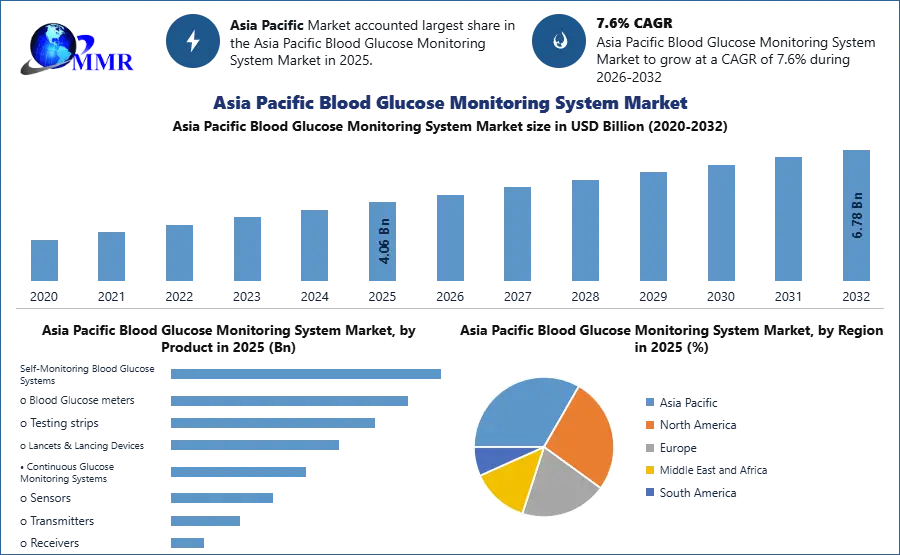
The Asia Pacific Blood Glucose Monitoring System Market Size was valued at USD 4.06 billion in 2025 and is projected to reach nearly USD 6.78 billion by 2032, growing at a CAGR of 7.6%. The expansion signals sustained demand for blood glucose meters, testing strips, continuous glucose monitoring systems and home-based diabetes care tools.
Key Highlights
- The Asia Pacific Blood Glucose Monitoring System Market was valued at USD 4.06 billion in 2025.
- Market revenue is expected to reach nearly USD 6.78 billion by 2032.
- The market is forecast to grow at a CAGR of 7.6% from 2025 to 2032.
- Self-monitoring blood glucose systems are expected to grow at the highest CAGR by product category.
- Testing strips held the largest market share within self-monitoring blood glucose systems.
- Continuous blood glucose monitoring devices are expected to grow at the greatest rate during the forecast period.
- Fingertip testing is expected to grow at the highest CAGR by testing site.
- Hospital and clinics are expected to grow at the highest CAGR by care setting, while self/home care is expected to expand at the fastest rate.
- Type 2 diabetes is expected to grow at the highest CAGR by application.
- China leads the regional market, while India is identified as the fastest-growing market.
Why This Matters Now
Diabetes care is becoming a larger operating challenge for healthcare systems across Asia Pacific. The report identifies rising diabetes incidence, technological advances in monitoring and diagnosis, early identification of diabetes and growing demand for continuous glucose monitoring as central drivers of the market.
For hospitals, clinics and diabetes specialists, faster access to blood glucose data can improve treatment decisions. For patients, monitoring tools make it easier to track how food intake, exercise, insulin, stress and illness affect glucose levels. This creates demand for products that support regular measurement outside traditional clinical settings.
The market’s projected growth from USD 4.06 billion in 2025 to USD 6.78 billion by 2032 also changes the commercial outlook for medical device companies. Demand is no longer limited to hospital testing. It increasingly includes consumer-facing devices, home-care products, testing strips, sensors, transmitters, receivers and digital monitoring systems.
Market Overview
Blood glucose monitoring involves measuring glucose levels in the blood to determine whether they are within a target range. These systems provide information that can help patients and healthcare professionals manage diabetes, monitor treatment objectives and assess the impact of medication, food, exercise, stress and illness.
The Asia Pacific market includes self-monitoring blood glucose systems and continuous glucose monitoring systems. Self-monitoring systems include blood glucose meters, testing strips, lancets and lancing devices. Continuous glucose monitoring systems include sensors, transmitters and receivers.
The market also covers multiple testing sites, patient care settings and diabetes applications. Fingertip testing and alternate site testing form the testing-site categories. Hospital and clinics, along with self/home care, are the primary patient-care settings. Applications include Type 1 diabetes, Type 2 diabetes and gestational diabetes.
This broad market structure matters because diabetes monitoring is becoming more individualized. A patient managing insulin-dependent diabetes may require frequent readings and treatment adjustments. A hospital may need rapid data for inpatient or outpatient care. A consumer may use self-monitoring to support preventive care and lifestyle changes.
Key Trends Driving Growth
The strongest market driver is the rising prevalence of diabetes. The report states that diabetes is more common among the elderly population and that diabetes-related causes are increasing across the region. This creates recurring demand for monitoring systems that can support daily disease management.
Preventive care is another major growth factor. The report links early diabetes identification with improved health outcomes and identifies increasing awareness of preventive diabetes management as a demand driver. This supports wider use of monitoring devices before patients experience more serious complications.
Technology is also changing product demand. Advances in diabetes monitoring and diagnosis are increasing interest in continuous glucose monitoring systems. These devices provide continuous and real-time glucose readings every five minutes, allowing users to assess glucose patterns rather than relying only on isolated readings.
For manufacturers, this raises the value of device ecosystems. Sensors, transmitters, receivers and glucose meters must compete on accuracy, usability, affordability and patient convenience. The commercial opportunity is strongest where companies can support both clinical needs and everyday patient use.
Access remains a major issue. The report identifies lower diagnosis rates, delayed treatment and limited awareness in emerging economies as restraints. In China and India, delayed diabetes treatment can reduce adoption of monitoring systems. This creates a challenge for device makers and healthcare systems: growth depends not only on product availability but also on diagnosis, education and patient engagement.
Request a Free Sample Report for Comprehensive Market Insights
Segment Insights
- Dominant Segment: Testing Strips — Testing strips held the largest market share within the self-monitoring blood glucose systems category. Their widespread use and low cost support demand. The segment is expected to grow at a profitable CAGR, making consumables a major recurring-revenue opportunity for device suppliers.
- Fastest-Growing Product Segment: Self-Monitoring Blood Glucose Systems — Self-monitoring blood glucose systems are expected to grow at the highest CAGR during the forecast period. Their lower price and ease of use make them important for everyday diabetes care, especially where affordability and home-based testing matter.
- High-Growth Technology Segment: Continuous Blood Glucose Monitoring Devices — Continuous blood glucose monitoring devices are expected to increase at the greatest rate. The technology is particularly relevant for Type 1 diabetes patients at risk of severe hypoglycemia because it provides frequent, real-time readings and helps users identify glucose patterns.
- Dominant Continuous Monitoring Component: Transmitters and Receivers — Within continuous glucose monitoring systems, transmitters and receivers held the highest revenue share. Their role in moving glucose data from implanted sensors to a monitor creates a significant device-system opportunity.
- Fastest-Growing Testing Site: Fingertip Testing — Fingertip testing is expected to grow at the highest CAGR. It is quick, convenient and less invasive than venous blood collection, making it suitable for patients seeking regular testing with greater privacy and less time away from work.
- Fastest-Growing Care Setting: Self/Home Care — The self/home care segment is expected to develop at the fastest rate. Self-monitoring has changed short-term glucose management by allowing people with or without diabetes to check glucose levels at home and assess the effects of diet, insulin, exercise and stress management.
- Fastest-Growing Application: Type 2 Diabetes — Type 2 diabetes is expected to grow at the highest CAGR. The report links this to the population of insulin-dependent Type 2 diabetes patients and the need for frequent monitoring when glucose levels fluctuate.
Regional Growth Story
China holds the leading position in the Asia Pacific blood glucose monitoring device market, according to the report. Advanced technology, a rising number of diabetic patients, high healthcare spending, government support for research and development, increased R&D activity and consolidation among major companies are supporting market growth.
China’s position makes it a priority market for global device manufacturers. The combination of patient demand and technology investment creates an environment where companies can compete through product innovation, distribution strength and local market execution.
India holds the second position in the regional market, supported by government backing for research and development and the availability of research funding. The report identifies India as the fastest-growing blood glucose monitoring market because of its large patient population, high healthcare spending and rapidly advancing healthcare technology.
India’s growth has wider implications for the region. The country’s large patient base creates a strong need for affordable and accessible monitoring systems. Companies that can combine lower-cost self-monitoring products with education, distribution and home-care access may be better placed to capture demand.
Japan, Australia and the Republic of Korea are also identified as markets with significant growth. South Korea and India are expected to benefit from rising demand for novel treatment techniques. The report does not provide country-level revenue values, reimbursement figures or specific regulatory changes for Japan, South Korea, China or India, so no further country-level market estimates are stated.
The United States, Germany and the United Kingdom are outside the geographic scope of this Asia Pacific market assessment. No market data for these countries is included in the supplied report.
Competitive Landscape
The market includes global diabetes-care companies, medical device manufacturers and specialist monitoring-device providers. Key players listed in the report include Abbott Diabetes Care, Roche, Johnson & Johnson, Dexcom, Medtronic, Arkray, Ascensia Diabetes Care, Agamatrix, Bionime Corporation, Acon, Medisana, Trivida, Rossmax, Diamontech GmbH, 77 Elektronika Kft., GlySens Incorporated, Novo Nordisk, Nemaura and PHC Holdings Corporation.
Competition is intensifying across both traditional self-monitoring systems and continuous monitoring technologies. The report states that leading competitors are continually developing merger and acquisition strategies to increase market share and growth potential. This signals a market where scale, product portfolios and technology access can shape competitive positioning.
For patients, stronger competition can support broader device availability and innovation. For providers, the key issue is whether systems can deliver accurate data quickly and fit into hospital, clinic and home-care workflows.
Recent Developments
- Major competitors are pursuing mergers and acquisitions to strengthen market share and growth potential.
- Continuous glucose monitoring is gaining importance because it can provide real-time glucose readings every five minutes.
- Hospitals and clinics are expanding use of blood glucose monitoring devices because they provide practitioners with rapid patient data.
- The U.S. Food and Drug Administration permitted the use of continuous glucose monitoring devices in hospitals during the COVID-19 pandemic, according to the report.
- Government initiatives supporting preventive healthcare, subsidies and device accessibility are creating new adoption opportunities in Asia Pacific.
Strategic Implications
Healthcare providers need to build glucose monitoring into broader diabetes-management pathways. Hospital use remains important, but home-based monitoring is growing faster. Providers that can connect testing, treatment guidance and patient education may improve follow-up care and reduce avoidable treatment delays.
Device manufacturers need a two-track strategy. Affordable self-monitoring systems remain important because testing strips and glucose meters are widely used. At the same time, continuous monitoring devices create a higher-growth opportunity for companies that can deliver real-time data and patient-friendly technology.
Governments and payers can influence market adoption through preventive healthcare initiatives, subsidies and improved access to diagnostic services. The report identifies government support and wider healthcare access as major opportunities, while low diagnosis rates and delayed treatment remain barriers.
Future Outlook
The companies that combine affordable self-monitoring tools, continuous glucose technologies and practical home-care access will lead Asia Pacific diabetes monitoring, while those that fail to address diagnosis and adoption gaps will lose ground.
Analyst Perspective
“Asia Pacific blood glucose monitoring demand is being driven by rising diabetes prevalence, stronger preventive-care awareness and the need for patients to manage glucose levels more effectively outside hospitals,” said Komal Patil, Analyst at Maximize Market Research. “The market will increasingly favor companies that can deliver accessible self-monitoring systems alongside advanced continuous glucose monitoring technologies.”
About Maximize Market Research
Maximize Market Research Pvt. Ltd. (MMR) is a global market research and consulting company that provides reliable, data-focused, and practical business insights. The firm serves a wide range of industries, including healthcare, pharmaceuticals, technology, automotive, electronics, chemicals, personal care, and consumer goods. Through market forecasts, competitive analysis, strategic consulting, and industry impact assessments, MMR helps organizations understand changing market conditions, identify growth opportunities, and make informed business decisions for long-term success.
Contact Us
2nd Floor, Navale IT Park Phase 3
Pune Banglore Highway, Narhe
Pune, Maharashtra 411041, India
+91 9607365656
sales@maximizemarketresearch.com
