Key Highlights
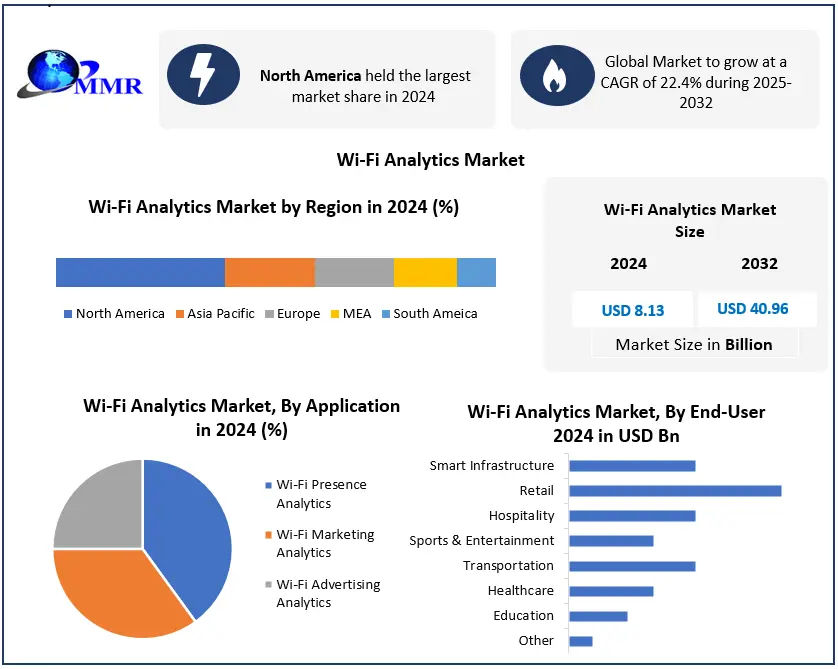
Market valuation stood at USD 8.13 billion in 2024 with a projected expansion to nearly USD 40.96 billion by 2032.
Compounded annual growth rate (CAGR) is established at 22.4% over the 2025–2032 forecast timeline.
Core demand levers include real-time customer analytics, hyper-targeted marketing campaigns, and automated footfall tracking.
Cloud deployment models dominate enterprise software demand due to reduced capital expenditure and rapid scalability.
Digital transformation initiatives across retail, hospitality, and smart cities are forcing a shift from utility Wi-Fi to monetization infrastructure.
Why This Matters Now
Enterprise networking has passed a critical inflection point where connectivity alone yields zero differentiation. Chief Information Officers and Chief Technology Officers no longer view wireless infrastructure as a corporate utility or utility-cost center; it is now a primary pipeline for physical-world data capture. As physical brick-and-mortar spaces race to match the granular tracking capabilities of e-commerce platforms, Wi-Fi networks serve as the foundational sensor layer.
Failing to capitalize on this infrastructure means leaving vital data unharvested, directly impacting customer retention and operational efficiency. Investors and telecom operators are shifting capital toward platforms that seamlessly integrate location-based services with predictive analytics engines. This structural market pivot turns every public and private Wi-Fi access point into an intelligent monetization node.
Market Overview
The global Wi-Fi Analytics Market reached a valuation of USD 8.13 billion in 2024 and is on track to achieve USD 40.96 billion by 2032, registering an annual compounding growth rate of 22.4%. This rapid expansion signals a deeper industry migration toward software-defined brick-and-mortar environments. Enterprises are utilizing existing hardware footprints to run advanced analytics software, bypassing the need for expensive dedicated sensor deployments.
What changed is the fundamental capability of standard network controllers to process location indicators without interrupting primary data transmission. Previously, physical venue tracking relied on fragmented systems like thermal cameras or manual counts. Today, unified enterprise software platforms ingest MAC addresses, dwell times, and return rates to construct comprehensive consumer profiles.
This transition directly benefits brick-and-mortar retailers, shopping mall operators, transit hubs, and municipal planners who require immediate operational transparency. The next phase of development involves fusing these location data streams with broader enterprise resource planning and customer relationship management platforms.
Key Trends Driving Growth
The convergence of edge computing and cloud-based analytics platforms represents the primary technological growth driver. By offloading heavy processing tasks to localized edge nodes, businesses can analyze footfall patterns and trigger automated marketing actions in real time. For example, a customer lingering in a specific retail aisle can receive an instantaneous mobile promotion, vastly increasing conversion rates.
Furthermore, digital transformation initiatives across the public and private sectors are accelerating network modernization. Municipalities are installing smart city Wi-Fi infrastructure not just to provide public internet access, but to map pedestrian traffic, optimize public transit schedules, and enhance public safety. In the enterprise domain, the integration of machine learning algorithms allows networks to predict crowd formations and adjust HVAC or staffing levels dynamically.
Another structural driver is the increasing strictness of data privacy regulations worldwide. As third-party digital cookies face deprecation, first-party physical data captured via opt-in Wi-Fi portals has become a highly valuable asset for corporate marketing teams. This shift ensures a reliable, legally compliant source of consumer behavioral data.
Segment Insights
Dominant Segment: Smart Retail and Hospitality Solutions remain the dominant market sector, capturing the largest market share due to immediate monetization needs and high-density consumer environments.
Fastest-Growing Segment: Cloud-based Wi-Fi Analytics Platforms represent the fastest-growing technology deployment model, expanding rapidly as enterprises deprecate legacy, on-premises hardware in favor of agile Software-as-a-Service architecture.
Core Functional Segment: Customer Analytics and Footfall Tracking engines lead functional software demand, driven by corporate mandates to map physical attribution and optimize venue layouts.
Regional Growth Story
North America maintains a commanding position in the global Wi-Fi analytics ecosystem, driven by aggressive digital infrastructure investments and high smartphone penetration. Major retail chains and entertainment venues across the United States are executing multi-year cloud migration activities to centralize their location intelligence operations. This high concentration of enterprise software vendors and mature cloud data centers ensures fast deployment times and low latency for analytical processing.
Concurrently, the Asia-Pacific region is emerging as the fastest-growing geographic market. Governments in India, China, and Southeast Asia are funding massive telecom infrastructure expansions and smart city frameworks. In India, rapid urbanization and the proliferation of organized retail hubs are creating greenfield opportunities for advanced network virtualization.
European markets, led by Germany and the United Kingdom, are focusing heavily on digital sovereignty and strict regulatory compliance. Software developers in these regions are redesigning their platforms to guarantee complete data anonymization while preserving the operational value of footfall insights.
Competitive Landscape
The competitive environment is shifting away from standalone analytics applications toward integrated platform economics. Legacy networking hardware giants are actively acquiring or partnering with specialized software-as-a-service providers to offer unified hardware-and-software bundles. This strategy enhances their pricing power and builds deep competitive moats against pure-play software vendors.
For telecom operators, providing managed Wi-Fi analytics services presents a major opportunity to move up the value chain. Instead of competing on low-margin connectivity tariffs, operators are positioning themselves as comprehensive digital transformation partners for enterprise clients. This evolution allows telcos to secure long-term, high-margin contracts while lowering customer churn.
Cloud providers are also expanding their native data analytics suites to ingest edge network streams directly, positioning themselves as the definitive backends for global physical intelligence. The market is consolidating around vendors that can deliver highly accurate location tracking without requiring complex, site-specific hardware calibration.
Recent Developments
Major enterprise networking vendors have rolled out integrated application programming interfaces (APIs) that allow direct integration between Wi-Fi controllers and leading marketing automation suites.
Telecom operators in the United States and Europe have launched managed location-intelligence services tailored specifically for large-scale transportation hubs and stadiums.
Software providers have introduced advanced privacy-safe tracking protocols that comply fully with global data sovereignty mandates without compromising analytical accuracy.
Cloud migration activities among tier-one retail operators have accelerated, with major brands shifting their legacy on-premises analytics architectures to hybrid cloud configurations.
Strategic Implications
The financial and operational reality for modern enterprises is clear: physical footprint optimization can no longer rely on guesswork or historical intuition. Deploying advanced analytics software over existing wireless networks enables companies to measure physical spaces with the same precision as digital websites. This capability alters how corporate real estate is valued, how marketing budgets are allocated, and how customer experiences are designed.
Organizations that exploit these datasets can rapidly adjust to shifting consumer behaviors, fine-tune their staffing matrices, and capture high-margin advertising revenue through localized brand partnerships. Conversely, companies failing to upgrade their legacy networks risk operating with significant blind spots, leaving them highly vulnerable to more agile, data-driven competitors.
Future Outlook
Looking ahead, the global Wi-Fi analytics market will move beyond descriptive reporting and focus heavily on predictive intelligence. The integration of generative analytics engines will allow business managers to query physical space metrics using natural language, receiving automated suggestions for floor plan modifications or targeted marketing schedules.
As 5G enterprise private networks expand alongside next-generation Wi-Fi architectures, the granularity of physical tracking will reach sub-meter accuracy. This convergence will enable seamless indoor-outdoor tracking, creating completely unified visibility across logistics networks, corporate campuses, and smart urban zones. The ultimate market division will separate future digital leaders who weaponize network data for immediate operational superiority from laggards who continue to treat corporate connectivity as an unmonetized utility overhead.
Analyst Perspective
“The modern wireless network has evolved far beyond a basic connectivity pipeline into a primary mechanism for enterprise intelligence,” states Yash Ghosalkar, Analyst at Maximize Market Research. “Organizations that successfully integrate cloud-based customer analytics with real-time footfall tracking are transforming their physical infrastructure from a cost center into a high-yield engine for growth and targeted monetization.”
About Maximize Market Research
Maximize Market Research Pvt. Ltd. (MMR) is a global market research and consulting company that provides reliable, data-focused, and practical business insights. The firm serves a wide range of industries, including healthcare, pharmaceuticals, technology, automotive, electronics, chemicals, personal care, and consumer goods. Through market forecasts, competitive analysis, strategic consulting, and industry impact assessments, MMR helps organizations understand changing market conditions, identify growth opportunities, and make informed business decisions for long-term success.
2nd Floor, Navale IT Park Phase 3
Pune Banglore Highway, Narhe
Pune, Maharashtra 411041, India
+91 9607365656
sales@maximizemarketresearch.com
