Key Highlights
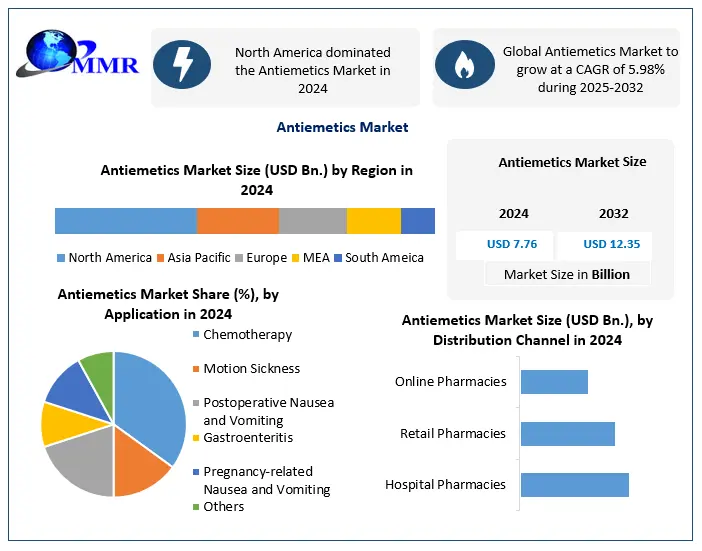
Market Scale: The global antiemetics market was valued at USD 7.76 billion in 2024 and is projected to reach USD 12.35 billion by 2032.
Compound Growth: The sector is maintaining a steady 5.98% compound annual growth rate (CAGR) through the 2025–2032 forecast window.
Dominant Class: The 5-HT3 receptor antagonists segment represents the largest product category due to its extensive clinical use and proven safety profile.
Primary Application: The chemotherapy segment commands the biggest application share as cancer therapies expand worldwide.
Regional Strength: North America holds the premier market position, supported by advanced clinical infrastructure and robust healthcare expenditure.
Why This Matters Now
Escalating cancer cases and advanced chemotherapy regimens put immediate pressure on clinical systems to adopt reliable supportive care solutions. Patients undergoing oncological interventions face severe therapy compliance risks when chemotherapy-induced nausea and vomiting (CINV) are left unmanaged. For pharmaceutical manufacturers, healthcare providers, and biotechnology investors, this creates an urgent demand for targeted, fast-acting antiemetic formulations. Systems must actively incorporate reliable supportive care platforms to minimize treatment disruptions and stabilize recovery cycles.
Market Overview
The global antiemetics market Size is entering a phase of structural stability, shifting from broad symptomatic management to highly target-specific clinical regimens. Valued at USD 7.76 billion in 2024, the market is on track to hit USD 12.35 billion by 2032, showing an 5.98% CAGR. This long-term growth is anchored by expanding patient bases requiring specialized anti-nausea interventions.
The product landscape is built around distinct drug classes, including 5-HT3 receptor antagonists, dopamine antagonists, neurokinin-1 (NK1) receptor antagonists, anticholinergics, and antihistamines. While the industry faces commercial headwinds from high research and development costs and clinical trial design complexities, steady global therapeutic demand provides a dependable long-term framework for established pharmaceutical networks.
Key Trends Driving Growth
The major engine behind current market growth is the rising global incidence of complex oncological conditions and chronic gastrointestinal diseases. As next-generation, high-efficacy anti-cancer drugs enter standard practice, the use of chemotherapy in advanced patient populations is increasing. This growth creates a direct need for reliable antiemetic co-therapies to counter the side effects of aggressive treatments.
Simultaneously, healthcare infrastructure modernization is driving clinical adoption across both developed and developing economies. The industry is seeing increased investment in specialized oncology supportive care, alongside efforts to expand treatment access in decentralized healthcare settings. This clinical focus is prompting facilities to maintain large stocks of advanced anti-nausea therapeutics.
𝐃𝐨𝐰𝐧𝐥𝐨𝐚𝐝 𝐏𝐃𝐅 𝐁𝐫𝐨𝐜𝐡𝐮𝐫𝐞 @
Segment Insights
Dominant Drug Class: The 5-HT3 receptor antagonists segment held the premier market position in 2024. These agents remain the standard choice due to their high efficacy and established safety record in treating acute nausea across chemotherapy and surgical settings.
Dominant Application: The Chemotherapy segment captured the largest application share in 2024. This leadership is sustained by the daily increase in global cancer patient populations requiring systemic oncology therapies.
Emerging Hurdles: The absence of a precise animal model that mirrors human responses to antiemetic treatments remains a significant technical challenge, slowing the commercialization of newer therapeutic variants.
Regional Growth Story
North America led the global industry in 2024 and is projected to maintain its dominant position through 2032. The region’s strength is anchored by high healthcare spending, a well-established network of specialized hospitals, and a substantial cancer patient population receiving active treatment. Furthermore, prompt regulatory clearances by the US FDA and robust reimbursement networks for supportive therapies allow advanced antiemetics to quickly secure high market shares.
Concurrently, international markets across Europe and the Asia-Pacific region are seeing steady clinical adoption. In countries like Germany, the UK, China, Japan, India, and South Korea, market growth is fueled by expanding healthcare access and rising screening rates for geriatric populations. In emerging economies, increasing public health investments are expanding the availability of basic anti-cancer and supportive drug classes, creating new opportunities for global pharmaceutical manufacturers.
Competitive Landscape
The global competitive space is highly consolidated among large, multi-national pharmaceutical firms and specialized formulation developers. Key industry players secure their positions by managing large-scale global distribution networks, optimizing production costs, and securing long-term hospital supply contracts.
Competition centers heavily on expanding therapeutic indications and obtaining regulatory approvals for next-generation combination therapies. Because generic substitutes present persistent downward pricing pressures on legacy small-molecule lines, major industry participants focus their strategies on developing premium formulations that offer extended durations of action or improved patient compliance profiles.
Recent Developments
Established Player Matrix: The market is driven by sustained investments from core global leaders, including Teva Pharmaceutical, GlaxoSmithKline, Merck, Sanofi-Aventis, Bristol-Myers Squibb, Eli Lilly and Company, Pfizer, and Astellas Pharma.
Clinical Integration: Ophthalmic and supportive care developers are expanding clinical trials to optimize antiemetic performance during the acute window of cancer therapy, seeking to minimize post-treatment care complications.
Portfolio Strategy: Companies are prioritizing high-efficacy anticancer therapies alongside their supportive portfolios to offer comprehensive, dual-action therapeutic bundles to global hospital networks.
Strategic Implications
The dominance of the chemotherapy segment highlights a clear market mandate: pharmaceutical developers must design antiemetic strategies that align seamlessly with modern oncology protocols. Success in the hospital market depends on a drug’s ability to show immediate clinical efficacy and reduce the need for extended post-operative or post-chemotherapy stays.
To counter generic competition, leading drug developers must adapt by manufacturing multi-drug combinations or utilizing advanced delivery methods that reduce dosing frequencies. These clinical advantages help protect premium pricing tiers on hospital and insurance formularies.
Future Outlook
The global antiemetics market will increasingly favor highly integrated pharmaceutical portfolios that provide proven, long-acting control over both acute and delayed nausea cycles. As institutional purchasing systems transition toward value-based procurement models, long-term clinical data showing reduced hospital readmission rates and stabilized patient recovery times will determine formulary success. Future market leaders will be defined by their ability to bring target-specific, low-side-effect supportive care therapeutics to market, while slower-moving competitors will remain stuck in the low-margin commodity market of legacy generic molecules.
Analyst Perspective
“The antiemetics sector is experiencing a crucial shift toward targeted oncology supportive care. We are moving beyond general symptom relief into an era where antiemetic precision directly determines the success and continuation of advanced chemotherapy protocols. Companies that focus on high-efficacy formulations to address the expanding global oncology burden will capture long-term institutional trust and market share.” — Komal Patil, Research Analyst at Maximize Market Research
About Maximize Market Research
Maximize Market Research Pvt. Ltd. (MMR) is a global market research and consulting company that provides reliable, data-focused, and practical business insights. The firm serves a wide range of industries, including healthcare, pharmaceuticals, technology, automotive, electronics, chemicals, personal care, and consumer goods. Through market forecasts, competitive analysis, strategic consulting, and industry impact assessments, MMR helps organizations understand changing market conditions, identify growth opportunities, and make informed business decisions for long-term success.
2nd Floor, Navale IT Park Phase 3
Pune Banglore Highway, Narhe
Pune, Maharashtra 411041, India
+91 9607365656
sales@maximizemarketresearch.com
