Key Highlights
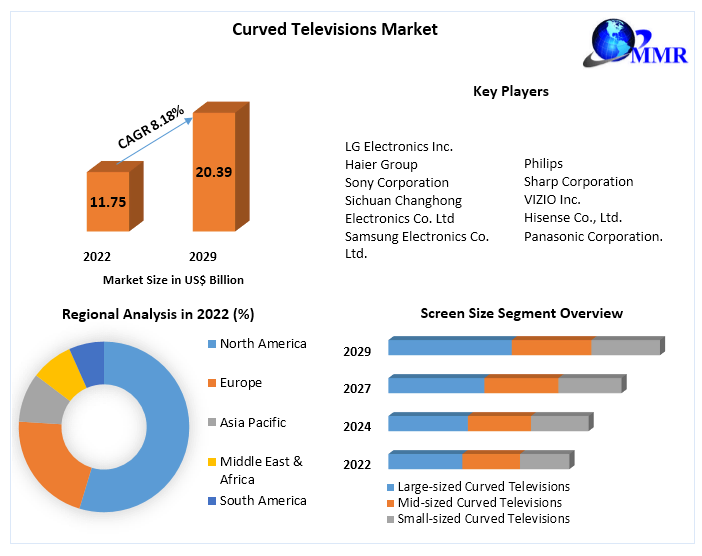
- Television hardware is moving from flat display replacement to immersive screen design, where gaming, UHD resolution and smart-TV demand reshape premium viewing economics. The Curved Televisions Market was valued at US$ 11.75 Bn in 2022 and is expected to reach US$ 20.39 Bn by 2029, creating a defined opportunity for display manufacturers, smart TV brands and consumer electronics retailers.
- The Curved Televisions Market is forecast to grow at an 8.18% CAGR from 2023 to 2029, linking demand to better image quality, larger screens, advanced features and consumer preference for visually enhanced entertainment devices.
- The commercial segment held 42.10% share in 2022 and is projected to grow at the highest CAGR of 10.05%, making offices and commercial spaces the strongest disclosed end-user opportunity.
- North America is expected to hold the highest share, supported by curved TV adoption and demand for customized television-screen solutions.
- Online gaming and flexible displays are shaping the product story, with LG announcing a 48-inch flexible display at CES that can be used as a 1000R curved gaming display or as a flat display.
Why This Matters Now
Curved televisions sit at the intersection of display innovation, smart entertainment and consumer-electronics premiumization. For CIOs, telecom executives and digital infrastructure leaders, the market matters because larger smart screens pull demand toward streaming, gaming, connected entertainment and high-bandwidth content ecosystems.
The public MMR page does not disclose AI adoption trends, generative AI use, cloud migration activity, cybersecurity developments, data center investments, 5G deployment metrics, edge computing adoption or telecom network modernization. The supported technology story is display quality, smart TV adoption, online gaming, flexible screens and e-commerce-led sales.
Market Overview
Curved Televisions Market provide modern features with ultra-high-definition resolution and improved picture quality. MMR states that television has become an important entertainment and education medium across homes, institutions and businesses, while consumers increasingly expect better image quality, screen size and product features.
The market is segmented by screen size into large-sized, mid-sized and small-sized curved televisions. It is segmented by end user into commercial, institutional and residential markets, which makes demand dependent on both household entertainment spending and commercial deployment in offices and public-facing venues.
The forecast period is 2023 to 2029, with 2022 as the base year. MMR’s scope table confirms US$ 11.75 Bn in 2022 and US$ 20.39 Bn by 2029, giving investors a measurable display-hardware growth trajectory.
Key Trends Driving Growth
Image quality is the first growth driver. MMR identifies demand for innovative and advanced television technologies, changing customer expectations, better image quality, larger screen sizes and improved features as key forces behind market expansion.
Energy performance and durability add another product advantage. The report lists durability, environment-friendly technology and efficient energy consumption as major factors contributing to demand, which positions curved TVs as premium devices with both performance and efficiency appeal.
Online gaming is creating a sharper display-use case. LG’s 48-inch flexible display example shows how curved television technology is being pulled toward gaming screens that can deliver uniform viewing distance and immersive use.
Smart TV adoption is also accelerating demand. MMR states that an exponential rise in smart TV adoption, particularly during coronavirus lockdowns, supported market expansion, showing how connected entertainment became a household infrastructure priority during digital behavior shifts.
E-commerce is changing sales channels. MMR cites U.S. Department of Commerce data showing U.S. e-commerce sales increased by over 30% between the first and second quarters of 2022, making online retail an important route for premium television distribution.
The main restraints are manufacturing cost and R&D barriers. High manufacturing costs limit broader adoption outside shopping malls, commercial trade centers and affluent consumers, while technology barriers in curved-TV R&D remain a challenge.
Request a Free Sample Report for Comprehensive Market Insights
Segment Insights
- Dominant Segment Commercial: The commercial segment held 42.10% share in 2022. Its lead is driven by deployment of curved monitors in offices and other commercial spaces, where the display format can reduce eye strain and support premium screen environments.
- Fastest-Growing Segment Commercial: The same commercial segment is projected to grow at the highest CAGR of 10.05% from 2023 to 2029. That makes commercial buyers the clearest disclosed growth target for vendors.
- Residential Segment Growth Opportunity: The residential segment is expected to gain during the forecast period, supported by smart TV adoption, home entertainment demand and consumer preference for better image quality.
- Screen Size Scope Large, Mid-Sized and Small: The public page covers large-sized, mid-sized and small-sized curved televisions, but it does not disclose screen-size-level market shares or CAGRs.
- Technology Gap AI, Cloud and 5G Not Disclosed: The public page does not provide quantified AI, cloud, cybersecurity, edge computing, 5G or network modernization data for curved televisions.
Regional Growth Story
North America is expected to hold the highest share in the Curved Televisions Market. MMR links the region’s lead to increased adoption by the general population and growing demand for customized television-screen solutions.
Europe occupied the second-largest market share in 2022, although the public page does not disclose the exact percentage. The region’s demand is linked to e-sports growth and gaming industry expansion in economies such as the UK.
Germany is highlighted through rising disposable income and increasing smart TV sales. That makes Germany a key European demand signal for premium television vendors and connected-screen retailers.
India is disclosed through consumer electronics momentum. The Indian appliance and consumer electronics market reached INR 76,400 crore, or US$ 10.93 Bn, in 2021 and is expected to double to INR 1.48 lakh crore, or US$ 21.18 Bn, by 2025; the Indian television industry reached a projected US$ 11.26 Bn in 2021 and is projected to reach US$ 14.50 Bn by 2025.
The report covers the United States, Canada, Mexico, the UK, France, Germany, Italy, Spain, Sweden, Austria, China, South Korea, Japan, India, Australia, Indonesia, Malaysia, Vietnam, Taiwan, Bangladesh and Pakistan. Country-level curved TV revenue, telecom infrastructure investment, data center spending, 5G deployment and cloud adoption values are not disclosed.
Competitive Landscape
Key players include LG Electronics, Haier Group, Sony Corporation, Sichuan Changhong Electronics, Samsung Electronics, Philips, Sharp Corporation, VIZIO, Hisense and Panasonic. The competitive field is led by global television and display manufacturers with established distribution, brand trust and consumer electronics portfolios.
Competition is defined by image quality, screen design, smart-TV features, pricing and retail reach. Brands that can combine UHD resolution, flexible display capability, gaming use cases and e-commerce distribution will be better positioned than vendors selling curved screens as a narrow design upgrade.
LG’s flexible display signal matters because it connects curved televisions to the gaming ecosystem rather than only living-room entertainment. That expands the addressable market toward gamers, content creators and premium display buyers seeking screen adaptability.
The public page does not disclose named acquisitions, partnerships, cloud platform launches, AI initiatives, cybersecurity developments, data center investments, telecom network expansions or regulatory programs by key players. The visible competitive direction is display innovation, smart TV demand, gaming adaptability, e-commerce distribution and premium consumer electronics positioning.
Recent Developments
- LG Flexible Display: In January 2021, LG announced a 48-inch flexible display at the remote CES show that can operate as a 1000R curved gaming display or as a flat display, signaling demand for adaptable premium screens.
- E-Commerce Sales Momentum: U.S. e-commerce sales increased by over 30% between the first and second quarters of 2022, making digital retail a major sales channel for television categories.
- Smart TV Adoption: Smart TV adoption increased sharply during coronavirus lockdowns, supporting connected entertainment demand and broader curved TV market growth.
- No Named Dated Deals Disclosed: The public page does not disclose specific acquisitions, partnerships, cloud migrations, AI deployments, data center investments, cybersecurity launches or 5G projects.
Strategic Implications
For consumer electronics brands, the market rewards differentiation beyond screen curvature. Vendors need UHD quality, smart features, gaming relevance, durable design, energy efficiency and retail execution to justify premium pricing.
For telecom and digital-content players, curved TV adoption supports larger connected-screen usage. That can strengthen demand for streaming, e-sports, cloud gaming and high-quality digital content, although MMR does not quantify telecom traffic, cloud gaming or 5G impact.
For investors, the market offers exposure to premium television hardware, online gaming, smart TV adoption, flexible display development and e-commerce distribution. The key risks are high manufacturing cost, R&D barriers and limited adoption among price-sensitive buyers.
Future Outlook
The Curved Televisions Market is forecast to grow from US$ 11.75 Bn in 2022 to US$ 20.39 Bn by 2029 at an 8.18% CAGR. Growth will come from commercial deployments, residential smart TV demand, gaming screens, UHD picture quality, flexible displays, e-commerce sales and consumer preference for advanced viewing experiences.
The next phase will test whether brands can turn curved television from a premium form factor into a connected display platform for gaming, streaming and commercial environments. Future digital leaders will control the immersive screen layer behind entertainment and connected content; laggards will remain tied to flat-panel price competition in a market moving toward adaptive, software-ready viewing experiences.
Analyst Perspective
“Curved televisions are gaining strategic relevance as consumers and commercial buyers demand better image quality, smart TV features and immersive display formats,” said Yash Ghosalkar, Analyst at Maximize Market Research. “The strongest brands will combine UHD performance, gaming adaptability, e-commerce reach, energy-efficient design and premium user experience.”
About Maximize Market Research
Maximize Market Research Pvt. Ltd. (MMR) is a global market research and consulting company that provides reliable, data-focused, and practical business insights. The firm serves a wide range of industries, including healthcare, pharmaceuticals, technology, automotive, electronics, chemicals, personal care, and consumer goods. Through market forecasts, competitive analysis, strategic consulting, and industry impact assessments, MMR helps organizations understand changing market conditions, identify growth opportunities, and make informed business decisions for long-term success.
Contact Us
2nd Floor, Navale IT Park Phase 3
Pune Banglore Highway, Narhe
Pune, Maharashtra 411041, India
+91 9607365656
sales@maximizemarketresearch.com
