Key Highlights
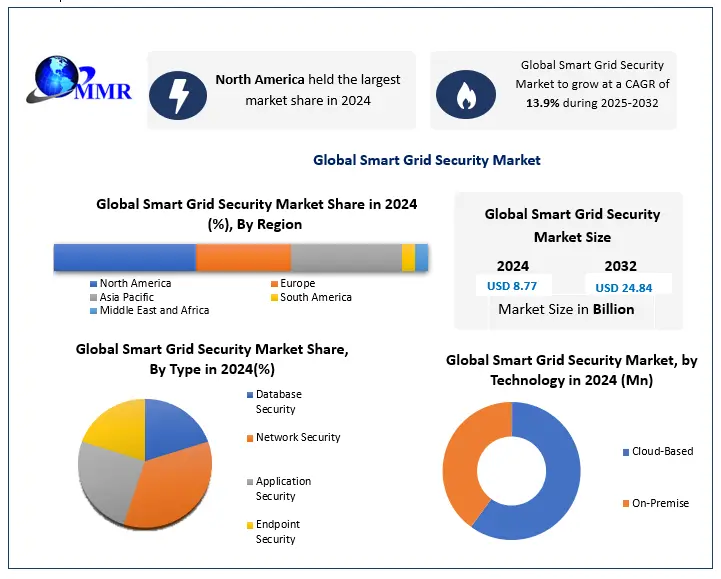
Global market scale expanding from USD 8.77 Billion in 2024 to USD 24.84 Billion by 2032.
Power grid security deployments maintaining a 13.9% compound annual growth rate from 2025 to 2032.
Network security architectures capture the dominant technological slice within utility operations.
Cloud-based deployment configurations command the primary structural share over legacy on-premise installations.
North America remains the dominant regional landscape, securing 40% of historic global transaction volume.
Asia Pacific emerges as the highest-velocity expansion geography powered by cross-border grid updates.
Why This Matters Now
The global energy sector is facing an unprecedented wave of sophisticated distributed denial-of-service (DDoS) attacks and ransomware exploits, turning legacy physical power grids into high-risk targets for digital disruption. Utility operators can no longer depend on isolated, offline sub-stations when managing urban electricity demands across interconnected regional distribution lines. The critical necessity to secure live electricity consumption metrics, automate load balancing, and protect automated supervisory control and data acquisition (SCADA) channels is forcing immediate capital reallocation toward hardened cloud-native grid security platforms.
What changed is that electricity distribution has evolved from a mechanical balancing act into a highly connected, data-heavy digital network. Utility directors and network architects must defend millions of internet-connected smart meters and distributed home energy management links from malicious modification. Why now? Because an unmitigated software breach within a critical electrical grid can trigger immediate widespread blackouts, paralyze industrial operations, and expose confidential consumer usage profiles to bad actors. Technology providers, specialized system integrators, and security framework developers benefit directly by rolling out zero-trust security layers that eliminate configuration vulnerabilities across the entire energy transmission path.
Market Overview
The global Smart Grid Cyber Security Market achieved a verified institutional valuation of USD 8.77 Billion in 2024 and is on a clear path to reach USD 24.84 Billion by 2032. This expansion represents a steady 13.9% CAGR over the forecast timeline running from 2025 to 2032, reflecting a massive baseline increase in global security software spending. This capital expansion signifies that utilities are actively moving away from basic firewall protections to fund comprehensive, end-to-end threat detection platforms that shield automated power grid endpoints.
This structural shift requires overcoming deep operational integration complexities between modern IT frameworks and aging industrial systems. Deploying advanced encryption and continuous network monitoring over decades-old power distribution components is a highly time-consuming task that can increase initial implementation costs and create deployment bottlenecks. To address these technical integration issues, utility technology buyers are prioritizing flexible, cloud-managed security platforms that embed into existing communication structures without requiring immediate, cost-prohibitive hardware overhauls.
Key Trends Driving Growth
The heavy application of cognitive threat intelligence tools within the energy sector acts as the primary driver across the utility landscape. Modern smart grid security architectures are embedding machine learning algorithms and advanced automated analytics to baseline normal power transmission trends, allowing them to spot minor data anomalies instantly. This cognitive oversight means that automated defense layers can flag malicious command-and-control overrides or fraudulent smart meter updates long before an exploit compromises the broader regional distribution grid.
Concurrently, the rapid migration of grid management workloads into centralized, hybrid cloud infrastructures is fundamentally changing utility software design. Cloud-hosted security delivery options allow energy companies to handle real-time threat monitoring, roll out remote software patches, and deploy automated software updates across millions of endpoints simultaneously. This operational move eliminates manual, truck-roll field updates, enabling utility teams to respond to freshly discovered software exploits within minutes rather than weeks.
Additionally, the global deployment of smart consumer endpoints and connected internet-of-things (IoT) devices is redefining the outer boundaries of utility network defense. Home energy management applications, smart meters, and demand response systems require continuous security validation to ensure that localized consumer requests do not become entry vectors for larger network attacks. To safeguard these vulnerable consumer touchpoints, power operators are investing heavily in network virtualization tools that isolate edge activities from core grid controls.
Segment Insights
Dominant Technology Type: The network security segment represents the dominant configuration type across the global market. This leading footprint is driven by substantial utility spending on robust intrusion detection engines, industrial firewalls, and secure communication protocols to protect SCADA assets.
Dominant Deployment Model: The cloud-based deployment model functions as the dominant installation method across the sector. This configuration leads because it offers energy companies a highly scalable, cost-effective infrastructure capable of running advanced data analytics across multi-regional utility operations.
Fastest-Growing Segment: The application security segment is recorded as the fastest-accelerating vector. This high-velocity growth stems directly from the rapid integration of web-based corporate portals and mobile-based business applications, which are increasingly vulnerable to targeted malware attacks.
Regional Growth Story
North America commanded the leading position in the global smart grid cyber security market, with the regional footprint accounting for an institutional share of 40% of the market. This dominant position is sustained by rapid digital grid investments, early cloud infrastructure adoption, and strict government regulations mandating data protection across the United States and Canada. Commercial grid modernization initiatives throughout the region are forcing power operators to deploy automated threat management tools to defend large-scale industrial distribution networks.
In comparison, the Asia Pacific regional marketplace is accelerating at the highest CAGR through the forecast period. This high-velocity expansion is powered by rapid urbanization, massive economic growth, and sweeping digital infrastructure investments across India, China, and Japan. Governments across these developing territories are funding complete overhauls of legacy distribution networks, driving the adoption of cloud-hosted security software to safeguard newly deployed advanced metering infrastructures.
Competitive Landscape
The global smart grid cyber security arena is highly consolidated around prominent industrial engineering innovators, defense contractors, and information technology heavyweights, including BAE Systems PLC, IBM Corporation, Cisco Systems, Inc., Siemens AG, Symantec Corporation, N-Dimension Solutions, Elster Solutions, Leidos, AlienVault, Black and Veatch, Intel, Entergy Services, HP, Sophos, Sourcefire, ViaSat, VeriSign, Honeywell International, AlertEnterprise, Sentryo, and Eaton. This specific corporate alignment highlights a major market consolidation pattern where providers must offer unified, multi-layered defense ecosystems rather than standalone software products.
For technology leadership, this competitive structure signals that long-term pricing power belongs exclusively to vendors capable of blending traditional operational technology (OT) security with enterprise IT cloud networks. Industrial giants like Siemens and Honeywell are building strategic platform partnerships with cloud security specialists to embed continuous threat scanning directly into hardware routers and distribution switches. This comprehensive ecosystem focus makes it incredibly difficult for smaller, single-utility software developers to compete, as large enterprise buyers systematically choose tier-one integrators that can guarantee digital sovereignty and end-to-end grid resilience.
Recent Developments
Tier-one network innovators are launching automated edge-defense software that isolates compromised smart meters from the core distribution network without interrupting local power transmission.
Industrial automation conglomerates are developing pre-configured encryption chips that integrate directly into newly manufactured SCADA controllers to protect against remote code execution.
Cloud-native security platforms are integrating deep learning models to screen operational data traffic, immediately catching subtle protocol manipulations that bypass classic firewall rules.
Energy technology vendors are rolling out advanced metering infrastructure protection suites that automate identity verification across millions of residential consumer endpoints.
Strategic Implications
The transition to automated, cloud-hosted grid defense completely transforms how utility chief technology officers and security directors approach asset tracking and capital budgeting. Technology teams can no longer manage power grid security as a passive, perimeter-focused firewall task; it must be run as a continuous, active data orchestration architecture. Safeguarding modern electricity networks demands deep, ongoing investments in zero-trust verification engines, virtualized network segmentation, and automated log analysis tools to ensure unexpected code changes are caught and isolated instantly.
Furthermore, connecting thousands of local distribution assets to centralized cloud analytics hubs introduces critical infrastructure security challenges. Because smart grid management repositories consolidate highly sensitive load balancing statistics, customer data records, and core industrial control commands, they represent primary targets for state-sponsored cyber disruptions. Security groups must insulate these critical software pipelines using advanced data encryption and rigid identity access controls. Leaving these connection paths unmonitored risks massive operational failure, immediate regulatory penalties, and a complete loss of public trust in critical utility infrastructure.
Future Outlook
As the global market marches toward its USD 24.84 Billion valuation by 2032, the historical separation between physical electrical switches and cloud-hosted data security tools will entirely disappear. Future digital leaders within the energy vertical will operate fully automated, self-healing smart grid security ecosystems that deploy real-time patches across millions of endpoints simultaneously via embedded AI networks, while laggards will remain exposed to devastating network blackouts, escalating incident remediation costs, and crippling regulatory penalties.
Analyst Perspective
“Relying on manual security verification or legacy firewalls within highly connected, automated utility grids is an immediate threat to operational survival,” states Yash Ghosalkar, Analyst at Maximize Market Research. “As modern cyber attacks targeting critical national infrastructure grow in frequency and scale, implementing continuous, cloud-hosted network protection tools is the only viable method for utility operators to guarantee uninterrupted energy delivery while safeguarding sensitive operational data.”
About Maximize Market Research
Maximize Market Research Pvt. Ltd. (MMR) is a global market research and consulting company that provides reliable, data-focused, and practical business insights. The firm serves a wide range of industries, including healthcare, pharmaceuticals, technology, automotive, electronics, chemicals, personal care, and consumer goods. Through market forecasts, competitive analysis, strategic consulting, and industry impact assessments, MMR helps organizations understand changing market conditions, identify growth opportunities, and make informed business decisions for long-term success.
2nd Floor, Navale IT Park Phase 3
Pune Banglore Highway, Narhe
Pune, Maharashtra 411041, India
+91 9607365656
sales@maximizemarketresearch.com
